


Published : 20 Jun 2019, 08:07 PM
Updated : 08 Apr 2022, 02:13 PM


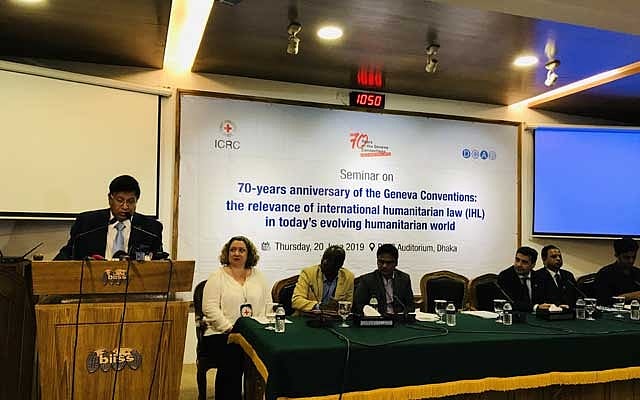
“Otherwise the spirit and value of the Geneva conventions would continue to be undermined,” he said while speaking at a seminar on the 70 years of ‘Geneva Conventions’ in Dhaka on Thursday.
The Diplomatic Correspondents Association, Bangladesh (DCAB) and the International Committee of the Red Cross (ICRC) jointly organised the seminar marking the anniversary of the conventions adopted in 1949 with a clear call that even the war has rules.
The foreign minister thanked DCAB for organising the event and said “it is more timely as selective application of these laws by the rich and the powerful nations has been questioning the moral and ethical values of those leaderships and asking for soul search".
“Discriminatory application and enforcement of the laws are surely not desirable in today’s world,” he said.
“The need of the hour is to create a mighty public awareness across nations so that non-discriminatory enforcement and compliance of humanitarian loss are adhered to”.
He said “unfortunately violation of humanitarian laws again and again creating a group of people working deprived from basic services. And we are not reaching that our goal is no one left behind”.
“And who knows all these better than us in Bangladesh?
“We have seen the horrors of war in 1971, which not only massacred 3 million lives. Over 200,000 women became victims of sexual violence. 10 million people had to leave the country and 30 million internally were displaced as well,” he said.
“Under the Geneva conventions, every person who is not or no longer actively participating in the hostilities is entitled to protection and must be treated with humanity. Everyone, even the enemy, must be seen as a human and be protected.”
But Momen said, “We are painfully aware that respect for humanitarian law has been descending causing further humanitarian crisis. Take the example of Myanmar.
“They have claimed that the Combing operation in Rakhine States was intended counter terrorist threats posed by so called ARSA. And that resulted into forced displacement of over a million innocent civilians.
“Not only that the international reports including those from the UN suggest the Rohingyas were subjected to mass atrocity crimes and worst form of human rights violations in Myanmar. They have laid mines to prevent return of the displaced Rohingyas.
“Even today the Rohingyas continue to flee their homes to save themselves from forced starvation and deprivation of livelihood. It is not only Muslims both Muslims, Buddists, Hindus and other Rohingyas are being forced out of their traditional homes and jobs,” he said, calling for ‘accountability’ for such actions by Myanmar.
The foreign minister said having suffered the worst forms of war crimes and crimes against humanity in 1971, Bangladesh has remained “deeply committed” to international humanitarian laws.
“Our commitment is reflected in our hosting of the Rohingyas and ensuing basic services in Bangladesh,” he said.
Speaking at the opening session, Head of the ICRC Bangladesh delegation Ikhtiyar Aslanov said those present during the adoption of the Geneva Conventions were in mind with enormous horrors of the second world war.
“States shared a strong resolve to never see such destruction repeated, and agreed for a binding obligation to protect civilians,” he said, adding that “together the world agreed that, even during armed conflict there remain limits as to what we – as nations, communities, can do to each other”.
DCAB President Raheed Ejaz, General Secretary Nurul Islam Hasib and ICRC Deputy Head of Delegation Abdou Latif Mbacke spoke at the opening session chaired by ICRC Bangladesh Communication and Prevention Manager Anna Schaaf.
Professor of law at Dhaka University Mohammad Nazmuzzaman Bhuian spoke on the relevance on International Humanitarian Law (IHL) in today’s world.
Professor of law at Chittagong University ABM Abu Noman spoke on the “Customary Law: a contribution to improve the protection civilian during armed conflicts” in on of the two thematic sessions of the seminar.
Bhorer Kagoj Editor Shyamal Dutta, and Professor of international relations Lailufar Yasmin discussed on the Rakhine crisis and its reflections on humanitarian response.













