


Published : 18 Mar 2016, 09:06 PM
Updated : 19 Oct 2022, 05:10 PM


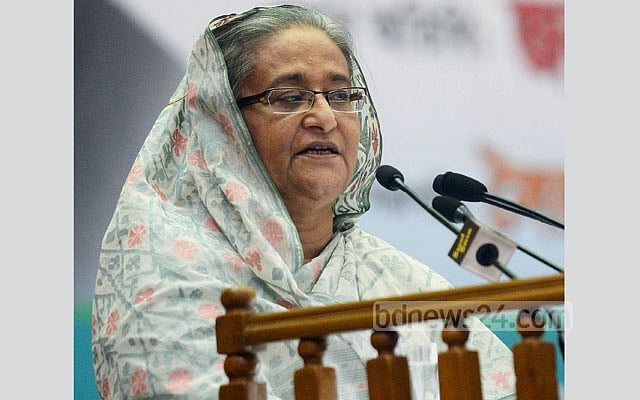
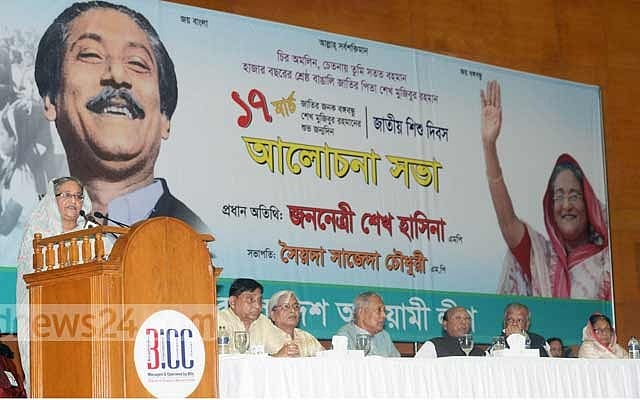
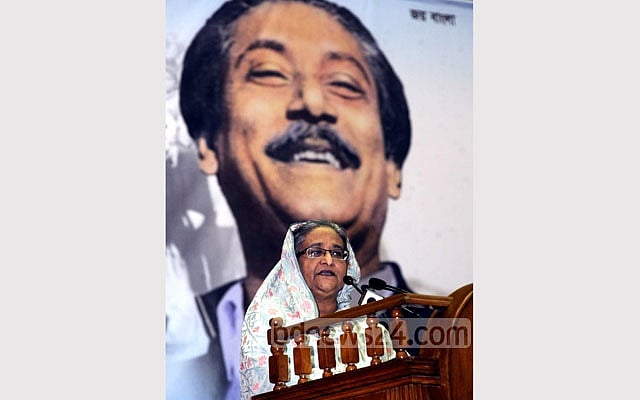
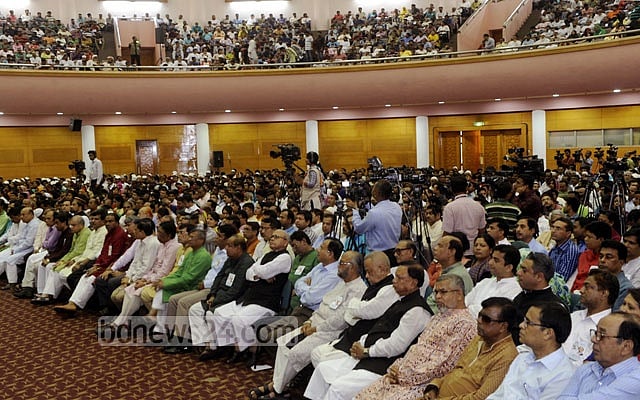
At a discussion in Dhaka on Friday, she said the Bangabandhu, her father, had fallen ‘victim to the powerful country which supported Pakistan’ during the Bengalis’ struggle for independence.
“The world was bipolar at that time (in global politics). Those who did not support our Liberation War and supported Pakistani invading force were also hatching conspiracies,” the prime minister said.
“Nobody paid heed to them. The country (Bangladesh) got liberated. Pakistan was defeated in our Liberation War. Many powerful countries could not ensure their victory. Many couldn’t take the defeat easily.”
The United States, one of the two superpowers at the time, supported Pakistan and supplied it arms while the other superpower, then the Soviet Union, stood by the Bengalis during the war.
“The Father of the Nation fell victim to the conspiracies on Aug 15, 1975,” she added.
A group of disgruntled Army officers killed Sheikh Mujib and most of his family members on Aug 15 and four national leaders on Nov 3 that year.
Following coups and countercoups, the then army chief Ziaur Rahman usurped power and became the first military ruler of the country. He later formed the BNP.
“Ziaur Rahman duplicated the Pakistan government by grabbing the power illegally,” Hasina said.
She said Zia made a person, ‘who had killed 150 Bengalis in a day’, a member of his Cabinet.
The International Crimes Tribunal had sentenced former BNP minister Abdul Alim to life in jail for crimes against humanity he committed during the War. He later died in jail.
Shah Azizur Rahman, who was the prime minister during Zia’s rule, had supported the Pakistani forces and denounced the Bengali nationalist struggle in the United Nations at the outbreak of the Liberation War.
The prime minister also said Zia’s rule saw 19 coups. “Thousands from the Army had been hanged night after night. The Air Force alone had 562 of its members killed. All freedom fighter officers were murdered one by one.”
About the Bangabandhu, she said, “He was pained by poor men’s plight. He started politics when he was a schoolboy.”
“The Father of the Nation has contribution in all Bangladeshi’s achievements,” she said.
Hasina said the Pakistani rulers had harassed the Bangabandhu as they understood that the Six-Point Demand he made had laid the ground for independence.
“The Pakistani rulers wanted to stop the Bangabandhu at any cost,” she said.
“...The Bangabandhu never compromised his principles,” she added.
Hasina also recalled what the Bangabandhu said in reply to a foreign journalist’s query on her 52nd birthday on Mar 17, 1971.
“He told the journalist that 'I'm one of them (people). So what is the significance of my birthday or date of my death? My life is the people of the country'."
"A person who deeply loves his people can only say this," she said.
The Pakistani forces flew the Bangabandhu to Pakistan on Mar 26 as a prisoner. He was later sentenced to death.
“Facing death, the Father of the Nation said, ‘I’m a Bengali, a human being, a Muslim. A Muslim dies once, not twice’."
Hasina also spoke about how the Bangabandhu rebuilt the ravaged economy and infrastructure in his only three and a half years' tenure in power.
“The Bangabandhu has given us independence. We have to build the nation on his ideology,” she added.













