Published : 26 Sep 2026, 12:28 AM
Updated : 26 Sep 2026, 01:06 AM


The United States has expressed the "hope" that Bangladesh and India will decide together on the issue of ousted prime minister Sheikh Hasina, who has been sentenced to death for crimes against humanity.
Washington says it has not yet given a specific opinion on what should happen to Hasina.
A US State Department official outlined the Trump administration's position at an "on-background" briefing in New York on Wednesday.
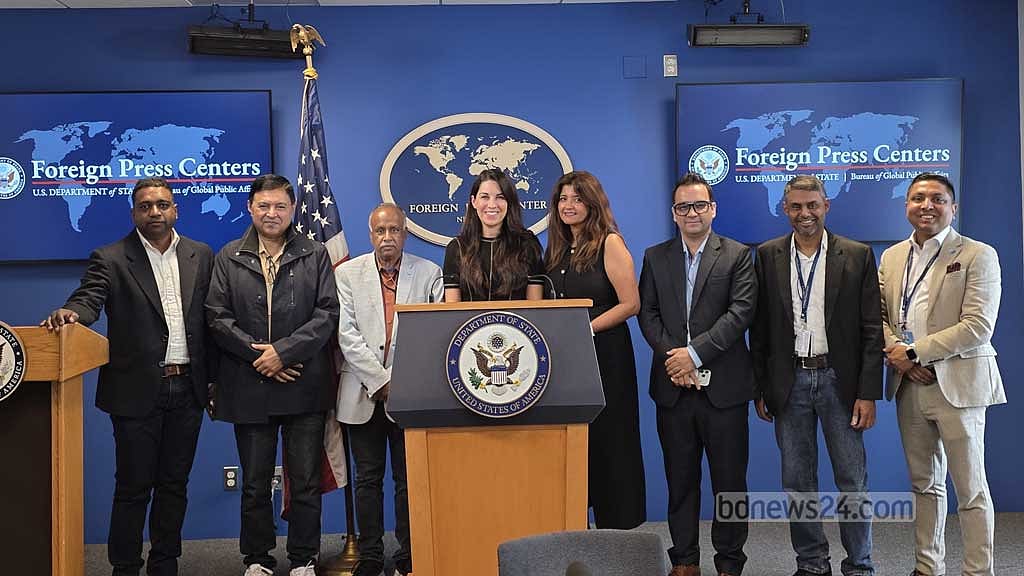
The briefing, titled "US Policy in Support of a Stable, Prosperous and Sovereign South Asia," was held at the New York Foreign Press Center. It was attended by journalists from Bangladesh, India, Nepal, and Sri Lanka, including representatives from bdnews24.com.
Hasina has been living in India since she was ousted in a student-led mass uprising in 2024. She was sentenced to death in absentia by the International Crimes Tribunal in Bangladesh last November on charges of crimes against humanity for ordering deadly repression to suppress the movement.
Hasina has announced that she will return to Bangladesh by December and surrender to the court, bearing her death sentence in mind. However, she has also spoken about concerns for her own security and sought the opportunity to challenge the trial being conducted in her absence.
Under the circumstances, a US State Department official was asked about the country’s position on Hasina in a briefing on Wednesday.
In response, he said: "The US has not yet taken any official position on this issue. We understand that the issue has become a major cause of hostility between India and Bangladesh.
"So we hope that they will reach a solution through discussions among themselves. And we have not yet specified what should happen to Hasina."
The official was also asked whether there is a possibility of President Donald Trump or his Secretary of State Marco Rubio meeting Prime Minister Tarique Rahman.
Questions also came up at the briefing about the lifting of the ban on the activities of the Awami League and US-China relations.
Asked about the US’s position on the Awami League ban, the official said: "I do not want to speak about the internal politics of Bangladesh, but I would like to say that our relations with Bangladesh, with the BNP, are in a very good place.
“We want to continue working with the elected government. We are on the side of the work that is ongoing to make Bangladesh stronger and safer. The United States has no qualms about making Bangladesh more prosperous. So, I do not think it is appropriate to say anything about the internal politics of Bangladesh.”
When a journalist asked specifically about the issue of lifting the ban on the Awami League, he said: “That decision will have to be taken by the Bangladesh government.”
A reporter said at the briefing, “Bangladesh is trying to maintain good relations with the United States, India, and China. How is it possible to maintain diplomatic relations with all the three major powers without choosing any one? How does the United States view this?”
In response, the official said: “Geographically, Bangladesh is in a complex part of the world. Your point is that they are located next to a much larger neighbouring country than the United States. We always encourage every country to stay in their sphere.
“We want to help you consolidate your sovereignty; we want to help you keep your system secure.”
“We want to present an alternative,” he said. “We’re not saying you have to choose; we want to be an alternative for these countries.”
A reporter at the briefing said that President Trump had written to Prime Minister Tarique after the 13th parliamentary elections in Bangladesh and expressed interest in meeting him.
Asked if the two leaders could meet in New York, the official said: “I can’t comment on the president’s schedule. However, he had a very brief meeting with Foreign Minister Khalilur Rahman this week. It was also possible for him to take pictures with the president. Not all foreign ministers had the opportunity to meet or take pictures with the president.”
Before the briefing, Bethany Morrison, deputy assistant secretary of state for South and Central Asia at the State Department, spoke about the situation in South Asia and the Trump administration’s policies. She then participated in a photo session with reporters.