


Published : 02 May 2018, 06:37 PM
Updated : 05 Aug 2022, 06:39 PM


Dr Ashikur Rahman, senior economist at Dhaka-based Policy Research Institute, however, told bdnews24.com that there is no doubt that the existing minimum wage of Tk 5,300 a month merits a serious revision.
But to do that, he said, policymakers and stakeholders should address the issue as “systematically” as possible, “mitigating the risk of an ugly violent negotiation between workers and garment entrepreneurs in the future”.
The minimum wage negotiations between workers and entrepreneurs have been a contentious issue in Bangladesh since long.
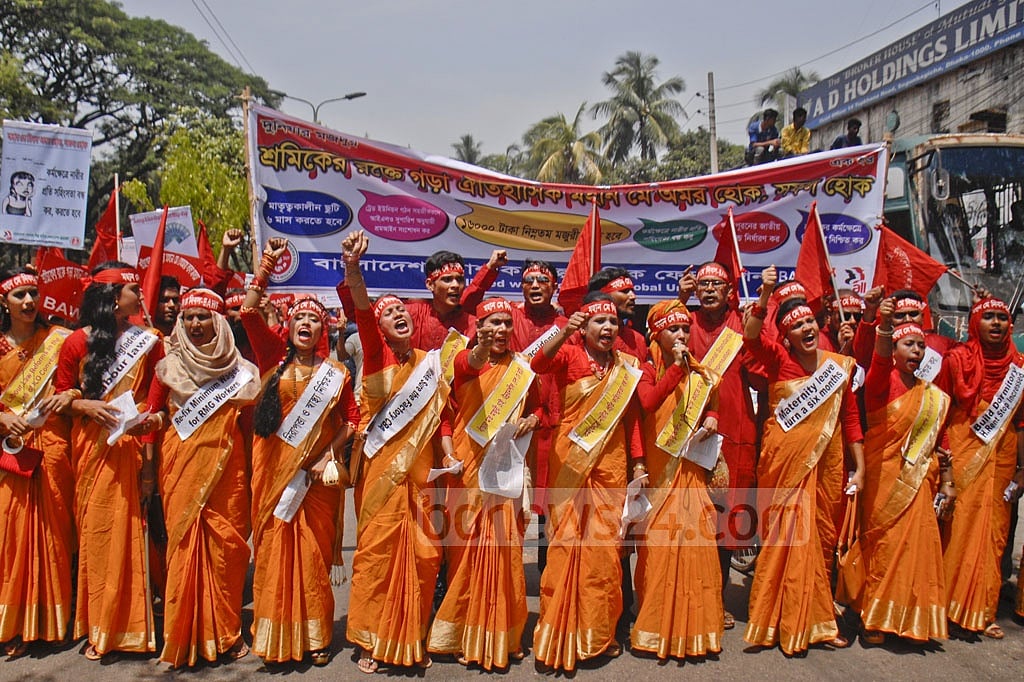
The latest call for setting the monthly minimum wage at Tk 18,000 came on May Day.
Dr Rahman said the core underlying philosophy guiding minimum wage negotiations demands “a balance between the economic viability of a particular minimum wage and its adequateness in offering workers a basic livelihood”.
“I found their position devoid of economic logic and to a large extant counterproductive in protecting the interest of the garment workers,” he said.
“First, in almost no country in the world, the annual salary that one is expected to earn from a minimum wage contract can exceed the average GDP per capita of the country.
“However, with a minimum wage of Tk 18,000 per month, a garment worker is expected to receive at least Tk 216,000 per year (excluding Eid and other bonuses) which is roughly 166 percent of our annual per capita income of approximately Tk 130,000.”

In countries such as Germany, the UK or France, where the economic system is mostly viewed as relatively egalitarian due to an effective welfare state, the annual salary that one expects to earn from a minimum wage contract is less than 55 percent of their respective per capita income.
In a communist country like Vietnam, which is also Bangladesh’s competitor in garment trade, it is 61 percent of their per capita income. In China, which is perhaps the fiercest competitor in garment exports, it is 22 percent of their per capita income.
“Thus, with the demand for a minimum wage contract that is 166 percent of our per capita national income, I found the labour representatives to be poorly-informed and counterproductive as the voice of workers,” said Rahman.
He said the second issue that also needs serious reflections is the pace at which machines are replacing workers in the production process of the garment industry.
“If labour leaders feel that settling for too high a minimum wage is a victory, then that will risk motivating entrepreneurs to either shift to a different trade or depend heavily on capital machinery for increasing production.”
“As a result, unusually high minimum wage can effectively reduce jobs in the sector,” he said.
In revising the minimum wage, he suggested some factors that need consideration.
Those include inflation between 2014-18; economic growth between 2014-18; its implication for production cost in Bangladesh and how does it compare to production cost in competitive countries; costs of entrepreneurs using high capital-intensive production process, so that we better understand the risk of capital substitution in the sector; and contemporary economic state of the sector itself.












