


Published : 24 Mar 2016, 08:40 PM
Updated : 08 Aug 2022, 03:38 PM


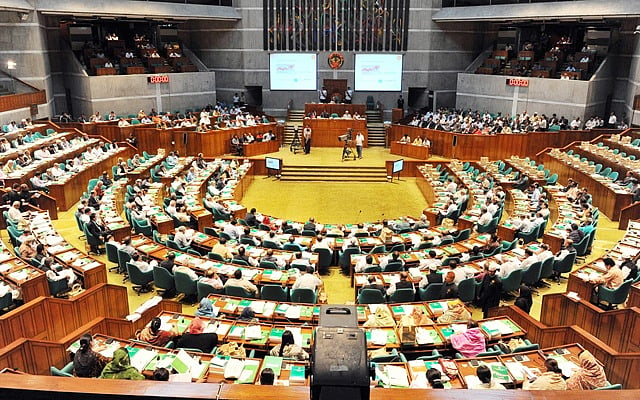
The 16th Amendment to the Constitution from 2014 had revived Parliament’s powers to sack top judges on the grounds of incompetence and misconduct.
Law Minister Anisul Huq said he will wait for the chief justice to respond to a request for his opinion of the draft law before making a comment.
Justice ABM Khairul Haque, who heads the Law Commission, informed the president about its completion while presenting an annual report on Mar 22.
A copy of the draft is available with bdnews24.com.

File Photo
The Awami League government brought on the latest amendment to Constitution nine months after coming to power for a second consecutive term in 2014.
It was then said that the law would be formulated within three months of a relevant Bill being passed in Parliament.
But it took more than two years for the draft to be completed and it will be debated before being finally signed into law.
“I said before that I’ll hear the opinions of stakeholders before formulating the law. The honourable judges are the stakeholders of this law,” said Law Minister Huq.
“I’ve sent a copy of the draft to the honourable chief justice’s office. The process will continue after he sends his remarks.”
When to remove?
The draft sets the definition for impropriety and incompetence for judges which, if proven, could deliver grounds for termination.
Exploiting position and office for gaining privileges, violations of ethics and influencing others in matters of judgment or being influenced can lead to violation under the law.
International and continual failure to carry out judicial role and concealment of necessary information from personal details were also listed under misbehaviour.
Incapacity, in the draft law, is when a judge suffers physical or mental ailment of permanent nature.
How to remove?
The proposed law says any individual has the right to lodge a complaint against a judge with the speaker of Parliament.
The complaint will then be sent for primary fact-checking to a committee of ten MPs who will investigate and then write to the speaker if they find any substance.
A three-member committee formed with an ex-attorney general, a respected citizen and a former chief justice or a former appellate justice as head will be in charge of the enquiry.
A judge found guilty of misdemeanor or incompetence is entitled to self-defence through a written or oral statement before Parliament, according to the draft law.
The proposal to remove a judge will go to the president if two-thirds of the MPs vote in favour. The president will then execute the decision.
If an accused judge is found not guilty, the enquiry committee will write to the speaker who will then present their decision before Parliament.
It can choose to dismiss a report and vote to have it reinvestigated which will involve the same process, the draft law says.
An individual may be jailed for two years and fined up to Tk 500,000 for bringing false accusations.
Looking back
Bangladesh’s Constitution drafted in 1972 gave MPs the power to impeach judges and decide their term in office.
But after the Fourth Amendment in 1975, the power was vested with the president.
The Fourth Amendment was cancelled after Bangabandhu Sheikh Mujibur Rahman was assassinated and the military rule set up by Gen Ziaur Rahman saw the formation of a Supreme Judicial Council for impeaching judges in 1977.
A military proclamation led to the creation of the council, without precedence or warrant, to suit the whims and caprices of an unlawful military ruler, the Law Commission observes in the historical context section of the proposed law.
The Fifth Amendment, brought on during Gen Zia’s rule, legalised the council, which kept functioning until the Fifth Amendment and all other laws passed during military rule in Bangladesh were declared illegal by the High Court.
In 2012, a ruling by Speaker Md Abdul Hamid, who is now President, prompted several MPs to demand impeachment of a High Court judge, which resurrected the demand to have the power return to Parliament.
Then the Awami League government after passing 16th Amendment to the Constitution on Sept 17, 2014 said it was in favour of returning that power to the people.
The BNP, once the main opposition, accused the Awami League of attempting to grab full control of the judiciary and announced that it will have it cancelled once it is elected back to power.













