


Published : 10 Jan 2018, 01:25 PM
Updated : 05 Aug 2022, 06:34 PM


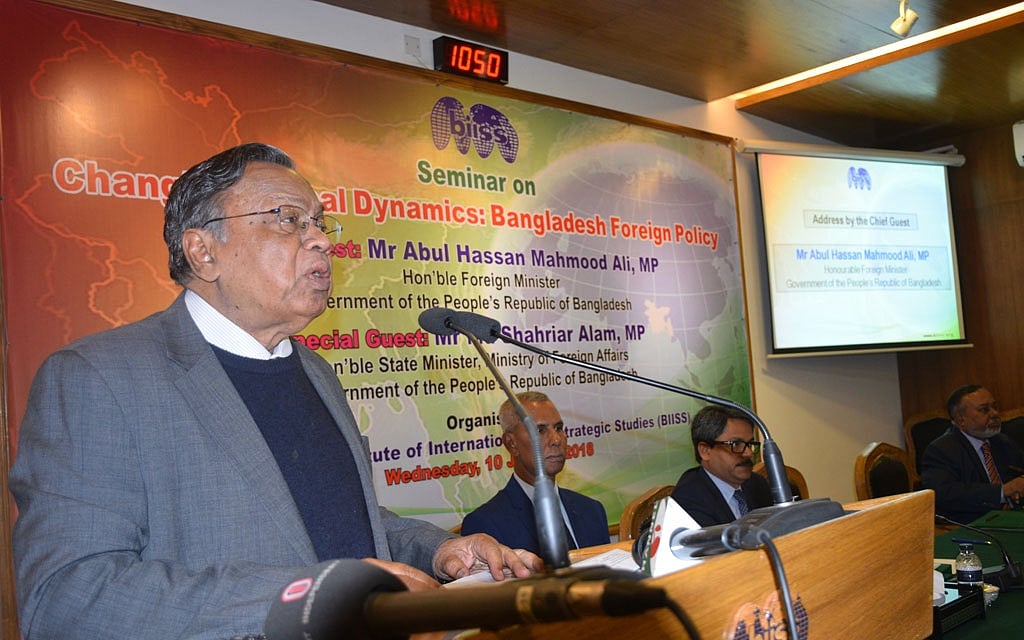
Foreign Minister Abul Hassan Mahmood Ali while divulging eight priorities on Wednesday at a seminar said the dynamics of international politics are changing “rapidly”.
“Individuals and non-state actors are taking prominence in decision-making of the states. The growing physical connectivity among the geographical territories for trade and economy are redefining the state boundaries. Thus, some often terms the current geopolitical changes as ‘transformational’,” he said.
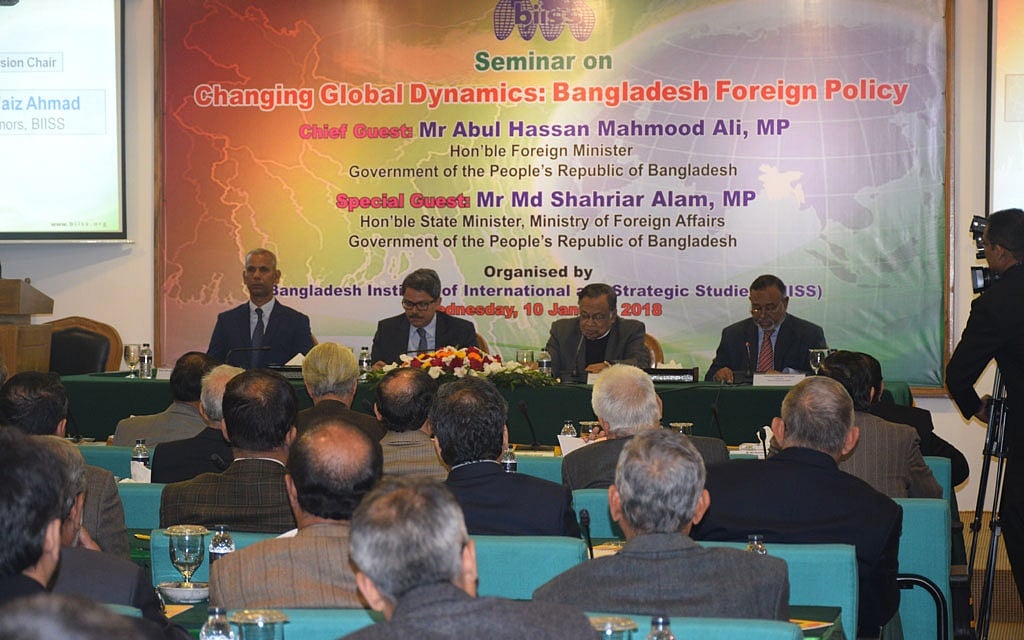
Government think-tank Bangladesh Institute of International and Strategic Studies or BIISS organised the seminar: ‘Changing global dynamics: Bangladesh foreign policy’.
BIISS Director General Maj Gen AKM Abdur Rahman said the support of the three trusted and most dependable allies — China, India and Russia — was “not up to the expectations of Bangladesh” on the Rohingya issue.
“Hence, Bangladesh should not rule out the possibility of reconsidering its alliances in regard to its security needs.”
“Our engagement beyond our traditional partners like the United States, UK, Russia, China and Japan has yielded benefits during the testing time,” he said.
But he kept “deeper engagement with Europe” at the top of his priorities. The European Union was at the forefront with Bangladesh while putting international pressure on Myanmar after the latest episode of Rohingya crisis when more than 650,000 refugees took shelter in three months.
“The relationship with European countries will cover economic ties, democratic values as well as partnership in the areas of protection of environment,” he said.
Second — Maritime cooperation and Blue Economy: “With our maritime boundaries settled, we will continue to develop partnership in the maritime field for realization of our ‘Blue Economy’ pursuits.”
Third — Regional integration and multi-modal connectivity: As a natural connect between South and South-East Asia and beyond, Bangladesh will continue to pursue regional cooperation as an engine for sustainable growth and economic integration through SAARC, BIMSTEC, BBIN, SASEC, and BCIM.
Fourth — Focusing on immediate neighbours: Given the shared political, cultural, social, economic history over centuries, India remains our most important partner. “With Myanmar, the issue of Rohingya influx remained as an irritant in bilateral relations. With the repatriation of the Rohingyas under the arrangement signed on 23 November, 2017 we hope to have a new beginning with Myanmar,” the foreign minister said.
Fifth — Effective partnership for economic interests: To secure economic benefits we will continue to forge effective partnerships with other countries. We have already developed such partnerships with India, China, Japan, UK, US in the recent years across mega infrastructure, power and energy sector projects.
Sixth — Realisation of sustainable development goals: Bangladesh would continue to stretch its partnership in multiple fronts for realisation of sustainable development goals.
Seventh — Promotion of justice, rule of law and human rights: Human rights and fundamental freedoms are the keys to our existence. After ending the culture of impunity through the trial of war criminals who committed genocide and crimes against humanity during our war of liberation in 1971, we are now focusing on international recognition of the 1971 genocide.
Eighth — Maintaining a lead role in peacekeeping and peace-building: Bangladesh will continue to maintain a lead role in the UN peacekeeping operations by contributing troops, police, including female peacekeepers. We would also gradually bring more focus on peacebuilding activities, the foreign minister said.
In accomplishing these objectives, Ali said, Bangladesh would employ “mix tools and options” at bilateral, regional and multilateral level.
“As we have done recently with the issue of Rohingyas, we will continue to utilise our image in the multilateral forum to further our national interest,” he said.
“Bangladesh will continue to pursue its peace-centric and sustainable development focused approach in the international forum.”
“At the domestic front, the development agenda will continue to take priority which will be furthered by regional integration and connectivity,” he said.
“Multilateralism, particularly through UN system, remained Bangladesh’s diplomatic strength where Bangladesh engages as an active voice in various normative and policy making initiatives.”













