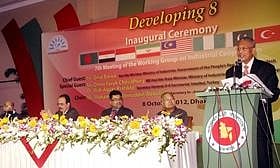
Expand areas of cooperation, Barua tells D-8
Industries Minister Dilip Barua on Monday urged D-8 leaders to expand areas of mutual cooperation as he believes the global crisis is 'an opportunity' for the eight developing nations, which make up 13 percent of the world population.
bdnews24.com News Service
bdnews24.com
Published :
08 Oct 2012, 03:09 PM
Updated :
09 Aug 2022, 04:20 PM
Dhaka, Oct 8 (bdnews24.com)—Industries Minister Dilip Barua on Monday urged D-8 leaders to expand areas of mutual cooperation as he believes the global crisis is 'an opportunity' for the eight developing nations, which make up 13 percent of the world population.
"In the global market we've competitive advantages that need to be utilised," he said at the inauguration of the 7th Meeting of the Working Group of Industrial Cooperation of D-8 in Dhaka.
Academicians, experts, entrepreneurs, business leaders and the government high officials are taking part in the two-day meeting in connection with the third D-8 Ministerial Meeting on industry on Thursday.
Under D-8, established in 1987 with the aim of economic cooperation, Muslim-majority Bangladesh, Egypt, Indonesia, Iran, Malaysia, Nigeria, Pakistan and Turkey cooperate in 12 industrial areas, including automotive, cement, steel, electronics and IT, petrochemical, fertiliser, energy, food, textile and garment, SME (small and medium enterprises), machinery and environmental conservation.
Barua said: "We should identify some more potential areas (for mutual cooperation) like pharmaceuticals, printing and publication, plastic, leather, jute and jute goods."
He identified huge population, cheap labour force, vast internal market, scope of rapid technology transfer and relatively common cultural and social values as the competitive advantages of the D-8 countries.
"What we need now is to strengthen our mutual cooperation, communication and initiative through exchange of expertise, knowledge and technology transfer."
According to the Ministry of Industries, the meeting will discuss common strength and weakness and share countries' progress and experiences on the selected industrial sectors.
In addition, Bangladeshi entrepreneurs will exchange their experiences and achievements in SME, pharmaceuticals, and textile and garments sectors with the representatives of other countries.
The minister said: "We've opportunities to increase our internal and external trade as D-8 members belong to the developed countries' group stretching from Southeast Asia to West Africa."
"We can open up new window of cooperation in the trade and business sector with the fast growing Asian and African nations."
Six working group meetings were held on the opening day when Dhaka Chamber of Commerce and Industry (DCCI) organised a parallel seminar on SME that has been shown as 'a catalyst for D-8 economic development.'
"A healthy SME sector is critical to the D-8 economy," DCCI President Asif Ibrahim said, citing instances of China, Japan, Korea and Australia where SME created huge employment and reduced poverty.
Briefing media on the closing of the first day, Director General of Bangladesh Accreditation Board Md Abu Abdullah said the working group meetings gave the private sector leaders scope to find business opportunities in D-8 countries.
He said they aimed at including pharmaceutical sector as the 13th industrial area of cooperation among the member countries.
The Second D-8 Industries Ministers' meeting was held in Istanbul, Turkey in October last year and the first round in Iran.
bdnews24.com/nih/ssr/2034h