


Published : 25 Oct 2015, 10:56 PM
Updated : 23 Apr 2022, 01:13 PM


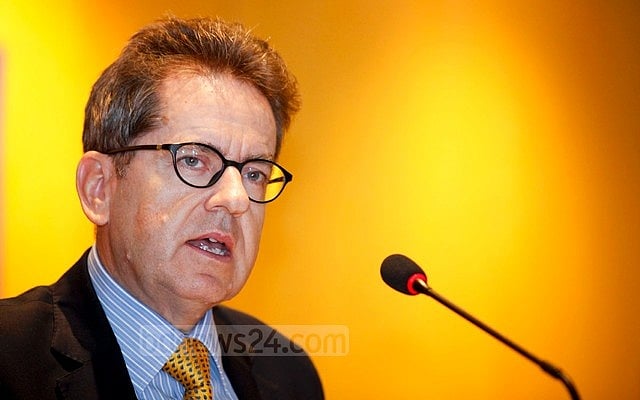
EU Ambassador to Bangladesh Pierre Mayaudon on Sunday said he had already seen the nature of this impact.
“Soon, the EU diplomatic community will conduct a collective field visit precisely directed at better assessing this impact,” he said while speaking at a function on the conclusion of a EU-backed fishery project.
His comment came ahead of the December climate change conference in Paris.
Fisheries and Livestock Minister Muhammed Sayedul Hoque was present at the function.
The ‘Better Fisheries Quality’ project, ‘BEST’, has made a difference in a key sector of the Bangladeshi industry: the breeding and processing of shrimps for export markets.
Before the project started, the shrimp industry was in “poor condition”.
One of the main problems related to sanitary and phyto sanitary (SPS) standards needed to export to the EU, comprising more than 75 percent of the total export market of Bangladesh’s shrimp industry.
The ambassador said the “control of residues and contaminants had been a constant challenge. The presence of banned antibiotics in shrimps was also a matter of concern”.
“Consequently, rejection of the products at the final destination was frequent,” he said, citing cases before the project was launched.
Through the project, the EU has supported efforts by the government and the private sector to introduce best practices in the shrimp sector and promote “farm to fork” control systems.
Organisational and human resource capacities have been improved. Regulatory framework and adjustment of the legislation have been introduced, he said.
“Modern fisheries inspection and quality control laboratories with state of the art testing equipment have been established”.
He, however, spoke on the working conditions of the industry and said the post-Rana Plaza projects through the ‘Sustainability Compact’ would also benefit the shrimp farming and processing where “the conditions, we all know it, are also quite challenging”.
“Helping Bangladesh climb the value chain by introducing better processes is also an ambition that we pursue through our bilateral cooperation in the field of science and technology,” he said.
The ambassador said “a ground-breaking offer that we have recently submitted to the Government: the cost-free access to space satellite images generated by the new EU earth observation COPERNICUS System that also covers the maritime domain.
“It carries solutions in terms of improving the fisheries industry and I am confident that the Bangladeshi experts, following proper training in Europe, will be in a position to seize the corresponding opportunities”.













