


Published : 20 Feb 2018, 12:44 AM
Updated : 08 Apr 2022, 02:59 PM


Without mentioning the name, he said, “one of the big parties in Bangladesh is harbouring terrorism, communalism and fundamentalism and they look at Bangladesh, India relations through the prism of Pakistan.”
“That’s a big problem,” he said, in an oblique reference to BNP, which is often branded by some ministers and ruling party leaders as a pro-Pakistani party in Bangladesh.
He also alleged that there is a political group that keeps the issues between India and Bangladesh alive, never tried to solve those.
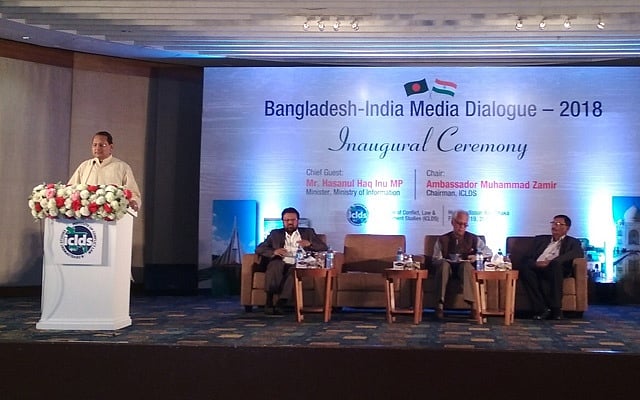
The information minister was inaugurating a ‘Bangladesh-India Media Dialogue’ at a Dhaka hotel on Monday night.
The Institute of Conflict, Law & Development Studies (ICLDS) organised the three-day dialogue bringing senior journalists of both sides.
Citing the historical background of India, Bangladesh relations that began in 1971 when Indian army shed blood for Bangladesh’s liberation, the minister said Bangladesh should look “the relations through the prism of Independent Bangladesh”.
“We have blood ties,” he said, adding that he sees India as a development partner and with this attitude, “we can go forward.”
He also urged all to change the attitude of evaluating the bilateral relations and said: “We know our miseries, but we don’t know our virtues. We don’t know how to share our virtues”.
“We must look forward jointly. There is no other way.”
“Problems are there. In a family, there are problems. We need to solve it, don’t keep those alive. That’s the focus of the current two prime ministers,” he said, adding that they are solving the issues one by one.
“The focus is to solve the issues, not to keep it pending. There is a very positive attitude.”
He also highlighted the security challenges of the region and said within the SAARC, Pakistan is harbouring terrorists.
“The non-state actors and cross-boundary terrorists are sometimes linked with international terrorist groups and intelligence network of Pakistan,” he said.
He said the current Bangladesh government of Prime Minister Sheikh Hasina had addressed all the security concerns of India.
He identified poverty and communalism as two bombs of the two countries that he said needed “to diffuse to build a harmonious society.”
“There is certain trust deficit and lack of confidence. But Bangladesh and India if we are together, we rise together.”
Gautam Lahiri, president of the Press Club of India, said they would discuss how the relations can be taken to a “logical height” during the dialogue.
“Mistrust is there, I can say. But how media can play the role to bridge the gap, would be the focus of discussion,” he said.
Bangla daily Bhorer Kagoj editor Shyamal Dutta, convenor of the conference, said they invited 23 leading journalists of India.
“We have seen wonderful relations in the last eight years. Still, we see a lot of gaps. The motive of our event is to interact with each other to give a good direction to the relations.”
The visiting Indian journalists would meet the Prime Minister on Tuesday. They will also be taken to central Shaheed Minar at the zero hours of Feb 21 to lay a floral wreath to the language martyrs of 1952.
ICLDS Chairman Muhammad Zamir chaired the inaugural session.













