Dig to uncover a lost city in Wari-Bateshwar
It is an archaeological dig into the past to find an old city frozen in time. The effort to unearth buried relics and treasures has been ongoing in Wari and Bateshwar villages of Narsingdi for the past eight years. bdnews24.com's Sanjay Dey visits the site.
bdnews24.com News Service
bdnews24.com
Published :
05 May 2008, 03:46 PM
Updated :
24 Apr 2022, 08:29 PM
Sanjay Dey
bdnews24.com Correspondent
Dhaka, May 5 (bdnews24.com)—It is an archaeological dig into the past to find an old city frozen in time.
Wari and Bateshwar are two remote villages in Belabo upazila of Narsingdi where students of Jahangirnagar University's archaeology department, led by Prof Sufi Mostafizur Rahman, have been searching for the rich city for the last eight years.
The team has already found the city surrounded by a wall in Wari village as well as several archaeological artefacts in Bateshwar village.
Of the old human habitations so far discovered in Bangladesh, Prof Rahman claimed, Wari-Bateshwar were the oldest.
He was of the opinion that the habitat surrounded by the wall was likely to be a lost fort city.
The formal search for artefacts in Wari village first started in 2000. Prof Rahman said a local schoolteacher, Hanif Pathan, had started collecting scattered artefacts from different areas of the village since the 1930s. His son Habibullah Pathan also joined in the work.
Habibullah also wrote in different newspapers of the archaeological prospects in Wari- Bateshwar. But the archaeologists did not give the matter much importance.
In connection with the writings of Habibullah Pathan, Prof Dilip Kumar Chakravarty went to Wari- Bateshwar in 1989. Three years later, in an article he recognised the presence of an ancient habitation in the area.
The article interested Prof Rahman. He started a primary search in 1996. But several more years elapsed before his embarking on an excavation drive due to lack of necessary funds and workforce coupled with hindrance at different levels.
In the archaeological excavation in Wari- Bateshwar, the existence of two forts has so far been found, one of them locally known as "Asam Rajar Garh".
Prof Rahman thinks the Asam Rajar Garh might have been constructed as part of the first level of defence for the main fort in the Wari area.
In the primary survey conducted by his team, it was found that on the south-west of the main fort was "Asam Rajar Garh". On the north is the Koira river and Arial Kha river in the east.
Prof Rahman claimed that the Wari Fort city was about 2,500 years old. The fort was built at the beginning of the second phase of urbanisation in the Ganges Valley (450 BC) after urbanisation at Harappa (2700-1700 BC).
"We confirmed this by examining (carbon dating) different samples of archaeological finds. The age of another archaeological site in Bangladesh Mahasthangarh is about 100 years younger than this," he said.
"At the start of the excavation, we found a road built of lime and bricks. It astounded many, as archaeologists did not believe such style of construction started in the area before the Muslim rule. But it was proved that after Harappa, use of lime and bricks started in the beginning of the second phase of urbanisation," Prof Rahman said.
Speaking of the characteristics of the old habitation of Wari-Bateshwar, Prof Rahman said: "It was a fort city. A high mud wall and deep trenches surrounded its four sides. Proof we have got so far indicates that a labour-based society was developed."
The labourers were mainly involved in ornament and mud-based work. From the artefacts found here, it also seems that the city had a commercial link with the Roman Empire. Discovery of large number of silver coins also proves the importance of the city as a commercial centre.
Prof Rahman said that 47 archaeological sites had so far been found in and around the fort city at Wari.
"It is said that outside the city lived the farming community. Their agricultural products met the demand of the inhabitants of the fort city."
Proof of pit habitation was found in Wari fort city during the 2005 excavation.
"This was the first proof of the existence of such a habitation in Bangladesh," he said.
Prof Rahman was of the opinion that the small pits were used to preserve crops. He said that such a habitation has earlier been discovered in Inamgaon in Maharasthra of India.
Showing the design on mud pot, Prof Rahman said, "Such designs are found only in old Roman art. So the possibility of a link between the Roman culture and Wari-Bateshwar cannot be ruled out. Besides, specimens of many amulets have been found. Such amulets were put entombed with mummies in old Egypt."
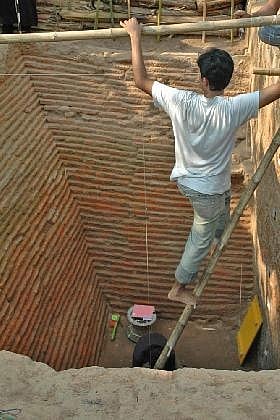
At present, the team is carrying out excavation of a piece of architecture made of inverted pyramid-shaped bricks.
It could not be ascertained exactly why the 32 feet by 18 feet structure had been built. Two teachers of the University of Asia Pacific Architecture Department Dr Abu Sayeed Mostaque Ahmed and associate professor Ziaul Islam visited the site on Thursday. A group of students of the University also accompanied them.
On the architecture, Ziaul Islam said, "There is novelty in its structure. It might have been used as a water reservoir. It might also have been used for reverence."
Prof Rahman started excavation work on a limited scale at Wari fort city with the financial assistance of International Centre for Practice of Bengal Art.
He also added some money from his own income to the project.
Students of different batches of archaeology of Jahangirnagar University are also providing assistance in the excavation work on the 600-square kilometre archaeological site.
The excavation work was carried forward in 2004 with money from the Asiatic Society fellowship and the next two years with the financial assistance of Grameenphone. This year Prime Bank is providing financial assistance.
Excavation work will continue through May.
Prof Rahman said that the overall work for archaeological artefacts in Wari-Bateshwar area required a large sum of money as well as modern technology. So nothing on such a big scale was available.
"I went to the then local government minister Abdul Mannan Bhuiyan in 2005 for money for excavation work. After about five months, he told be about his inability," he said.
Describing his experience, Prof Rahman said: "At the time we were neglected by different quarters. However, the local people always cooperated. Many gave up their land for the excavation work."
"Archaeologists and officials of the Directorate of Archaeology had no idea about the existence of such a site here, whereas two local schoolteachers drew attention to it. We are carrying out excavation in Wari-Bateshwar involving local people," he said.
Local inhabitant Rafiqul Islam echoed Prof Rahman.
Excavation is now going on the land given up by Rafiqul Islam.
"Earlier, if we found any artefacts, we would sell it, but now we will not do that, but rather preserve it."
bdnews24.com/snd/eh/rm/2136 hours