


Published : 06 Nov 2014, 08:14 PM
Updated : 08 Aug 2022, 07:19 PM


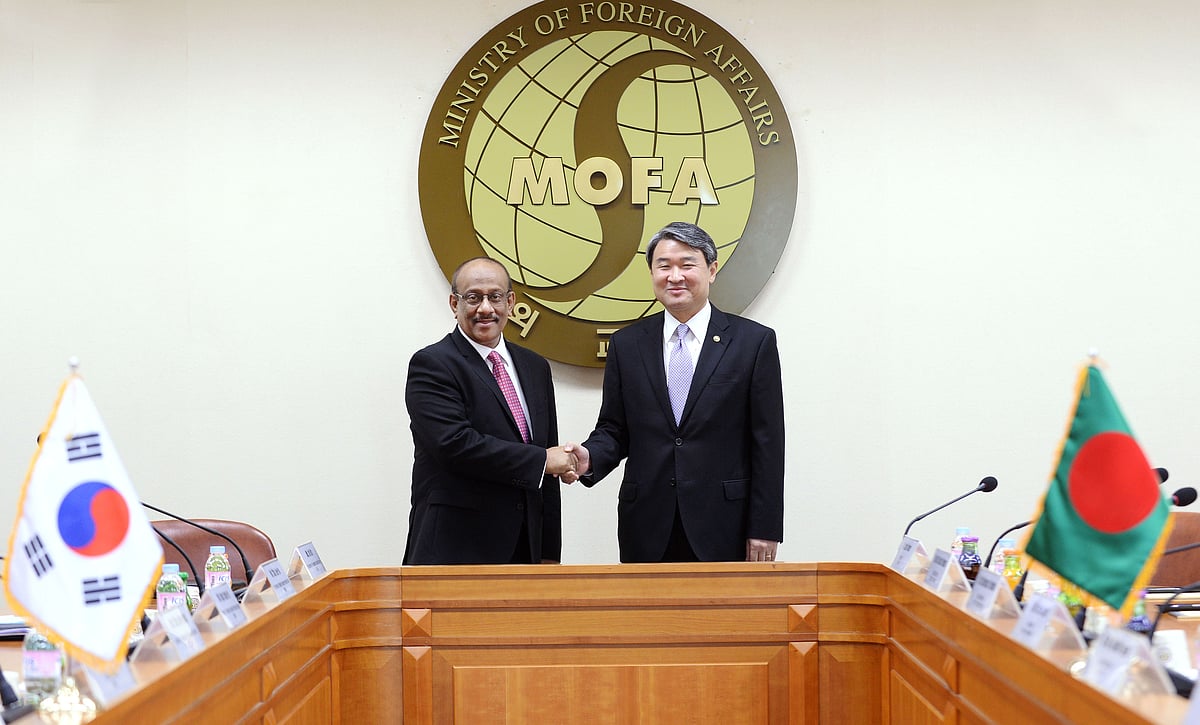
Foreign Secretary Md. Shahidul Haque led the Bangladesh delegation, while South Korea’s First Vice-Minister for Foreign Affairs Ambassador Cho Taeyong led his side at the second foreign office consultations held in Seoul on Wednesday.
The meeting discussed the whole spectrum of Bangladesh-Korea relations including existing bilateral cooperation in trade, investment and economy, human resources development, and employment.
It also explored cooperation avenues in health, climate change, agriculture, civil aviation, and defence, besides discussing post-2015 development goals and regional cooperation, including SAARC multimodal connectivity.
The talks had “a very warm and friendly ambiance”, the foreign ministry said in a statement on Thursday.
The Vice Minister opened the meeting by recalling the Prime Minister Sheikh Hasina’s “successful” visit to Seoul in May 2010.
In his opening remarks he also underlined that “the meeting should have taken place regularly, much earlier”.
The participants expressed satisfaction at growing bilateral trade between Bangladesh and South Korea while highlighting the issue of the balance of payments heavily tilted in favour of South Korea.
At present, the bilateral trade volume stands at $1.7 billion.
The Korean side identified the imports of industrial components and raw materials by the Korean companies operating in Bangladesh as a major reason for the imbalance and assured to put more efforts to reduce the gap.
Both sides acknowledged that there were “huge untapped potentials” that need to be harnessed to improve upon the current level of trade.
Foreign Secretary apprised his Korean counterpart of the possibility of importing pharmaceutical products, ceramics, more jute and jute products from Bangladesh.
He emphasised that Korean entrepreneurs and big companies could consider taking advantage of the Bangladesh’s prevailing competitive investment incentives.
He particularly suggested making investments in the Special Economic Zones in Bangladesh, besides in Korean Export Processing Zone (KEPZ) that also figured in the iscussion.
He stressed the need for increased investment in Bangladesh and requested Korean support in infrastructural improvement including road and rail connectivity.
Both sides agreed on mutual cooperation to mitigate the effects of climate change.
On defence cooperation, the Korean side highlighted their expertise in manufacturing training and combat aircrafts and high-tech defence hardware.
They also expressed hope that Bangladesh would consider Korea as “a possible source of procurement of such items”.
Bangladesh requested the Korean to consider establishing direct air connectivity between Dhaka and Seoul, a suggestion that evoked Korean interest.
On the issue of Bangladeshi nationals working in South Korea, the Korean side said they had already increased the quota for Bangladeshi workers to 4,600 per year from this year.
The Bangladesh delegation acknowledged that the Employment Permit System (EPS) model was working well and requested the hiring of Bangladeshi sea-farers in Korean ships.
The Vice Minister appreciated the Bangladesh proposal and assured Foreign Secretary of giving “due consideration to this matter”.
The Foreign Secretary also thanked the Korean side for extending cooperation in the area of health management, including the training of Bangladeshi nurses.
He invited the Korean side for the 3rd foreign office consultations in Dhaka next year.
“Both sides emphasized having regular high-level visits at the political level in order to further bolster the existing bilateral relations of strategic partnership between the two countries”.
Before the consultations, the foreign secretary had a meeting with the President of KOICA in which they discussed future engagements.
He also visited the Global Green Growth Institute (GGGI) Headquarters in Seoul, where Bangladesh side was briefed about the activities of the 22-member international institution that started its activities in 2010 as a Korean NGO.
The Deputy Director General of GGGI informed that they could help countries plan and design effective projects to have access to climate finance.
Foreign Secretary also visited the Green Climate Fund (GCF) Secretariat at Songdo, Incheon near Seoul, and had a meeting with the GCF Executive Director.












