


Published : 05 Jan 2013, 08:35 AM
Updated : 09 Aug 2022, 10:04 AM


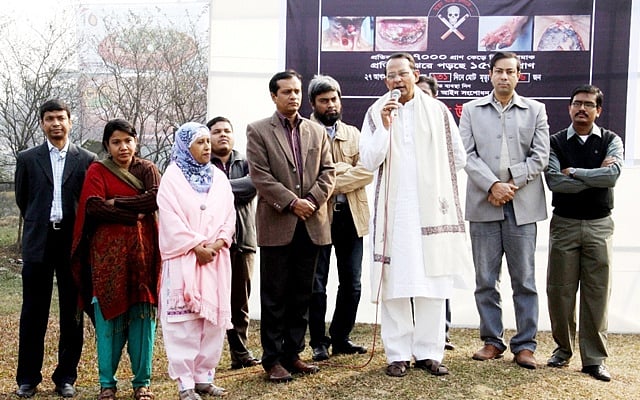
An organisation unveiled a 'Death Clock' in Dhaka on Saturday to remind lawmakers of the urgency for legislation to bring down use of tobacco in Bangladesh.
Information Minister Hasanul Haque Inu inaugurated the 'death clock' in a billboard on the Bijoy Sarani just opposite the Bangabandhu Sheikh Mujibur Rahman Novo Theatre.
Unveiling the plaque of the 'death clock', Inu called upon all to stop smoking or using other tobacco products. He assured the anti-tobacco campaigner Progga which launched the unique 'death clock' that there will be no more delay in passing the law to restrict use of tobacco products.
"It will be passed in the winter session of the parliament (scheduled to kick off at the end of this month)."
The "death clock" keeps a rolling tally of the number of people dying of tobacco-related illness each day in Bangladesh where prices of tobacco are said to be cheapest in the world.
156 people die each day in Bangladesh for tobacco-related ailment. The 'death clock' is now displaying a tally of 20,436 people who have died in tobacco related diseases since Aug 27 this year when the revised tobacco control law was approved by the cabinet nod and put up to the law ministry for vetting.
"More delay (in passing anti-tobacco law) means more deaths," said Taifur Rahman, Bangladesh coordinator of US-based Campaign for Tobacco Free Kids.
Inu, however, advocated higher taxes on tobacco products. "Our tobacco is the cheapest in the world. If we can increase the price, the government will get more taxes and many people will be saved (due to lower consumption)."
The Ministry of Finance argues that the tobacco industry is one the major sources of government revenue. But the information minister said: "There is no need to be rich selling tobacco."
The World Health Organisation (WHO) says smoking is rising quickly in lower-income countries in absence of strict anti-tobacco controls. It says almost two- thirds of the world's smokers live in these poor countries.
Bangladesh ratified the WHO Framework Convention on Tobacco Control (FCTC) in 2005 agreeing to control tobacco use by all means including banning advertisements, making laws and raising taxes.
Soon after ratifying FCTC, a tobacco control act was passed in 2005, but campaigners point to "loopholes" in implementing it.
Nothing was done to introduce pictorial warnings in the tobacco packets in the 2005 act.
The current government started revising the act after assuming power in 2009, but delay has pulled down Bangladesh in the global ranking in tobacco control.
The Canadian Cancer Society in November ranked Bangladesh 97th in tobacco control, against been 77th in 2010.
Media reports suggest lobbying by tobacco companies and bureaucratic hassles repeatedly frustrated efforts to pass a new law.
Apart from 57,000 annual deaths, WHO says, 300,000 people suffer from tobacco-related ailments in Bangladesh – a country where more than 43 percent above the age of 15 consume tobacco in some form.
The draft revised law would provide for statutory warnings covering 50 percent space on both sides of tobacco packs.
It has raised penalties for violations and identified certain public places where smoking would be banned.







