



Published : 19 Dec 2024, 09:56 AM
Updated : 28 Aug 2026, 01:15 AM


In October 2023, Munna Talukdar, a Bangladeshi worker at a restaurant in the southern French city of Toulouse, shared his experience of travelling through Libya to Italy, and eventually to France.
After enduring six months of brutal torture and an uncertain life in Libya, the physical wounds of this young man from Sunamganj had healed, but the emotional scars remained.
Munna recounted how he was captured by "mafias" in Libya, tortured, and witnessed the horrifying death of a fellow traveller.
The trauma drove him to the brink of considering suicide.
“The day I arrived in Italy, I couldn’t believe it. It felt like a completely new life,” he said.
However, memories of the "mafia" Sharif and his accomplices still haunt him.
Munna said he had to pay Tk 2.5 million to secure his release from their camp.
Like Munna, thousands of Bangladeshis fall victim to trafficking rings, spending fortunes and risking their lives to cross the seas illegally via Libya to reach countries like Italy and Greece.
When traffickers hold relatives hostage in Libya and demand more money, the families report the incident to police or authorities.
Recently, at least 61 families from Chuadanga, Shariatpur, and Madaripur have shared similar stories of relatives being held hostage by mafias in Libya, with ransom demands being made for their release.

Immigration experts say although police units occasionally arrest one or two people, investigations often fail to progress, which is one reason why the flow of people travelling through Libya to Europe has not stopped.
Another reason is the belief that once they reach Europe, employment is “guaranteed”.
Experts suggest that holding traffickers accountable could help deter such risky migration.
Shariful Islam Hasan, associate director of the BRAC Migration Programme and Youth Platform, believes that identifying local members of the trafficking rings is possible through the financial transactions involved in ransom collection.
“Money is transferred through various mobile banking numbers or bank accounts, or sometimes associates of the traffickers directly collect ransom from the victims' families,” he told bdnews24.com
“Tracking these financial transactions could help identify the entire domestic network. This approach might also reduce the trend, as financial dealings are crucial in organised crimes.”
Saiful said the Criminal Investigation Department, or CID, and other police units are work independently.
"To eliminate traffickers, a coordinated effort is needed, and a comprehensive database of these trafficking rings must be created," he added.
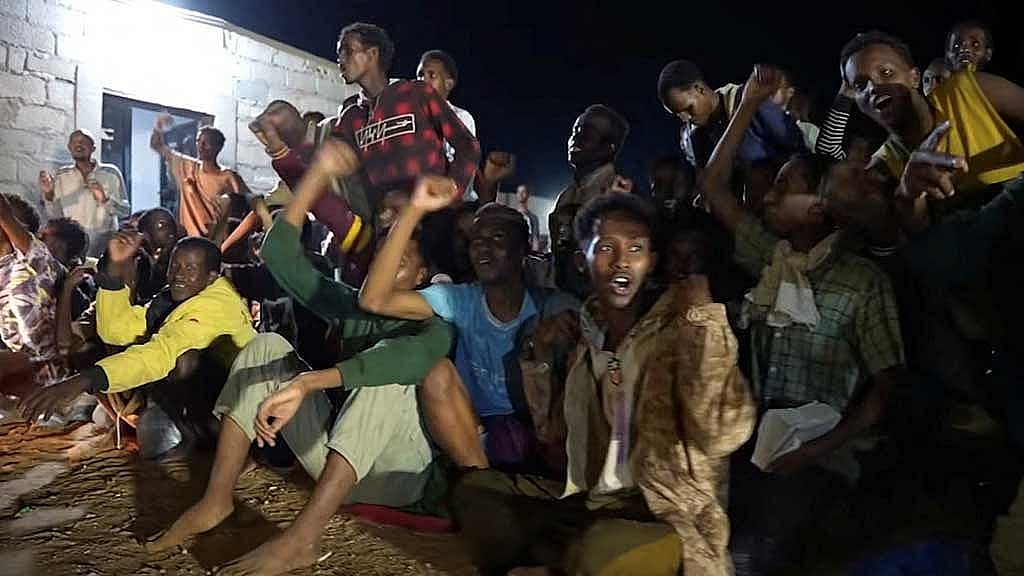
When asked about this, Additional Inspector General of the CID Matiur Rahman Sheikh said: "Crime can never be completely eradicated. It can be controlled. This is an organised crime."
"Human trafficking is one of our top priorities. Compared to other police units, CID has more capability and training in this area. We are continuously working to control these activities."
RISKY MIGRATION CONTINUES
In February, BRAC published a research report based on information from 557 Bangladeshis who had returned from Libya.
The report highlighted the brutal stories of torture and ransom extortion faced by migrants in Libya.
The report revealed that 60 percent of the families of these migrants had been promised good jobs by local brokers, but 89 percent of them never found employment or any work.
Instead, they found themselves in different risky situations.
According to individuals and organisations working on the issue, Bangladeshis are among the highest number of migrants following the Mediterranean route to Europe.
Of the nine migration routes to Europe, the most common choice for Bangladeshis is travelling from Libya by boat to Italy.
This route is fraught with the dangers of drowning in the sea, and additionally, there is the threat of the “mafias” along the Libyan route.
A group of Bangladeshis, in collaboration with local separatists, has established a “trade” of kidnapping migrants and demanding ransom.

When speaking with Munna in Toulouse in October 2023, he pointed out that one of the main leaders of these mafias in Libya is Sharif, a Bangladeshi known by a single name.
A National Security Intelligence, or NSI, officer, speaking on condition of anonymity, told bdnews24.com that Sharif had influenced many other Bangladeshis in Libya to get involved in this "trade”.
One of Sharif’s right-hand men is named Sagar, though the officer did not provide further details about him.
Earlier, several of Sharif's associates from Cumilla had been arrested in Bangladesh. However, this did not stop his activities.
On Dec 12, families of 37 people from Chuadanga, who were taken to Libya under the promise of reaching Italy, held a press conference at the Chuadanga Press Club.
The affected families claimed that their relatives had paid brokers between Tk 1.5 to Tk 2 million to be sent to Italy.
However, the brokers are now holding them in Libya and demanding an additional Tk 2 to Tk 2.5 million.
Most of these 37 youths are from the Nagdah union of Chuadanga’s Alamdanga.
The union’s chairman Darus Salam told bdnews24.com, “Many people from this village have previously gone to Italy and are now working and doing well there. Seeing this, others paid brokers for the same opportunity.”
"Now, the brokers are demanding more money, which is why they are torturing the victims, as their families have informed us," he said. "One family has filed a case, but no suspects have been arrested yet."
Abdullah Jahir Dipu, a resident of this union, is currently held hostage by the mafias in Libya.
His sister, Sabina Khatun, told bdnews24.com that the brokers had promised to send him to Italy within a month.
"But it's been almost a year, and he is being held captive, beaten, and tortured during video calls, demanding more money. They are strangling him, binding his hands and feet, and beating him."

She added, "The broker, Jim, was given Tk 300,000 at the airport. After Dipu reached Dubai, we sent Tk 700,000 to the broker's house. Now, they are demanding more money."
Tuhin Mia, a 19-year-old youth from Chuadanga, was sent abroad with the hope of bringing financial stability to his family.
However, he is now trapped in one of Libya’s “game rooms” [where people are held and tortured].
The brokers are demanding more money from his family.
Tuhin's father, farmer Rezaul Haque, told bdnews24.com that he had sent Tuhin through the brokers Sagar and Jim, paying all the required fees. But now they are demanding an additional Tk 700,000 from the family.
"I gave everything I had to send my son, and now they are demanding even more money. I don't know where I will get it from. I'm struggling to even feed my family," he said.
Riyazul Islam, the additional superintendent of police (promoted to the post of SP) in Chuadanga, informed bdnews24.com that seven people have been named in the case, along with several unnamed suspects who are outside the area and abroad. Police are trying to arrest them.
"Each family has paid Tk 1.5 million Taka to the suspects. In total, they have paid over Tk 35 million," he added.
On Dec 8, family members of victims from Madaripur and Shariatpur held a human chain outside the Shariatpur district commissioner’s office, demanding the release of their loved ones who are held hostage in Libya.
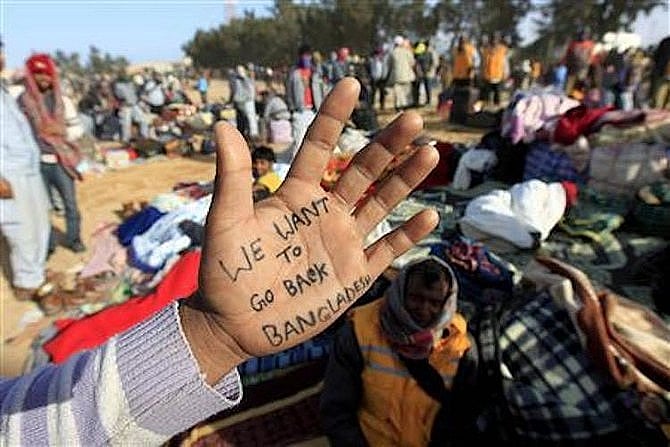
The father of one of the victims, Chunnu Bhuiyan, told the media: "The mafia has already taken Tk 2.8 million in several instalments. I sold my belongings to pay them, but I still don’t know in what condition my son is in Libya. I have filed a case against the brokers, and I want my son back.”
On May 28, 2020, 30 migrants, including 26 Bangladeshis, were shot dead by the Libyan mafias at a “game house” in Mizdah.
After the incident, discussions began regarding the Bangladeshi mafias in Libya, and the government promised to take action.
Around 15 suspects were arrested in several cases, but the investigation has not progressed since then.
HOW MANY PEOPLE ARE GOING TO EUROPE VIA LIBYA?
Shariful said the route from Libya to Europe, known as the “Central Mediterranean Route”, has seen more than 70,000 Bangladeshis travel from Libya across the Mediterranean to Europe [Italy or Greece] from 2009 until last year.
“We thought the number might decrease, but the statistics for 2023 and 2024 show that the number of Bangladeshis has increased. Now, Bangladeshis are at the top among citizens of different countries crossing the sea to enter Italy,” he said.
According to the United Nations High Commissioner for Refugees, or UNHCR, between January and October 2024, a total of 55,413 people from 29 countries crossed the Mediterranean to enter Italy.

Of these, 11,231 were Bangladeshis, making up 20.3 percent of the total number.
UNHCR's updated data shows that in 2023, 150,273 people crossed the Mediterranean to Italy.
Among those entering from Libya, Bangladeshis were the highest in number.
This year, 12,303 Bangladeshis crossed the Mediterranean from Libya to Italy.
According to UNHCR statistics, in 2021 and 2022, Bangladesh ranked third in the nationality-based statistics for sea crossings to Italy.
Over these 24 months, 22,105 Bangladeshis made the journey to Italy.
‘LIBYA TO ITALY GAME’
Human traffickers refer to the act of crossing the sea to Europe by boat as a “game”.
A simple search on Facebook for “Libya to Italy game news” reveals at least 100 groups, some with memberships of over a million.
These groups regularly share updates about reaching Italy by boat from Libya, arrests, or the tragic news of being trapped or killed by Libyan mafias.
In these groups, posts seeking information about lost loved ones along the journey to Italy are common.
In addition, many Bangladeshis comment, seeking opportunities to travel to Italy.
People also post requests for direct contacts to media or traffickers in Italy.
At the same time, brokers are advertising their services to send people through alternative routes, including via the Middle East (from Saudi Arabia to Egypt).
These groups have become a massive “commercial hub” for human trafficking.
WHY IMMIGRATION VIA LIBYA CAN’T BE STOPPED?
Over the past decade, at least 5,000 Bangladeshis are believed to have died trying to migrate through this route.
BRAC official Shariful said, "More than 25,000 migration aspirants have died in the last ten years while attempting to cross the Mediterranean. Our observations suggest that, on average, at least 500 Bangladeshis die each year during their journey."
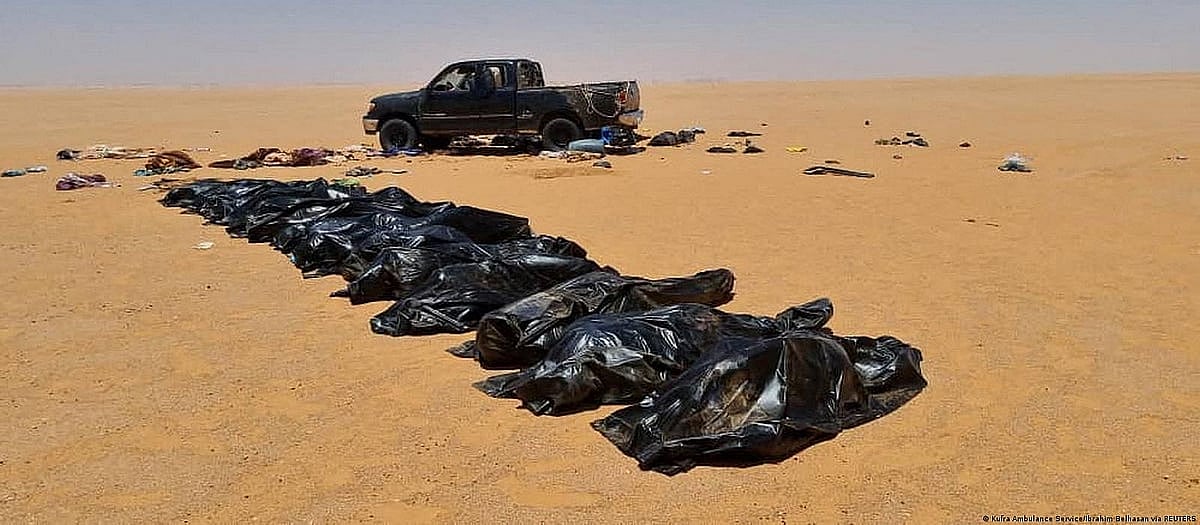
When asked why such immigration continues despite the deaths, torture, and extortion of large sums of money, he said: "The problem is that there has been no effective government in Libya since 2010. War and unrest are rampant in the region, including Syria, and international human trafficking rings are exploiting this chaos."
"Secondly, once migrants manage to enter Europe through these irregular routes, they find work. As a result, people from villages believe that if they can just get there, everything will be fine. They ignore the risks of death and suffering along the way.
"Members of international trafficking networks are operating from Libya, Dubai, and Syria. To combat this, an international platform is needed to work together.
"The nature of this crime has remained largely unchanged in recent years. By identifying the local networks involved in the money collection process, we could at least reduce this trend."
He believes that creating a database of Libya-based criminals and coordinating efforts among relevant authorities could help in tackling these crimes effectively.
[Writing in English by Sheikh Fariha Bristy]











