Country clocks in daylight saving
Bangladesh turned its clocks an hour ahead to 12 midnight at 11pm on Friday as the energy-starved nation introduced Daylight Saving Time for 'an extra hour of daylight' to save power.
bdnews24.com News Service
bdnews24.com
Published :
19 Jun 2009, 04:49 PM
Updated :
12 Aug 2022, 01:19 PM
Dhaka, June 20 (bdnews24.com)—Bangladesh turned its clocks an hour ahead to 12 midnight at 11pm on Friday as the energy-starved nation introduced Daylight Saving Time for 'an extra hour of daylight' to save power.
This means the sun will set an hour later on Saturday.
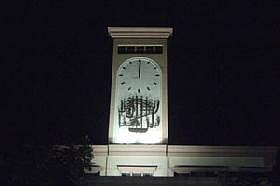
The curtain-raising event was played out in the full glare of the media, as state-run Bangladesh Television beamed live pictures of the capital's landmark RAJUK building clock being turned by an hour ahead, two seconds before the clock struck 11.
Prime minister Sheikh Hasina urged people to adjust to Daylight Saving Time being introduced to make the maximum use of limited energy resources.
She opened the cover of a replica watch and released a special commemorative stamp worth Tk 5 at her Jamuna residence at 10:44pm to kick off the time switch, which will be in force until further announcement.
The scheme has been introduced, limited resources now have to be tapped for the welfare of people, Hasina said in a brief speech broadcast by BTV.
"Daylight saving is new in our country. Many countries introduced it much before. It will open up scope for using more daylight."
Energy and power will be saved and the switch would not create much drawback, she assured people.
She acknowledged power crisis and said, "We have power problems. So, load-shedding happens and we have to suffer."
"We are trying to break free from this problem. We are taking many steps."
State minister for energy Shamsul Huque Tuku and energy affairs adviser to the prime minister, Towfiq-e-Elahi Chowdhury, were present at the ceremony.
A cabinet meeting chaired by Hasina on June 1 decided the move. Hasina had promised before the Dec 29 general elections to address the power crisis.
A massive campaign spearheaded by the government saw clocks across the country were also shifted an hour ahead to use the daylight hours most efficiently .
DST are practised in many countries, exploiting daylight by advancing clocks so that evenings have more natural light and mornings have less.
Energy is mainly saved by cutting down on the use of lights in homes during the dark evenings. By moving the clocks forward one hour, the evenings will be lighter and so the amount of electricity used can be reduced.
The energy division launched a massive awareness-raising campaign and other initiatives to make the transition as smooth as possible for people.
Towfiq-e-Elahi Chowdhury told bdnews24.com on Thursday, "All the countries of the world want more use of sunlight."
"This will carry a message of our being economical too, in our attitude to conserve daylight and therefore save power."
"This is going to be our first experience of this kind. Let us see what happens, how good a result it brings. It's a necessary change."
State minister for energy Shamsul Huque Tuku said on Thursday at least 200 megawatts of electricity would be saved daily across the country because of the extra daylight hour.
He was confident that people would quickly adjust to the time change. State-run and private TV channels broadcast information slots. Mobile-phone operators sent out text alerts.
Tuku said school timings should not be affected as no institution should change its timing.
"We have also had talks with business communities. They say all shops and businesses will remain open according to the new timings."
On other power saving measures of the government, Tuku said the national budget had allocated money for developing renewable energy sources.
The decades-old power plants are mostly fuelled by gas, but the reserves are depleting, officials said. The country faces a shortage of up to 250 million cubic feet of gas a day.
The government has temporarily closed down several fertiliser manufacturing plants to divert the natural gas they use to generate more electricity.
Frequent power failures cut the country's gross domestic product by around $1 billion annually, the World Bank has said, and the country would need $1.5 billion annual investment for power generation and transmission, and natural gas exploration.
The power sector is reeling from severe crisis as no considerable power has been added anew to national grid in recent times.
Uninterrupted use of power depends on weather as power outage increases if temperature is low or it rains.
However, power outage starts if temperature is high.
US inventor and politician Benjamin Franklin firstly came up with the idea of using more daylight in 1784 while staying in France as US envoy.
He suggested people in Paris to rise early in the morning too in an effort to use less candlelight.
Modern DST was first proposed by the New Zealand entomologist George Vernon Hudson, whose shift-work job gave him leisure time to collect insects, and made him aware of the value of after-hours daylight.
His proposal came into spotlight within some days next.
Germany is the first to have moved their clocks one hour ahead in an effort to save coal use in war fields in 1916. It is also said that the DST was introduced to defend them from their opposition's air strike.
The US firstly introduced this system in 1918, followed by many others.
More than 70 countries now move their clocks time ahead in the world.
bdnews24.com/mk/mrf/fwc/zr/rah/bd/0005h.