


Published : 20 Mar 2022, 08:06 PM
Updated : 03 Aug 2022, 11:39 AM


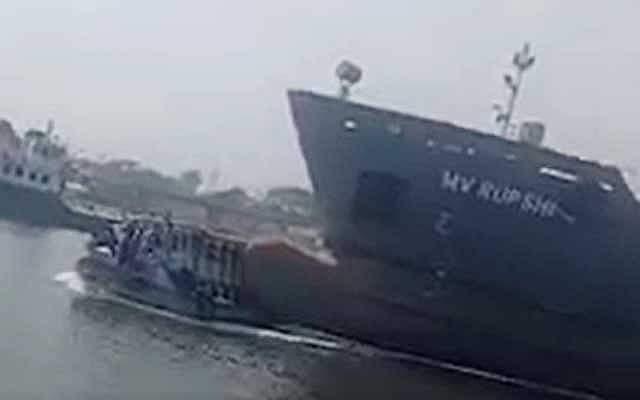
The cargo vessel MV Rupshi-9, owned by City Group, bore down on the side of the launch, ML Ashraf Uddin-2, with great force and eventually plunged it into the water near the coal market in Sonakanda around 2pm on Sunday.
Divers have pulled out six bodies from the river so far. Police have held both the ship and its pilot.
Passenger Rakib Al Raju was travelling from Narayanganj to Madaripur on another launch, named MV Naria-4, during the incident and witnessed the collision.
“Having arrived near the new bridge in Narayanganj around 2:10pm, I saw the ship getting over the launch,” he said.
“But the ship did not slow down. The ship’s pilot might not have seen it. We kept screaming, but it did not work.”
As the horror unfolded, Raju filmed the terrifying moments on his mobile phone and shared the video clip on Facebook. The clip went viral.
The video shows the ship broadsiding the launch as frightened passengers leapt off in hopes of swimming to safety. This went on for almost 25 seconds before the launch sank into the water as the ship ran relentlessly over it.
The ML Ashraf Uddin-2 headed for Munshiganj from the Narayanganj launch terminal, according to Badiuzzaman Badol, president of the Narayanganj Zone of the Bangladesh Inland Water Transport Authority.
The Rupshi-9 owned by City Seed Crushing Industries, a unit of City Group, was built in 2019, according to vesselfinder.com, a vessel-tracking website.
City Group General Manager Biswajit Saha could not be reached for comment.
COULD THE SHIP SLOW DOWN
Raju’s clip and several others have spread over social media, all containing footage of the ship thrusting the launch relentlessly for some time, eventually drowning it, and people screaming warnings.
People who have experience sailing launches think the distance between the vessels suggest that it was not possible for the ship to slow down and avert disaster.
They say a ship cannot slow itself down so rapidly, but the pilot should have spotted the launch earlier and sounded the siren.
Delowar Hossain, a first-class master with 33 years of experience, said, “The ship was moving at around 6 knots and the driver had to prepare from five minutes to save the launch. Nothing could be done here,” he said.
On what could be done, he said the ship could starboard to empty spaces past the launch.
Delowar mentioned that it takes large launches more than half an hour to reverse trajectory.
Mostafizur Rahman, another master, said, “From how close the launch was, even four engines wouldn’t be enough for the ship to stop.”
He underscored how important it is to consider the size and power of these vessels while sailing.
Shafiqur Rahman, chief inspector of the Department of Shipping or DoS, said, “The slower launch was in front of the ship, so…”, but did not detail his assessment as a committee is now investigating the incident.
Asking not to be named, another DoS official said drivers could not avoid the accident only by slowing down as the direction of the waves, the win also factor in. The sailors had to be skilled as well.
“Both the drivers of the ship and the launch displayed poor skills.”
The vessels were travelling with the tide and shutting off engines would simply keep them floating in the same manner.













