


Published : 03 Apr 2017, 03:52 PM
Updated : 11 Apr 2022, 09:01 PM


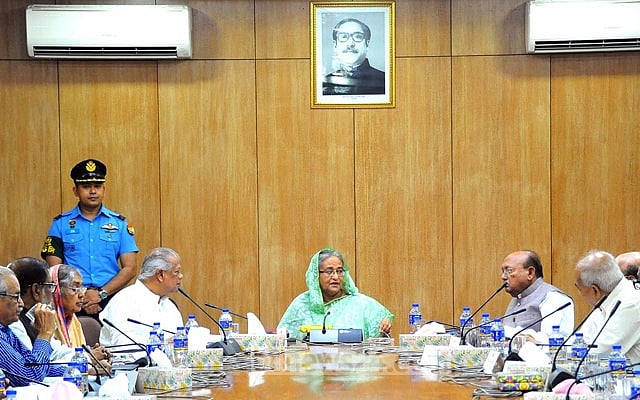
The draft of Immovable Property Lease and Acquisition Act 2017 was approved at a cabinet meeting headed by Prime Minister Sheikh Hasinaon Monday.
Unlike the 1982 ordinance, the new law if passed in parliament allows the government to acquire the lands for public interest.
Cabinet Secretary Mohammad Shafiul Alam said the lands where places of worship such as mosque, temple, pagoda, and graveyards and crematories are located, can be acquired if necessary.
“In such cases, the government needs to compensate the owner by relocating or reconstructing the structures,” he told reporters after the meeting.
For example, if a mosque is situated in the middle of a road, the government may need to relocate it and free the street, he said.
The ordinance passed in 1982 is now being rewritten in Bangla following a High Court order.
The new law proposes an increase in the compensation.
The compensation will be three times the market price of the land. In case any private entity acquires the land, the compensation will be four times the market value.
“In case, the government acquires a land, it needs to add 200 percent to the market price of the land and compensate the owner. For example, the owner will receive Tk30 million if the land’s value is Tk10 million in the market.”
Private entities may acquire land in special cases.
“They may acquire land to set up a school for example, but would need to compensate at a higher rate.”
The Land Registry Office will fix the price of a land by finding the average of the rates at which lands have been bought and sold in the area in the last 12 months.
Any official with status equivalent to joint district judge or sub judge will act as the arbitrator, as per the new law. Previously, additional district judge or the sessions judge had played the role.
The draft received initial approval on Dec 5 last year.
The cabinet considered the act as “complicated” then and set a committee headed by the law minister to finalise the draft.













