


Published : 01 Nov 2015, 02:18 AM
Updated : 23 Apr 2022, 01:14 PM


Human rights activists say the ‘key people’ behind such murders and attacks could not be traced due to the ‘attempts to gain political mileage out of these’.
It started with the attack on legendary writer Humayun Azad 11 years ago.
The latest victim is Faisal Arefin Dipan, a publisher of slain writer-blogger Avijit Roy’s books.
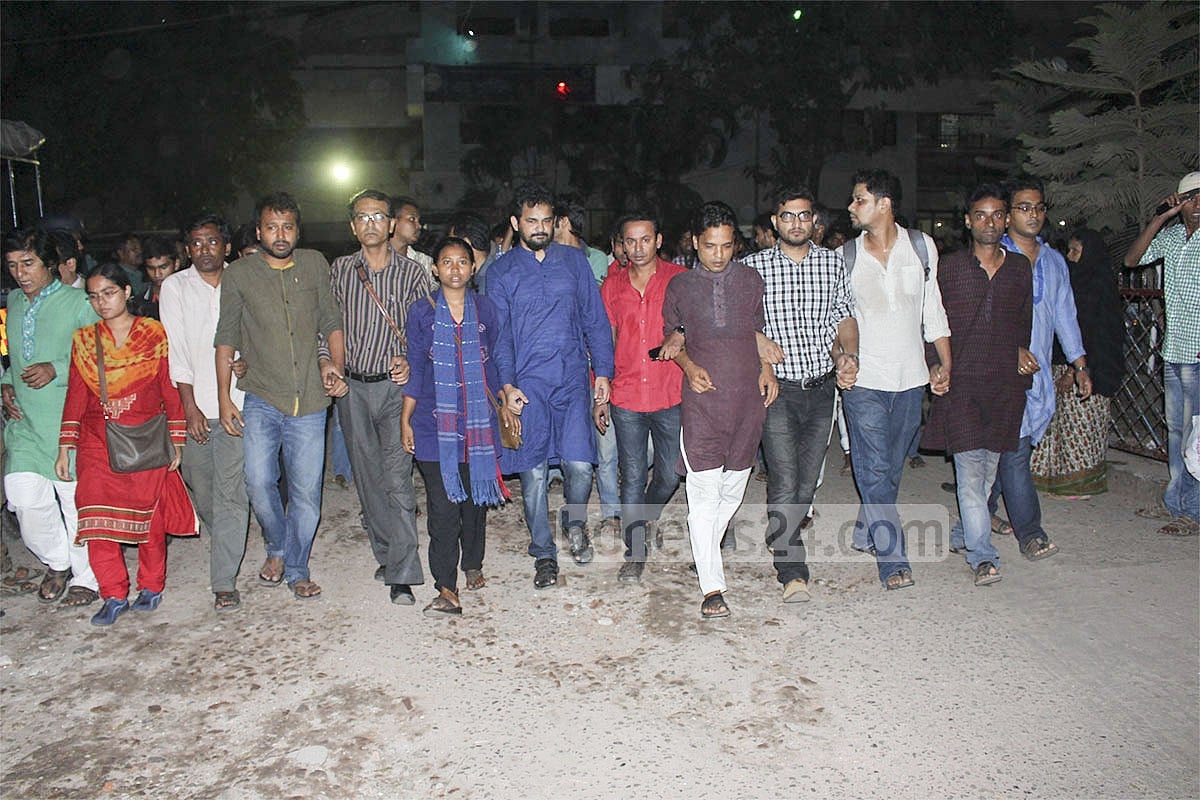
Dipan’s body was found at his office in Shahbagh on Saturday, hours after Ahmedur Rashid Chowdhury Tutul, who also published Roy’s books, and two others were hacked in Lalmatia.
Ganajagaran Mancha spokesperson Imran H Sarker said, “These attacks prove the law enforcing agencies have totally failed."
Sarker, speaking to reporters at Dhaka Medical College Hospital, also said, "It is not possible to carry out these attacks without connivance of some in the government."
Blogger Arifur Rahman, now staying in the UK, blamed Islamic militants for the attacks.
He opined that such attacks were taking place repeatedly because they wanted to prove that Bangladesh was not secular.
“Islamic militants are carrying out attacks on freethinkers regularly, because they know that it will not be possible to cultivate their ideologies in Bangladesh if the freethinking writers, publishers and bloggers cannot be prevented,” Rahman said.
“The government is also happy, because such a panic situation creates an environment suitable for autocracy,” he said.
“It is possible that the supporters of Islamic militants in the government are hindering the investigations and trials. After all, the government has failed to understand the gravity of the situation,” he added.
The blogger also demanded repeal of the Section 57 of the ICT Act and trials of the Islamic organisations, leaders, news portals, political parties that call for attack on bloggers and freethinkers.
“The trial process will have to be expedited by forming special inter-forces team to investigate all the attacks on the freethinkers in the past two years,” Rahman said.
Writer Azad, a teacher of Dhaka University, was attacked on the campus on Feb 27, 2004. He later died undergoing treatment.
The trial is yet to end after 11 years.
The next victim was blogger Ahmed Rajib Haider. He was hacked to death in front of his house at Pallabi on Feb 15 in 2013, just 10 days after the launching of Ganajagaran Mancha to press for the death penalty for war criminals.
Ganajagaran Mancha activist Arif Raihan Dip was hacked to death in a residential hall of Bangladesh University of Engineering and Technology (BUET) on Apr 9 the same year.
The trial of this murder is yet to begin.
This year’s first victim was Avijit Roy. The writer-blogger was killed on the DU campus on Feb 26. His wife Rafida Ahmed Bonya lost a finger in the attack.
Police arrested seven, but the investigation report has not been submitted yet.
The other bloggers killed this year are Oyasiqur Rahman Babu at Tejgaon on Mar 30, Ananta Bijoy Das in Sylhet on May 12, and Niladri Chatterjee Niloy at Gorhan on Aug 7.
Blogger Subrata Shubho blamed the ‘culture of impunity’ for the repeated killings.
“We can clearly see that the State and administration have failed. There were 29 militant organisations in the country in 2007. Now the number is over 130. So it can be clearly seen that the government has failed to prevent the killings of bloggers and the expansion of militancy as well,” he said.
“The culture of impunity is of course one of the main reasons. Besides, the law enforcing agencies are projecting the slain bloggers as instigators of the murders in a bid to hide their failure. So, police and RAB are also indirectly helping the creation of a social base for the murders of bloggers,” Subho said.
“I think it will be possible to overcome the situation only if all the accused are arrested and brought to justice, and if awareness among the people against militancy are raised,” he added.
Blogger Nirjhor Majumder said, “The steps taken by the law enforcing agencies are not only ineffective, they are also very much questionable and dubious. Many of their initiatives have encouraged and favoured militants and terrorists.”
“In short, the extent of the failures of law enforcing agencies in Bangladesh is so massive and dangerous that it is encouraging, strengthening militancy instead of preventing it,” he said.
“Not only impunity. The police chief, home minister and many top officials of the administration advised bloggers not to cross the limit – which is ‘victim blaming’ in one way. Such remarks only give moral legitimacy to incidents like murders and wild behaviour of militants and reactionists,” he added.
Rights organisation Ain O Salish Kendra Director Noor Khan Liton said, “These are not isolated incidents. It is the effect of rise of religious terrorism across the world.
“There are some weaknesses of the law enforcing agencies in these cases. Those who are carrying out these incidents are operating in small groups in a planned manner. Even if one or two are caught, there will be no outcome. There is also no preparedness to prevent such attacks,” he said.
The rights activist also said, “When the Aug 21grenade attack took place, Awami League said there were militants in the country. Now after coming to the power, they are saying there are no militants.”
“The real issues get suppressed because of this tendency of taking political advantage,” he added.
He said Bangladesh would be in danger if it failed to stop communal militancy now.













