


Published : 28 Dec 2020, 01:38 PM
Updated : 17 Oct 2022, 11:17 AM


Their selfless actions have set a new benchmark for humanity, overcoming various social and religious barriers along the way against the backdrop of an unprecedented crisis.
In the process, these volunteers sacrificed being with their loved ones amid safety concerns. Although the beneficiaries remained grateful to them, some members of society tried to drive them away and placed various obstacles in front of them. But the volunteers soldiered on and continued laying to rest one COVID-19 victim after another, while also arranging for the treatment of the infected.
"If it wasn’t for the pandemic, we wouldn’t have realised that a person’s brother, wife and children can abandon them in such a short period of time, out of fear of a virus,” Maksudul Alam Khandaker Khorshed, Narayanganj City Corporation councillor and a volunteer, told bdnews24.com.
The first COVID-19 patient in the country was identified on Mar 8, 2020 in Dhaka. The virus, which claimed the lives of millions in America and Europe, soon swept across the country and caused panic within the general population.
The homes of the infected were cordoned off in order to curb the spread of the virus followed by zone-based shutdowns, with the entire country going into lockdown for about two months at one point.
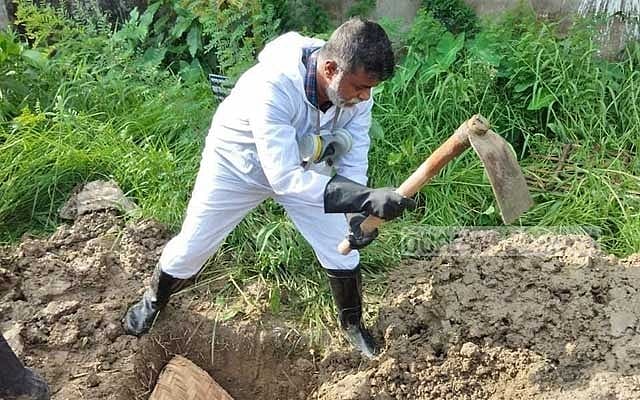
Narayanganj City Corporation Councillor Maksudul Alam Khandaker Khorshed, who volunteered to conduct the last rites of people succumbing to the coronavirus infection, digs a grave for a COVID-19 victim.
At the start of the outbreak in March, Councillor Khorshed took to the field to provide safety equipment, relief and medicine to those in need.
As the outbreak intensified, in early April, he was forced to conduct burials. Afterwards, he went on to oversee the funeral services of around 150 individuals who died of COVID-19 or were suspected to have been infected.
Elaborating on the early days of the pandemic, Khorshed said: "There was this one occasion when I did not have the time to look at the face of a man whom I'd buried. I did not see any of his relatives that day except for his wife and two daughters. Afterwards, I found out that he was my childhood friend. We grew up together but he had moved to the other side of town later on.”
From April to mid-December, Khorshed has conducted the funeral rites of 142 people with his team of 15 volunteers. Of them, 25 were followers of religions other than Islam. But in light of an escalating crisis in the early stages, religious differences had to be cast aside.
"One day, a Hindu gentleman called and said his brother-in-law was in bad shape and asked us to visit. After arriving, we saw a man lying on the stairs between the second and third floor. The people in the building weren’t allowing the victim’s wife, mother and daughter to cry out loud, fearing an adverse reaction from the neighbours.”
None of the relatives came forward to help when her husband was having breathing difficulties, the victim's wife told Khorshed.
“Later, I dialled 999 and called an ambulance. The man died as his mother-in-law and I were taking him down the stairs.”
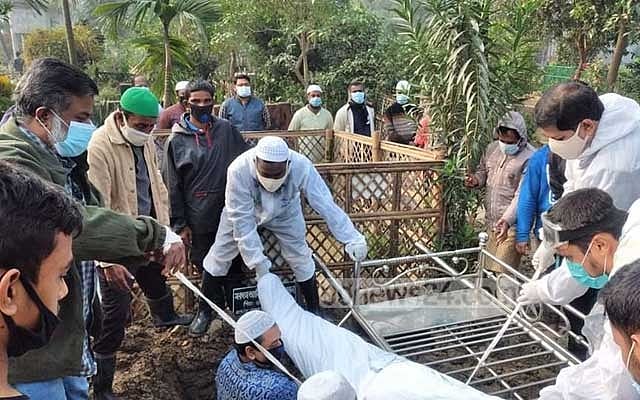
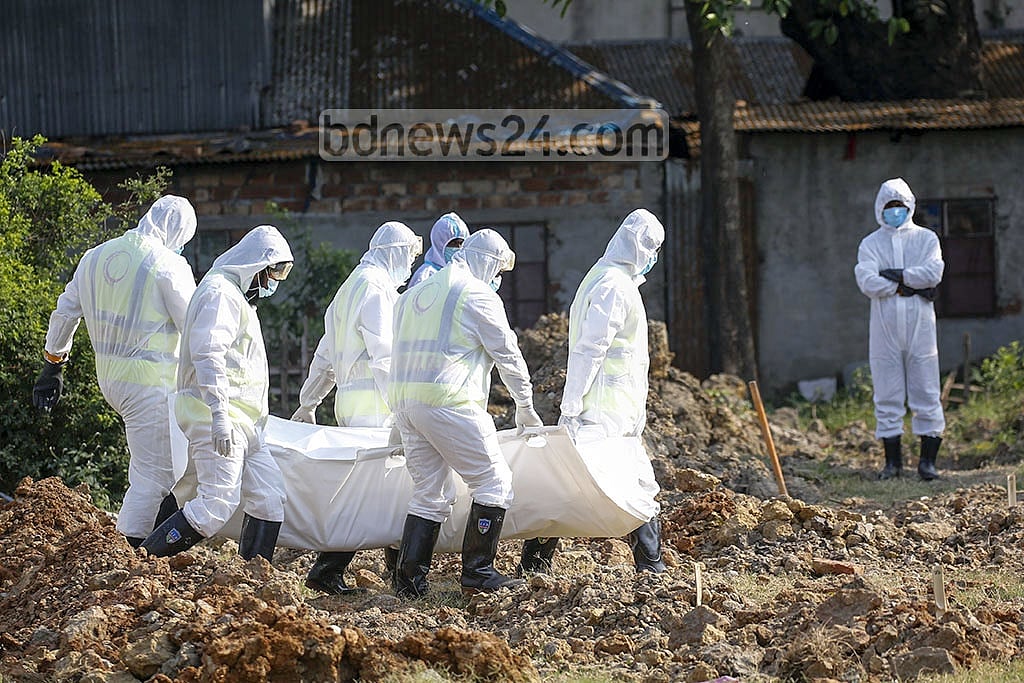
Councillor Khorshed, with the help other volunteers, lays a COVID-19 victim's body to rest.
"'As human beings, I demand that you find a way (to arrange the last rites) for my husband,' said his wife. We were all fasting that day; everyone in our group was a Muslim. The incident occurred on the second day of Ramadan. But we didn't want our religious beliefs to become a barrier that day. We burnt the body ourselves.”
Recalling another incident, Khorshed said, “It happened the day after Eid-ul-Fitr. I found another infected Hindu gentleman. He had no children. We were told over the phone that he had stopped eating and was suffering from diarrhoea.
"We were asked to arrange for some saline or other medicines if possible. When we arrived, we found him bleeding from his nose, ears and throat. He died after getting on the ambulance. We also conducted his funeral.”
SHAHANA ARRIVES IN DHAKA TO CONDUCT FUNERALS
Another organisation that made an indelible mark is the Quantum Foundation in Dhaka, providing a wide array of humanitarian services during the outbreak. Starting from Apr 7 until December, volunteers of the organisation have buried about 2,600 bodies.
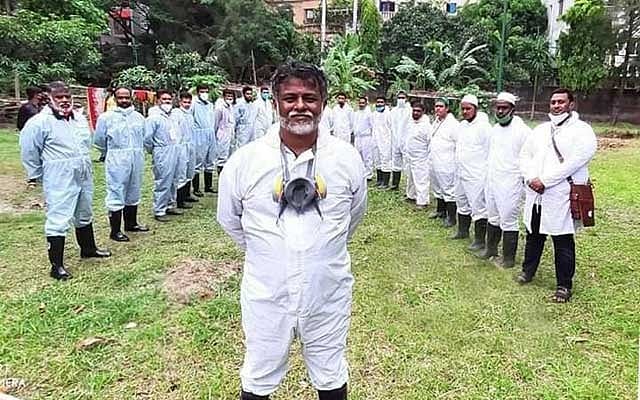
Councillor Khorshed and his team of volunteers pose for a photograph.
Shahana grew interested in volunteering after hearing about Quantum workers in Dhaka conducting the funeral services of people who succumbed to the coronavirus, she told bdnews24.com.
"I have been involved in the work since Jun 5. I am continuing to wash the bodies of suspected COVID-19 patients. On many occasions, we had to take the bodies to the graveyards after washing them as the relatives of the dead did not assist out of fear of getting infected.”
Referring to an incident at Mugda General Hospital, Shahana said a woman died after a month of treatment.
"A man, identifying himself as her husband, admitted her to the hospital. But he disappeared afterwards. We took his number from the hospital registrar and called him. A man picked up the phone but said he did not know the victim. We encountered several similar incidents.”
Volunteers picked up bodies from the third, fourth and fifth floors of houses without any assistance from relatives of the deceased, said Shahana.
“None of the men lent a helping hand. They just pointed us to the direction of the bodies and then disappeared. Although these things did not happen all the time, it occurred on multiple occasions. They were all scared and were spraying sanitisers again and again.”
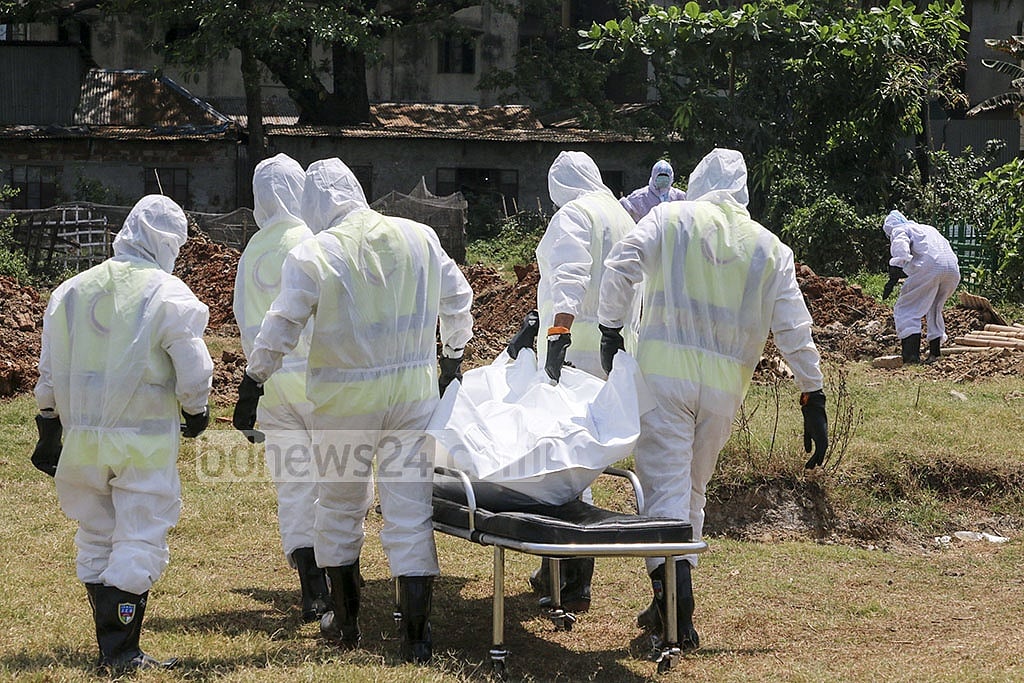
Volunteers carrying the corpse of a COVID-19 victim for burial at the graveyard in Dhaka's Khilgaon Taltola on Saturday. Photo: Mahmud Zaman Ovi
A resident of Rampura in the capital has been volunteering for Quantum and providing services to coronavirus victims since June. His wife has also joined him in his work. Together, they have conducted the funerals of people of various religions. However, they have kept the whole matter a secret from fear of backlash from colleagues and relatives.
"We are maintaining good hygiene. No Quantum volunteers have contracted the virus so far,” the man, who asked to remain anonymous, said.
SHAHIDUL’S EBOLA EXPERIENCE
Al-Markazul Islami is another organisation that stepped forward to address the crisis of arranging funeral services during the coronavirus outbreak. They have bathed 136,000 bodies in 32 years of service in line with Islamic precepts. Hamza Shahidul Islam, acting president of the organisation, had also volunteered to combat Ebola in Africa in 2015.
After receiving proposals from the health directorate and the Islamic Foundation, the organisation started performing funeral rites of infected patients, said Shahidul.
"We have buried more than 3,000 people until December. We also had to bury several unclaimed bodies from different hospitals between April and May."
“At first, the health directorate trained 10 of us. But at the end of that training, the other nine expressed unwillingness to do the work. I was the only one left. After the preliminary training, we started working with bodies on Mar 29. I went ahead on my own. We had no logistical support when we went to Iqbal Road to pick up the first body. The second body remained in the hospital for two days before we laid it to rest.”
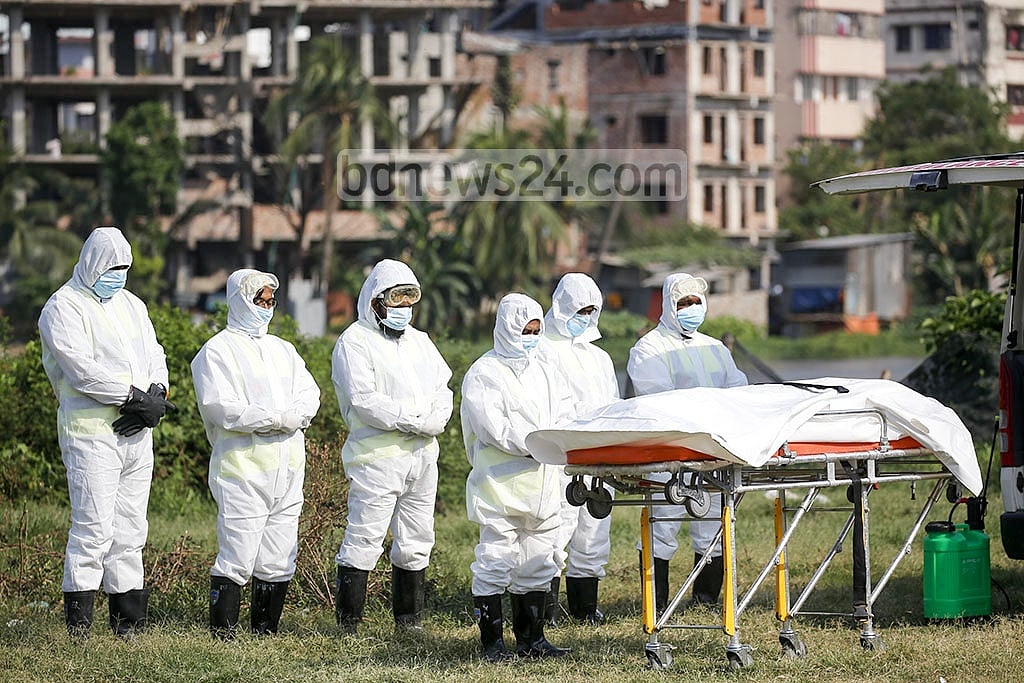
Volunteers attend funeral prayers of a COVID-19 patient at the graveyard in Dhaka's Khilgaon Taltola before burial on Saturday. Photo: Mahmud Zaman Ovi
When the volunteers went to pick up the first body, they did not have any safety equipment on them, said Shahidul.
“We went there empty-handed. But I got scared after finding a TV camera there, fearing criticism for my work. The body would have started to swell if we waited for the safety equipment as the person died in the morning and we reached the place in the afternoon."
Within a month of handling corpses, Shahidul's team members were all tested for the coronavirus twice. Everyone tested negative both times, he said.
Afterwards, the volunteers became less fearful, thinking the virus could not spread from dead bodies. Later, the health directorate issued a statement affirming that belief.
Asked how people in the neighbourhood viewed workers who handled the bodies of coronavirus patients, Shahidul said: “We felt unwelcome at that time. People became uncomfortable when we went near them. We were often obstructed by the locals. They forbade us from washing bodies there, saying it was a residential area even though we had been doing it for 32 years.
"They also attempted to break our ambulance once. We also faced obstructions when we attempted to bury bodies in Khilgaon, Azimpur and Martyred Intellectuals Graveyard. But we handled the matter and went on with our work.”
Written in English by Taif Kamal













