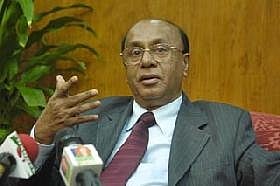
Azizul says he feels no pressure from WB-IMF
Finance adviser AB Mirza Azizul Islam said Thursday that neither the World Bank nor the International Monetary Fund had placed any pressure on him to follow their economic prescriptions at their annual meeting in Washington. "I took part in the annual meeting and held bilateral talks with officials of the World Bank and IMF," Azizul told reporters at Zia International Airport on his return from a two-day visit to the US. "They did not try to impose any policies on me. They did not even give any specific advice on tackling fuel price hikes in the international market." "Nevertheless, regular discussions will continue," added Azizul.
bdnews24.com News Service
bdnews24.com
Published :
01 Nov 2007, 12:04 PM
Updated :
17 Aug 2022, 04:25 PM
Dhaka, Nov 1 (bdnews24.com) -- Finance adviser AB Mirza Azizul Islam said Thursday that neither the World Bank nor the International Monetary Fund had placed any pressure on him to follow their economic prescriptions at their annual meeting in Washington.
"I took part in the annual meeting and held bilateral talks with officials of the World Bank and IMF," Azizul told reporters at Zia International Airport on his return from a two-day visit to the US.
"They did not try to impose any policies on me. They did not even give any specific advice on tackling fuel price hikes in the international market."
"Nevertheless, regular discussions will continue," added Azizul.
Recent reports in the media quoted the IMF as saying the GDP growth rate in Bangladesh could be reduced to 5.5 percent.
Responding to a query Azizul said: "No IMF official aware of the situation in Bangladesh would say anything like that."
The adviser added that it was far too early in the financial year to make any such financial projection.
Azizul said that although the monsoon floods had hampered agricultural production, it was also true that they had increased the fertility of the soil.
The public's purchasing power had also increased following the injection of rehabilitation funds, the adviser said.
"This will increase demand for commodities. We expect 15 to 16 percent growth as the import of intermediate commodities has increased."
"The rate of remittance inflow is also good," Azizul said.
The adviser admitted that there were no specific policies in place to tackle the spiraling cost of essentials.
"In an import dependent small country, commodity prices fluctuate with the rise and fall of prices in the international market. The main cause of inflation here is import dependency," he said.
bdnews24.com/mhs/eh/am/1730hours