


Published : 21 Jan 2013, 02:01 PM
Updated : 20 Oct 2022, 03:33 PM


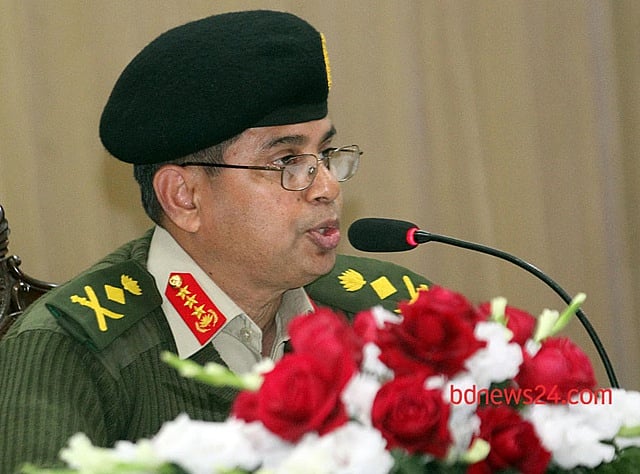
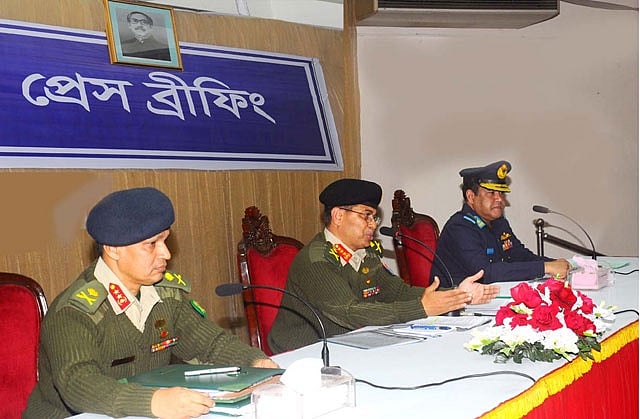
The Inter Service Public Relations orgainsed the briefing, first of its kind in Bangladesh, to what officials say quench media as well as public curiosity about the agreement which was ‘transparent but we cannot make every details due to confidentiality’.
Dhaka and Moscow signed a $1-billion defence deal on Jan 15 during Prime Minister Sheikh Hasina’s maiden official visit under which Bangladesh would procure military equipment and arms from Russia.
The signing triggered media outcry during the premier’s visit when a nuclear power agreement was also signed with the world’s second-largest weapon exporter.
Principal Staff Officer of Armed Forces Division Lt Gen Abu Belal Mohammad Shafiul Haque at the briefing said the annual interest rate of the loan would be 4.5 percent and the repayment would start from Apr 15, 2018 and end in 10 years in 20 phases.
He said between 2013 and 2017, they would buy all their necessary equipment including anti-tank missiles, armoured personnel carriers and pontoon bridges for the military, and combat-equipped trainer aircraft, helicopter and various others equipment for the air force.
He said the repayment would be made from their annual budget and money they receive as reimbursement for participation in the UN peace keeping mission.
The defence allocation in 2012-2013 was 6.77 percent of the total Bangladesh’s budget, while the armed forces earn $250 million as reimbursement from the UN every year.
He said they would repay directly to the Russian government through bank. “There is no middle man in between, so there is no question of commissioning,” he said replying to a question.
“We took loan even at more than 4.5 percent interest rate from many other countries for buying equipment,” he said without divulging the name of those countries for ‘confidentiality’ reasons.
He said Bangladesh’s laws and policies had been considered, and ‘transparency’ had been maintained, but “we cannot disclose all due to sensitivity, confidentiality and security.”
He said they called the press briefing to reply as many questions as the media would ask them.
“Prime Minister has endorsed the briefing as she advised us to reply all your questions,” he said. The briefing continued for nearly 90 minutes.
As questions have been raised from different quarters about the agreement with the Russia in the last year of the government, the Principal Staff Officer said the negotiation continued in the last few years and the agreement was signed ‘based on our requirement.’
He said the latest agreement was based on the agreement signed in 1999 under which sharing of experience and training between two countries defence forces had been stressed upon.
He said Bangladesh had inked similar agreements with other ‘friendly’ countries for buying military equipment considering geo-political and strategic reasons in the interest of the country.
He said as part of the continuous process, the current government in its four years bought 4th generation tank MBT 2000, fighter planes and war ships from ‘friendly’ China. “Process is still on to buy more.”
He, however, did not reveal the total amount of those purchases, but said they did not take any loan. “We have negotiated so that we can pay the amount in seven years,” he said.
He said Bangladesh military should be upgraded to keep ready a ‘mechanised force’ under the Standby Arrangement System for the UN peace keeping missions.
Besides, he said, “We have to maintain security of our Exclusive Economic Zone achieved after resolving the sea boundary dispute with Myanmar.”
In response to a query, he said, Bangladesh bought military arms and equipment from China, Russia, US and Ukraine.
Assistant Air Chief Air Vice Marshall Abu Esrar, who was also present at the briefing, said they strongly felt the need for more helicopters.
“We cannot deploy helicopters in the mission, though there is need,” he said and that “six helicopters are deployed in Congo right now”.
He said they were maintaining Russian equipment ‘satisfactorily’.
Maj Gen Abul Matin, Master General of Ordinance, said he had been in the committee, on behalf of the armed forces, formed before the defence deal with Russia.
“We cannot provide in the mission what is really needed. Many of our equipment become outdated,” he said citing UN Under Secretary-General Ameera Haq’s recent visit when she explained the changing trend of peace keeping mission which was more focused on civilian protections now than before.
Explaining the relationship between Bangladesh and Russia, the officers say it is based on the relations during the 1971 liberation war.
“Due to the then Soviet Union’s cooperation, we could open the Chittagong port by freeing water mines and other war scrapes soon after the liberation.”
Bangladesh has previously bought M-I 8 helicopters, Mig-29 planes and M-I 171 helicopters from Russia.
The then Soviet Union had gifted eight MiG-21 fighter aircraft in 1972 to war-ravaged Bangladesh that kicked off the military-to-military ties between the two countries.











