


Published : 28 Jul 2016, 01:54 PM
Updated : 19 Oct 2022, 05:23 PM


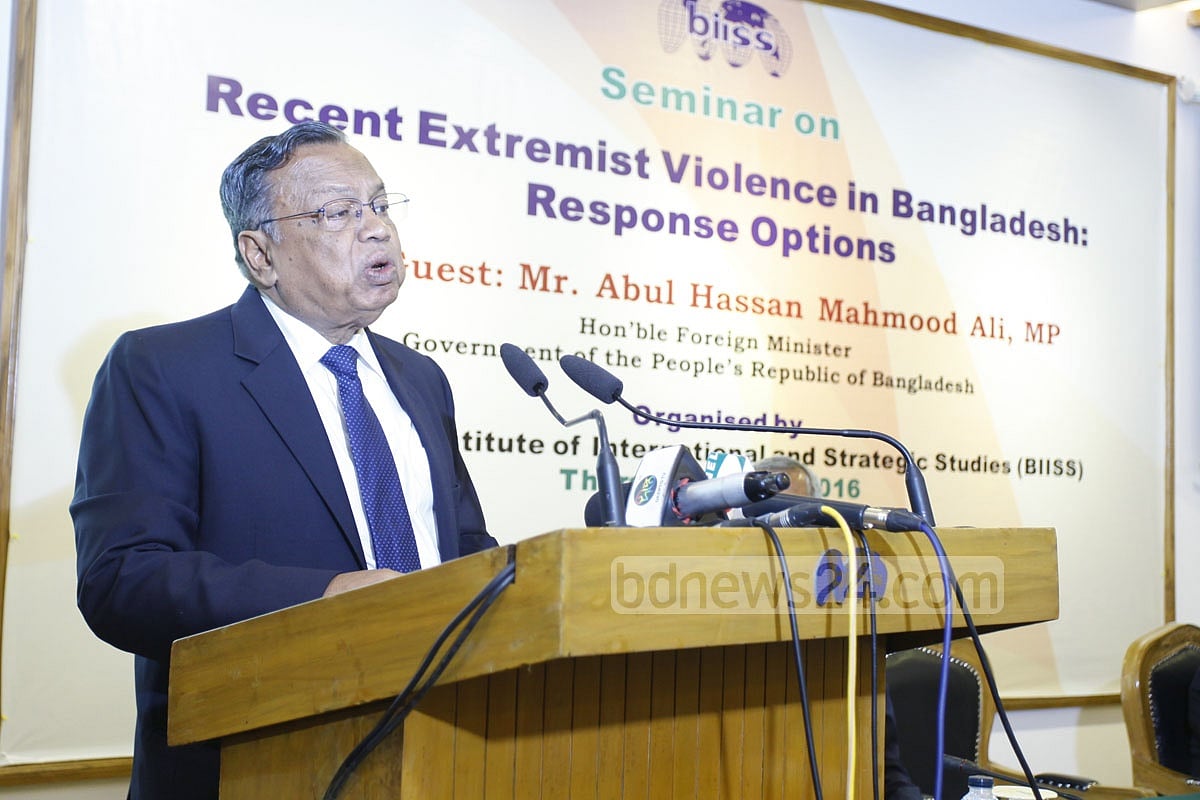
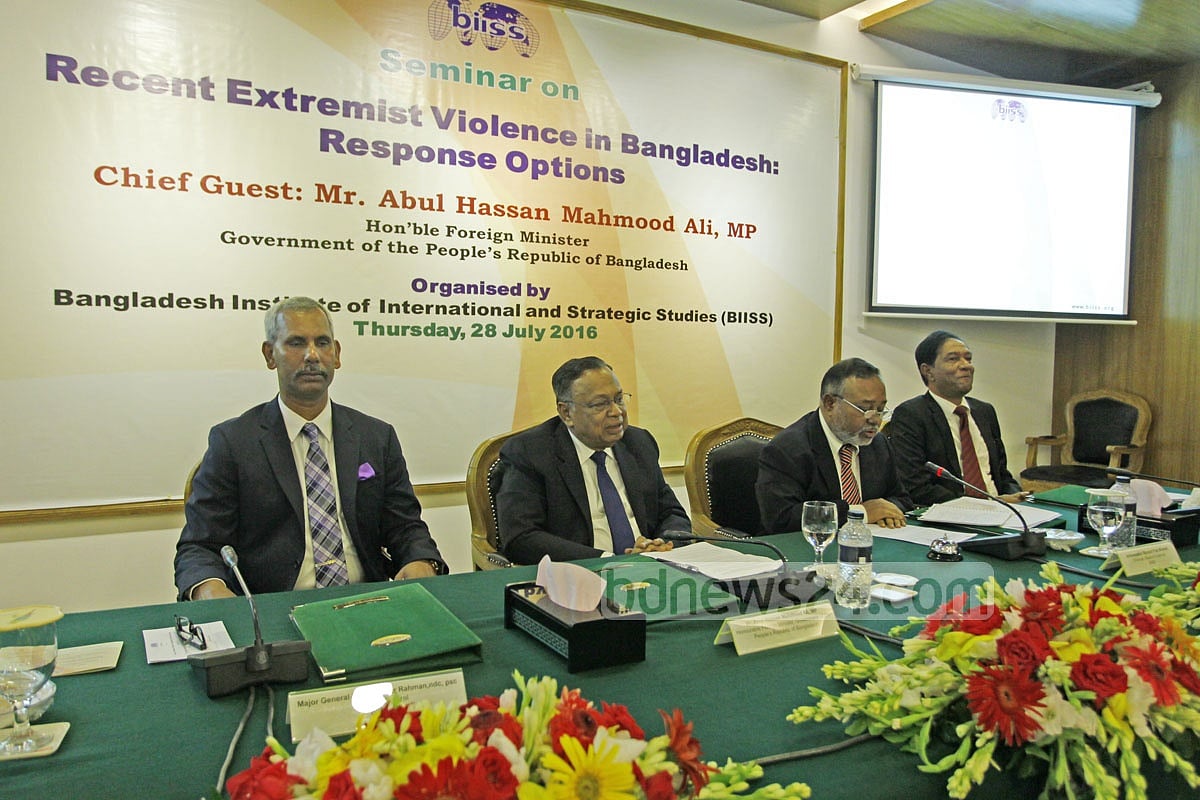
“They are also verifying, if the extremists are receiving any guidance from the international terrorist groups,” Abul Hassan Mahmood Ali said on Thursday at a seminar.
He said the government was also focused on ‘long term’ measures to prevent radicalisation of the youth.
“We are also working closely with our civil society, religious leaders, and private sector for advocacy against violent extremists,” he said, adding that a social movement against extremism had already been generated in Bangladesh.
“People from all sections are coming together,” he said.
The foreign ministry’s think-tank Bangladesh Institute of International and Strategic Studies (BIISS) organised the seminar on ‘Recent extremist violence in Bangladesh: Response options’.
Diplomats, government officials, including police, academia and journalists attended the seminar in which the speakers looked at the different aspects of extremist violence from the religious point of view to the psychological motivation of the youths to join the radical forces.
Director General of BIISS Major General Abdur Rahman said they organised this seminar in the backdrop of the recent terrorists attack at Gushan and Sholakia.
Bangladesh witnessed an unprecedented attack on July 1, in which 17 foreigners were killed in a Gulshan diplomatic zone cafe.
Before that, in the last two years, Bangladesh also witnessed a series of attacks targeting secular forces including writers, online activists, publishers, foreigners and religious minorities.
Police also busted a militants’ hideout in Dhaka’s Kallayanpur on Tuesday when nine suspects were killed in a gunfight.
Middle East-based group the Islamic State reported claimed many of the recent attacks in Bangladesh.
Md Abdur Rashid, a retired major general, said the nature and trend of those attacks were ‘often misinterpreted’.
Rashid, Executive Director of the Institute of Conflict, Law and Development Studies (ICLDS), said they were ‘home-grown’ terrorists with ‘domestic political agenda’ and patronised by political parties.
He indicated BNP and Jamaat-e-Islami’s patronage of Islamist radicals and added that they were never targeted in any militant attacks since 1992.
The foreign minister also said, from the recent attacks, it was “clear that certain vested quarters are trying to destabilise the country and stop its growth.”
“They want to create a sense of fear and insecurity among our people. They also want to tarnish the image of Bangladesh and discredit the government both at home and abroad.
“These vested groups do not like the secular values that the government is promoting. Unfortunately, to achieve this agenda, religion is being used as a tool and means,” he said.
He also mentioned the government’s response and said security measures have been strengthened all over the country to prevent recurrence.
“The security forces remain on high alert. The government is determined to break the nexus of terrorism, extremism, and radicalisation and eliminate them all from Bangladesh.”
He said apart from domestic efforts, the government was also working closely with other countries, regional organisations and the UN to fight this menace.
“We have joined the Global Community Resilience and Engagement Fund (GCERF) as a founding member,” he said.
GCERF is a public-private partnership, which was established to serve as a global effort to support local, community-level initiatives to strengthen resilience against terrorism and violent extremism.
Bangladesh has volunteered to be a Pilot Beneficiary country of its projects.
Recently, GCERF has signed grant agreements with some Bangladeshi NGOs, which are going to implement projects in designated areas of the country.













