


Published : 07 Sep 2014, 10:46 AM
Updated : 19 Oct 2022, 07:38 PM


Also Read:
Bangladesh, Japan embark on visa-free regimeAlso Read:
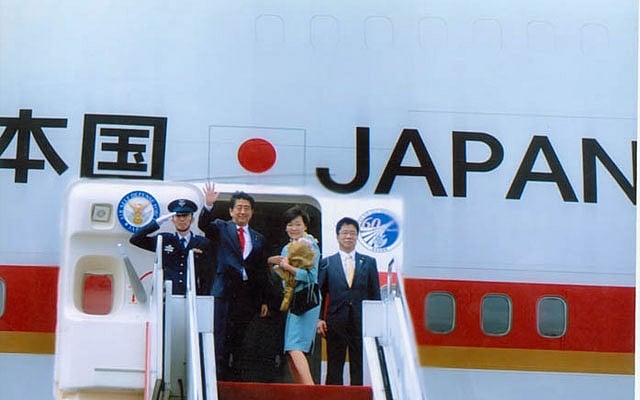
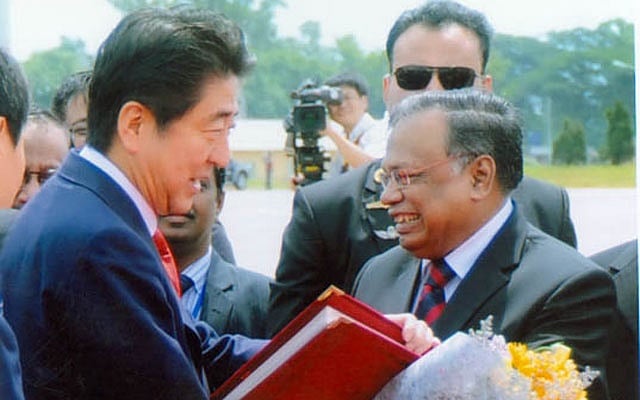
Partnership to move ahead: HasinaForeign Minister Abul Hassan Mahmood Ali saw him off at Hazrat Shahjalal International Airport on Sunday morning when his special flight left at about 10.30am.
This was the first visit by a Japanese premiere to Bangladesh in 14 years.
Abe termed it a “special year” for Dhaka-Tokyo ties as he said both sides have entered “a new level of cooperation”.
His counterpart Sheikh Hasina did Japan a great turn by announcing the withdrawal of Bangladesh’s candidature for the non-permanent seat on the UN Security Council in favour of Japan.
Abe promised to promote trade and investment in Bangladesh. His 150-member delegation included 22 CEOs of top Japanese companies.
He also reiterated his earlier promise to provide about $ 6 billion official assistance to Bangladesh in the next four to five years for infrastructure development.
Both leaders signed a 10-page joint statement that touched upon a whole area of future cooperation between the two “tested friends”.
Both sides also embarked on a visa-free regime beginning with the diplomatic passport holders.
Hasina said the relationship would move ahead based on the “comprehensive partnership” that they launched in May when she visited in Tokyo.
Japan has a grand design to pursue its economic outreach by combining the Pacific Ocean and Indian Ocean for more geo-political space. It calls the initiative “BIG-B” or Bay of Bengal Industrial Growth Belt Initiative.
The largest Bay in the world, Bay of Bengal forms the north-eastern part of the Indian Ocean. Bangladesh is located in the north of this Bay.
Sri Lanka, where his visit will be the first by any Japanese PM in 24 years, is to the west of the Bay.
Abe mentioned three dimensions of the BIG-B concept, mainly infrastructure development and connectivity.
He said Bangladesh was “very important” for its location between South East Asia and India.
He said the country was also important for implementing his “Abenomics”, a much-talked-about economic policy he has adopted to boost the staggering Japanese economy.
“To me Bangladesh is very important to enhance trade and investment of Japan because I am leading Japanese economic growth”.
“That’s why I chose Bangladesh for my visit today,” he said on Saturday in his lecture before the business leaders of both sides.
Abe said both countries entered “a new level of cooperation” which was reflected in the frequent high-level visits.
He sought business leaders’ support for the mutual growth of the two countries like “brothers and sisters”.
He also mentioned the “comprehensive partnership” both leaders launched in May, and said businessmen of both sides were “very important players” to achieve the partnership.
Pointing at the flags of both the countries, he said, “we are going to help each other like sisters and brothers and we are aiming to grow mutually together.”
He expressed his deep gratitude to the people of Bangladesh when Hasina announced withdrawing from elections to the UN Security Council's non-permanent seat for the “long-tested” friend.
Abe termed it as a “watershed” in the history of Bangladesh-Japan friendship.
Japan was the first country that recognised Bangladesh soon after the independence and is the largest aid donor.
Both leaders also lauded each other for their role in peace and security issues as well as for their countries socio-economic development.
Before leaving Dhaka, Abe visited the Institute of Fine Arts at Dhaka University on Sunday morning to see paintings of artists who once visited Japan in exchange programmes.
During his stay he also met with the leader of the opposition Raushan Ershad and BNP Chairperson Khaleda Zia.
His wife Akie Abe visited a missionary school and Dhaka Nursing College and pitched for exchange programmes between nurses of both countries.











