Published : 12 Aug 2023, 03:21 AM
Updated : 12 Aug 2023, 04:57 AM


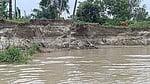
More than two dozen villages along the Jadukata River in Sunamganj’s Tahirpur are at the risk of losing their land and homes to illegal sand collection.
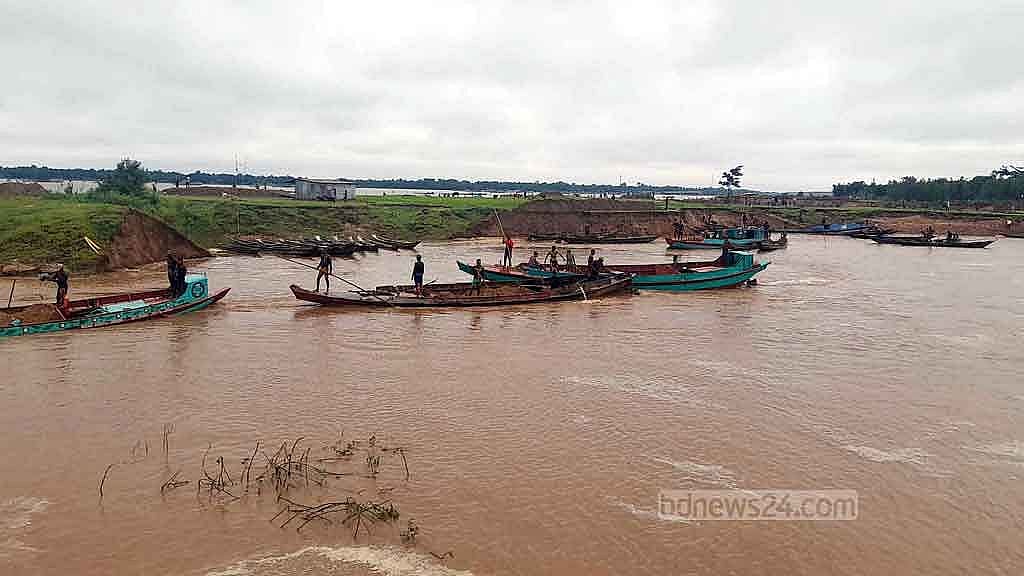
Lessees use unauthorised dredgers, while individuals even dig the banks of the river, villagers said.
They alleged politically influential people back the perpetrators, who on several occasions attacked, threatened or harassed villagers by filing cases against them.
“We’re helpless against the sand-eaters. The river was one kilometre wide but now it is 3 kilometres just because they dug up the banks,” said Rafiqul Islam Uddin, a resident of Binnakuli village.
The government has leased out a 500-acre area to two firms for sand collection from the middle of the river only, not the banks, at Tk 686.5 million.
The companies – Shohag Enterprise, owned by Ratan Mia, and Khandaker Manzur Ahmed's company Araf Trade Corporation Ltd – are supposed to use traditional equipment like manual digging, buckets, or shovels for the sand collection.
But instead, they use dredgers, impacting the flora and fauna and preventing the natural flow of the river posing a greater threat to the entire area, according to environmentalists.
Locals protested against the excavation of stones and pebbles while the authorities leased out the area to excavate sand only.
Sometimes, mobile courts of the Upazila administration visit the sites and fine the lessees or seize their equipment.
But most people call it a “show off”.
“The Jadukata River is simply being destroyed in the name of lease. If we don’t stop digging out the riverbanks, at least 20 villages will be eliminated,” said Tahirpur Upazila Parishad Chairman Karuna Sindhu Chowdhury.
“Many people in these villages lost their homes. If this [sand digging] continues, the entire region including Tahirpur Upazila will be affected. It is damaging the environment.”
Some locals and public representatives blamed Sunamganj-1 MP Moazzem Hossain Ratan, a member of the ruling party Awami League, for the indiscriminate digging of sand pits.
He, however, denied the allegations, saying a quarter had been running a "false propaganda" against him with the election nearing.
The Jadukata River originates in the Khashia hill area of the Indian state of Meghalaya.
It enters Bangladesh through the northeast end of Tahirpur Upazila.
Filled with natural beauty, the river also possesses huge water resources.
Sand, pebbles and stones are carried by the strong current from Meghalaya and accumulate in the riverbed.
The local administration has been leasing out the two sites for excavation of sand and stones since the 1980s.
The government, however, banned stone excavation in 2009 as it was quite damaging for the environment.
WHY THE RIVERBANKS BECAME TARGET?
According to the rules, sand must be excavated from the middle of the river or the flowing part of it.
The riverbanks cannot be damaged under any circumstances and any equipment that damages the environment cannot be used.
But it requires more time to excavate sand from the middle of the river manually as the water is very deep there, said Saharul Islam, a resident of the Ghagtia Adarsha village.
“The demand for the sand collected from the riverbed in the middle is low. Hence, the collectors start to dig out the banks when the water level goes up," he said.
The sand collectors dug a canal at one side of the Ghagtia Adarsha village and used it to row tiny boats and collect sand and stones after excavating the banks, he said.
"We're very much worried about our homes. The 100 families living in this village may get engulfed by the river at any time."
Any villager protesting against sand excavation faces consequences, including a ban on working in the river despite it being a major source of their income.
On Monday, hundreds of small boats were seen in Ghagtia Adarsha village used for digging the riverbank.
Due to the excavation of sand and stones, the river lost its banks and neared many houses already.
Workers were digging up sand from the riverbanks at Shimulbagan, a popular tourist destination.
Locals said digging is also on in other villages, including Lauergarh, Ghagtia, Borotek, Adarshagram, Garkathi, Ghagra, Rajargaon, Sohala, Pathanpara, Kunatchhara, Modergaon, Maharam, Manigaon, Binnakuli, Miarchar, Pirijipur, Dakkhinkul, Anwarpur, Noahat, Patari, Tiorjalal, Balijuri, Mahmudpur, and Barunka.
The river already engulfed a vast cattle grazing ground, a graveyard in Lauergarh, Noahat Government High School, the monastery of Adaita Maha Prabhu, and marketplaces in Anwarpur and Binnakuli.
Among the seven unions of the Upazila, people living in the Uttar Borodol, Badaghat, and Balijuri unions are affected the most.
30,000-40,000 CUBIC FEET STONES COLLECTED PER DAY
The sand traders based on the Jadukata River shared that earlier the workers used to excavate sand from the river using traditional equipment like shovels and buckets and small boats.
But a certain group of traders started using dredgers to make a larger profit.
They take a lease for a sand pit but excavate 30,000 to 40,000 cubic feet of stones per day defying the conditions in the lease.
The dredger menace halts for a few days when the villagers protest.
“Excavating stone is not permitted but they are doing it. The government is losing a huge amount of revenue here,” said Badaghat Union Parishad Chairman Md Nizam Uddin.
Workers said three types of stones were collected from the river. The first type, which they call ‘single’ , is a little bit larger than sand grains. The others are pebbles and boulders. The boulders are locally called ‘Bhutu Pathor’ and are mostly used for construction works, they said.
PROTESTS AND CONSEQUENCES
Razia Begum, 50, living in Adarsha village, protested against sand excavation from the Jadukata River.
UP Member Mashayid Alam aka Ranu Mia and his associates beat her severely.
At one point, they stabbed her.
Razia received treatment at the Tahirpur Upazila Health Complex.
Later, she filed a case naming three suspects including Ranu Mia.
Safar Ali, 65, was attacked on Monday when he prevented some people from digging out the riverbank near his house. “They beat me and pushed me down. I got my leg injured,” he said.
Another resident of the same village, Akkas Mia, 41, said they asked the traders not to dig out the riverbank but the digging went on for three months.
“When my wife stopped them, they stabbed her. They always attack us with sharp weapons or drag our sons out of the house tying them with ropes. They don’t listen to anyone. We already filed a case against them.”
Earlier in 2021, local journalist Kamal Hossain was tortured when he went to collect news about the illegal excavation of sand and stones.
“They tied me to a tree and beat me severely. Later, the police and locals rescued me and sent me to hospital,” he said.
ALLEGATIONS AND DENIALS
Locals in Karimpur village said Manzur Ahmed, one of the two lessees, runs the entire trade, while the other, Ratan Mia lives in Dhaka.
UP Member Ranu is the kingpin of the gang that digs off the riverbanks, they said.
Some influential families in the village are involved with him.
Ranu, however, left the village after he was named in some cases.
“Our representative in parliament is behind this business. Some local leaders and lease-holders are his associates,” said UP Chairman Nizam.
Many of the victims said the sand traders are linked to the ruling party and they were quite influential.
When asked, Sunamganj-1 MP Moazzem said his opponents were trying to frame him ahead of the election.
“Do you think I would do something that would damage my goodwill before the election? My opponents are paying different media houses to demean me,” he said.
The MP said he did not even know the people digging the riverbanks.
The current lessees were never involved in digging the riverbanks, said Manzur.
“We caught three or four boats and handed them to the police. Those belonged to the former lessees,” he said.
The lessees gave directives to the workers not to cross the demarcations while digging, he said.
“Police should monitor those who are digging outside the demarcation. That’s not our duty.”
Badaghat UP member Ranu said he had no connection to riverbank digging.
RAIDS AND CASES
Police said a mobile court fined four individuals Tk 400,000 in total for illegal sand excavation. Also, four boats were seized.
In another raid, authorities imposed Tk 200,000 fines on offenders, said Tahirpur UNO Suprobhat.
On Jul 16, Tahirpur Upazila Assistant Commissioner (Land) Asaduzzaman Rony handed seven-day jail terms and Tk 100,000 fines to five offenders. Also, police arrested 42 people for excavating sand illegally.
PROTEST BY VILLAGERS
Residents of 20 nearby villages called for a strong protest movement to save their homes from the riverbank digging and dredging menace.
They organised a rally on Jul 12 and called for steps to stop the sand traders. Another rally was held on Jul 17 at Badaghat Union where reserved seat MP Shamima Akter Khanam expressed her solidarity with the protesters.
“Women from these villages call me over the phone late at night and urge me to save their homes from the dreadful dredgers. Today I witnessed their plight,” she said.
Leaders from the Bangladesh Poribesh Bachao Andolan, Bangladesh Environmental Lawyers Association, and Bangladesh Poribesh Andolan also joined the protests on Aug 4.
The environmentalists said riverbank-digging was posing a great threat to the environment and ecosystem damaging the flora and fauna in the area.
“This is wrong and can’t be accepted,” said Abu Naser, chairman of Bangladesh Poribesh Bachao Andolan.
[Writing in English by Sabrina Karim Murshed; editing by Osham-ul-Sufian Talukder]