Published : 17 Dec 2024, 08:56 AM
Updated : 28 Aug 2026, 01:15 AM


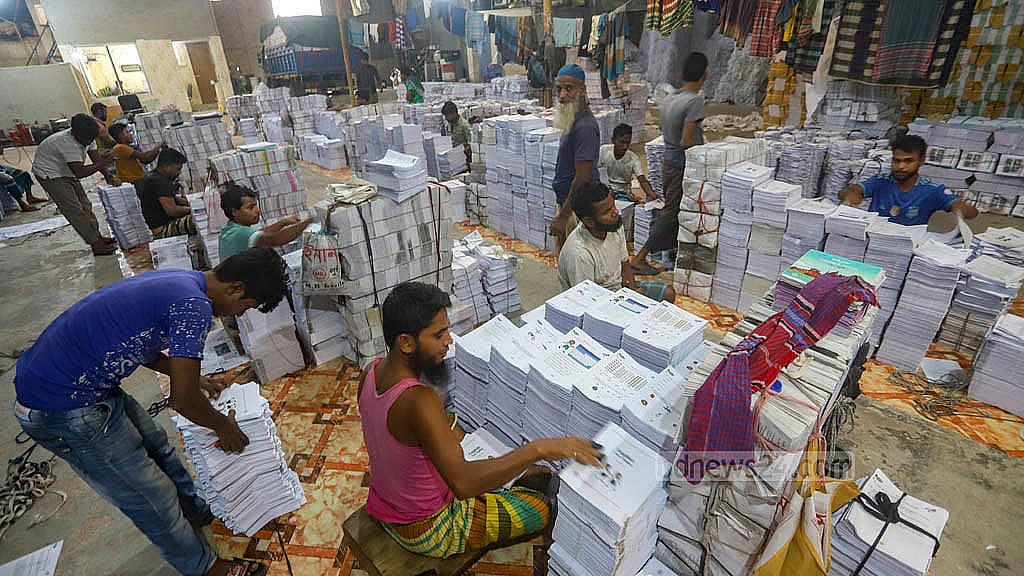
The National Curriculum and Textbook Board, or NCTB, responsible for supervising textbook printing, has backtracked on its earlier commitment to distribute all books to students at the beginning of the next academic year.
The board now says that distributing all 401.6 million textbooks to secondary students will only be possible by late January.
However, printing house officials offer a different perspective, indicating that it will be challenging to ensure all textbooks reach students before February.
They attribute the delays to issues such as curriculum changes, late manuscript submissions, and logistical hurdles.
This setback disrupts the long-standing practice of ensuring new textbooks are in students' hands by the first month of the academic year.
Revised manuscripts reached printing presses five months late this year.
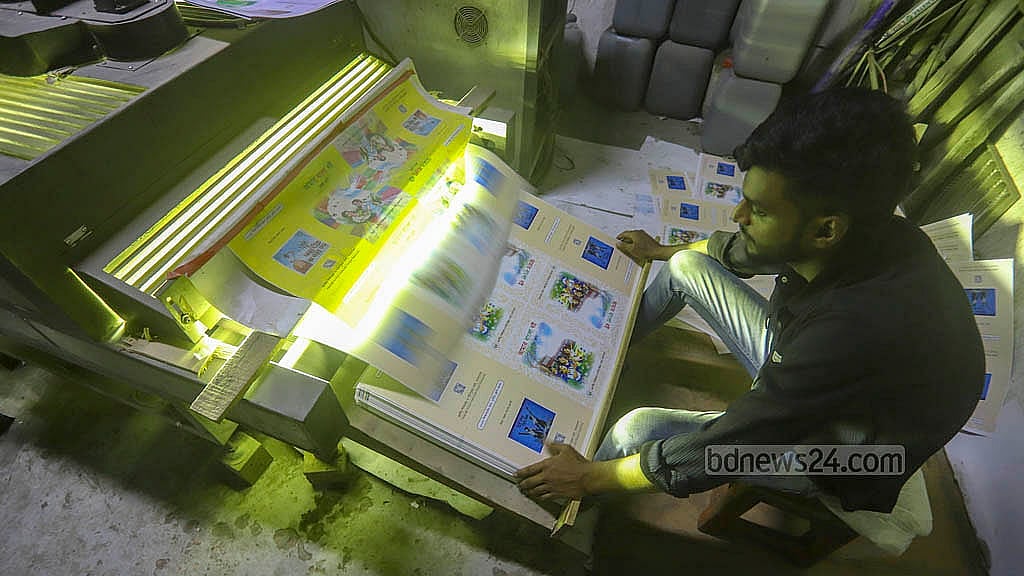
Visits to several presses in Dhaka have revealed that while the printing of primary textbooks is under way, the work for secondary textbooks has not even started.
NCTB Chairman AKM Riazul Hasan also admitted that delivering all books to students at the start of the year will not be possible.
“While there will be some delay in distribution, it will not extend to February. We hope to deliver all books to students by the 20th of January,” he told bdnews24.com
The shift in schedule follows a decision made on the first day of September to cancel the new curriculum and revert to the 2012 nation curriculum.
The NCTB had originally planned to print books based on the 2012 curriculum and distribute them by the start of January.
Generally, manuscripts for new books are sent to the printing presses in June.
The interim government declared that the “experience-based curriculum”, which was introduced by the ousted Awami League government in 2023, was unfeasible.
As a result, textbooks based on the 2012 curriculum, which had been designed a decade ago, began to be sent to the press in November after being revised.
In previous years, a portion of the textbooks was printed in India.
However, following the fall of the Sheikh Hasina regime on Aug 5, only domestic institutions are now handling the printing of books.
Some printing press owners said that delays in receiving approval from the overseeing authority had prevented the timely start of secondary textbook printing.
In addition, issues like paper shortages, power outages, and difficulties securing bank loans have further delayed progress.
Printing Industry Association Bangladesh, or PIAB, Vice President Anwar Hossain told bdnews24.com, “We have not yet received approval from the regulatory authority to print the secondary textbooks."
He continued, "The work is difficult because there is no power during the day. We only get the chance to work at night. We rely on bank loans, but this time, getting loans has been a struggle.”
“On top of that, there is a paper shortage. All printing presses are trying to start secondary textbook printing at once, leading to a paper shortage."
When asked about the expected completion date for the textbooks, Anwar said: “Theoretically, it can be said that the work will be completed in January, but in reality, it is difficult. It will take January to complete the work on all the books. So it does not seem possible to reach all the books to the students before February.”
He also confirmed that the NCTB had prioritised the printing of three textbooks first.
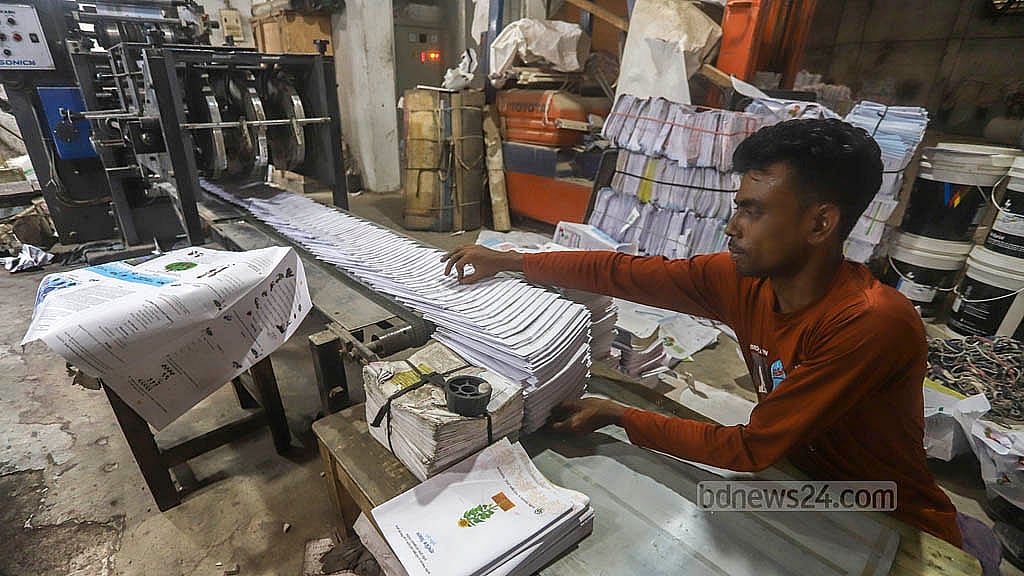
"We were instructed to finish the Bangla, English, and Mathematics books for the secondary level first. We will complete the work on those books first and send them," said Anwar.
Sheikh Siraj Uddin, managing director of a printing press named Letter n Colour Limited, said primary textbooks are being printed, but secondary textbooks have not even been started due to delays in receiving approval from the regulatory authority.
“The paper shortage is a problem. The NCTB specifies a particular quality of paper, and it’s been difficult to source it. If the quality does not meet the standard, the books will be rejected," he added.
When asked about when printing would be completed, Siraj said: “All work will likely be completed by February. It won’t be possible to finish before then.”
A third-party monitoring institution works with the NCTB and printing presses to ensure the quality of textbooks.
The NCTB has appointed two organisations to check the paper and other materials used for printing primary and secondary textbooks to ensure they meet quality standards.
Once the approval from these institutions is received, the printing presses can begin their work.
This year, the NCTB has assigned the task of overseeing the printing of secondary textbooks to an organisation called Bureau Veritas.
For primary textbooks, the responsibility has been given to a company named Phoenix.
NCTB chief said, “The monitoring organisation for secondary textbooks has already been appointed. Bureau Veritas has been given this responsibility. The presses will be allowed to print the secondary textbooks once they receive approval.”
He added, “The organisation Phoenix, responsible for overseeing the quality of primary textbooks, has completed the approval process and is currently conducting pre-delivery inspections.”
When asked about when the paper and other materials for printing would receive approval, Md Afzal Kabir Bhuiyan, deputy manager of Bureau Veritas said: “We signed the contract with the NCTB on Sunday.”
“Since Monday is a holiday for Victory Day, the paper will arrive on Tuesday. After that, we can begin the approval process,” he added.
NATIONAL ANTHEM MOVED TO END OF BOOK
A printing press in Dhaka allowed a glimpse of primary-level textbooks for the upcoming academic year.
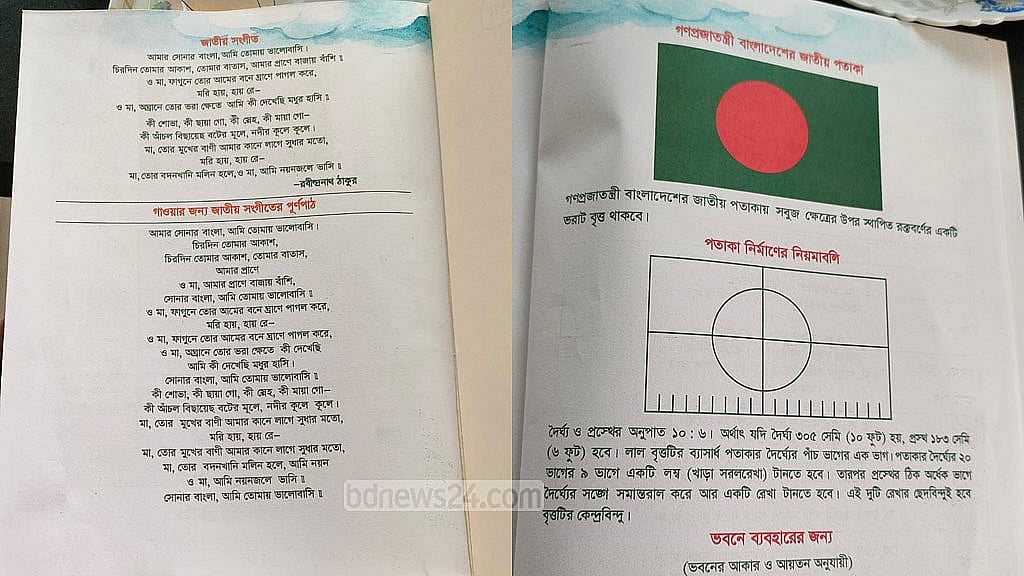
In this year’s first-grade "Amar Bangla" book, the rules for creating the national flag and the national anthem were included on the first page, right after the cover.
However, in next year’s edition, they have been moved to the last page, just before the back cover.
Press officials explained that the initial manuscript revisions did not include the national anthem or flag guidelines.
These were added later but placed at the end due to pagination adjustments during the printing process.
NCTB Chairman Riazul said those involved in the book revisions would be able to comment on this matter.
Rakhal Raha, an educational researcher responsible for the textbook revisions, said: “We wanted to start the children’s books with relevant topics.”
“The Textbook Revision Committee believed there would be no harm in placing the national flag guidelines and anthem at the end, which led to this decision,” he added.
However, Dhaka University Professor Emeritus Sirajul Islam Chowdhury criticised the change.
"There is no obligation to include these topics in the textbook. However, since they were initially placed at the start, it would have been better to keep them there rather than moving them to the end," he said.
HASINA’S PHOTO REMOVED
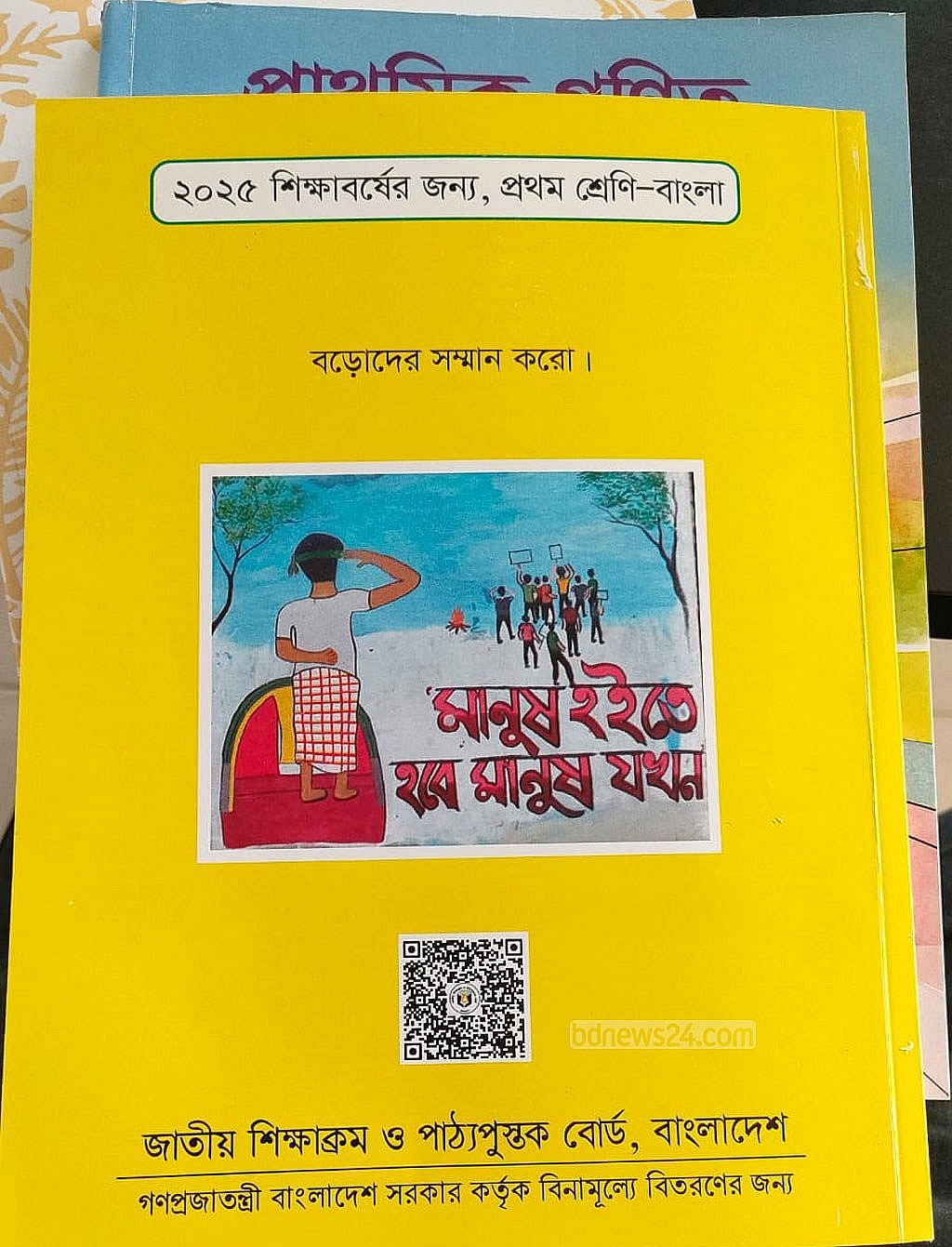
In the first-grader’s "Amar Bangla" book, the photo of former prime minister Hasina, which was previously placed on the back cover, has been removed in the edition prepared for next year.
Instead, a graffiti related to the July-August mass uprising has been included.
In addition, the moral phrase "Respect Elders" on the last page has been slightly altered.
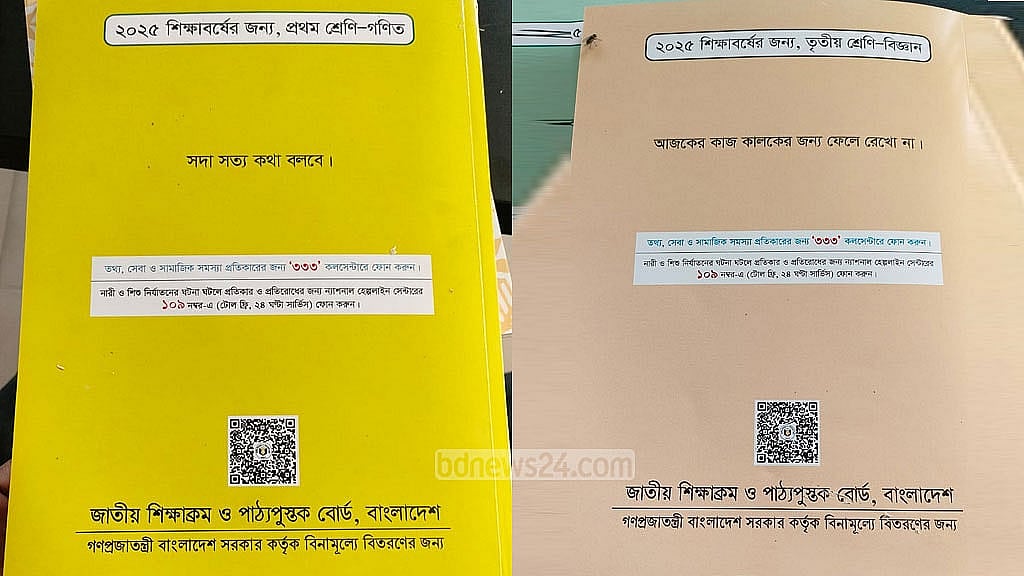
The photo of the Awami League chief Hasina with children has also been removed from the back cover of next year’s third-grade mathematics book.
Instead of "Respect Elders," the new edition will feature the phrase "If you want to be great, be humble first."
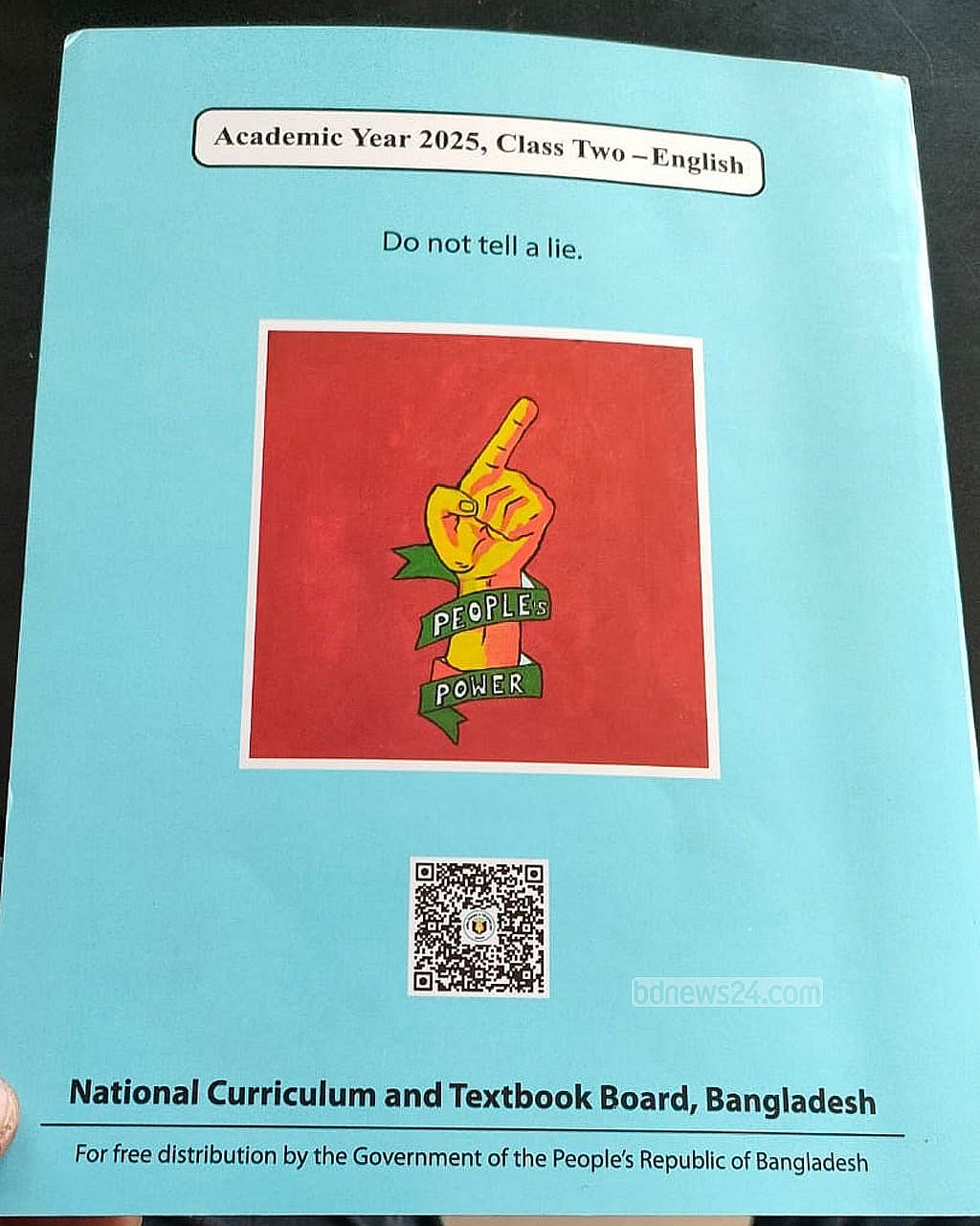
In the second-grade English book, Hasina’s picture from a book distribution event has been replaced with another graffiti from the July uprising, which reads "People's power”.
Furthermore, the photo of Hasina with children has been removed from the back cover of the third-grade science book, with no image replacing it.
Instead, the new edition features the phrase "Do not leave today’s work for tomorrow”.
The back cover of the first-grade mathematics book also no longer carries the photo of the ousted prime minister.
The new edition features no images but includes the moral saying "Always speak the truth”.
CHANGES IN SECONDARY TEXTBOOKS
The NCTB chairman had previously informed bdnews24.com that the message of Hasina from the back cover of secondary textbooks would be removed, and graffiti related to the student-led mass uprising would be included instead.
Riazul said the textbooks for next year will include content on the July-August uprising and the heroic tales of the martyrs of that time.
He highlighted that eight content pieces related to the mass uprising and the martyrs' bravery will be added to the Bangla and English books for the 5th, 6th, 7th, 8th, and 9th-10th grades.
The history of the Liberation War and the struggle for independence will also be included in the textbooks.
The chairman explained that the contributions of key figures such as Sheikh Mujibur Rahman, who declared the six-point movement and received the title "Bangabandhu" after the 1969 East Pakistan mass uprising, will be featured in the curriculum.
Other figures such as Maulana Abdul Hamid Khan Bhasani, Tajuddin Ahmad, Syed Nazrul Islam, General Ataul Gani Osmani, and Ziaur Rahman will also be highlighted.
In addition, the history of significant leaders like Sher-e-Bangla AK Fazlul Haq and Huseyn Shaheed Suhrawardy will be part of next year's curriculum.
Earlier this year, there was controversy surrounding a story titled "Sharifar's Story" in the seventh-grade history and social science book, which sparked significant debate.
However, the NCTB assured that the new textbooks will not include any content that could harm the feelings of any group or community.
There was also opposition to the inclusion of the theory of evolution in the curriculum.
The NCTB chief confirmed that no controversial topics, including the theory of evolution, will be present in next year’s textbooks.
[Writing in English by Sheikh Fariha Bristy]