Published : 13 Jan 2025, 09:43 AM
Updated : 28 Aug 2026, 01:15 AM


In just three days, the stage will be set for the Electoral Reform Commission to unveil its much-anticipated report, a tapestry of bold proposals poised to reshape the parliamentary landscape.
There are indications that the report will include several recommendations, such as increasing the number of parliamentary seats, invalidating elections without minimum voter turnout, a strategic shift to place national identity card services firmly under the purview of the Election Commission, the ambitious blueprint for a bicameral parliament, and the pioneering introduction of a proportional representation system.
Commission members have crafted these recommendations as a roadmap to be rolled out in phases—short, medium, and long term—each tailored to usher in a new era of electoral integrity and inclusiveness.
However, observers believe that the majority of such sweeping reforms may not be feasible for the interim government to implement.
Some of the recommendations could potentially be enacted through executive orders.
Amidst this complex reform matrix, analysts stress that the lynchpin will undoubtedly be the cooperation among the political factions.
Following its formation, the Muhammad Yunus-led government has set up a series of reform commissions.
The Electoral Reform Commission was formed on Oct 3, 2024, with Badiul Alam Majumdar, the general secretary of Sushashoner Jonno Nagorik, or SUJAN, at the helm.
The commission has finalised preparations to submit its findings to the government.
Badiul said the report will be presented to the chief advisor on Jan 15.
POTENTIAL RECOMMENDATIONS
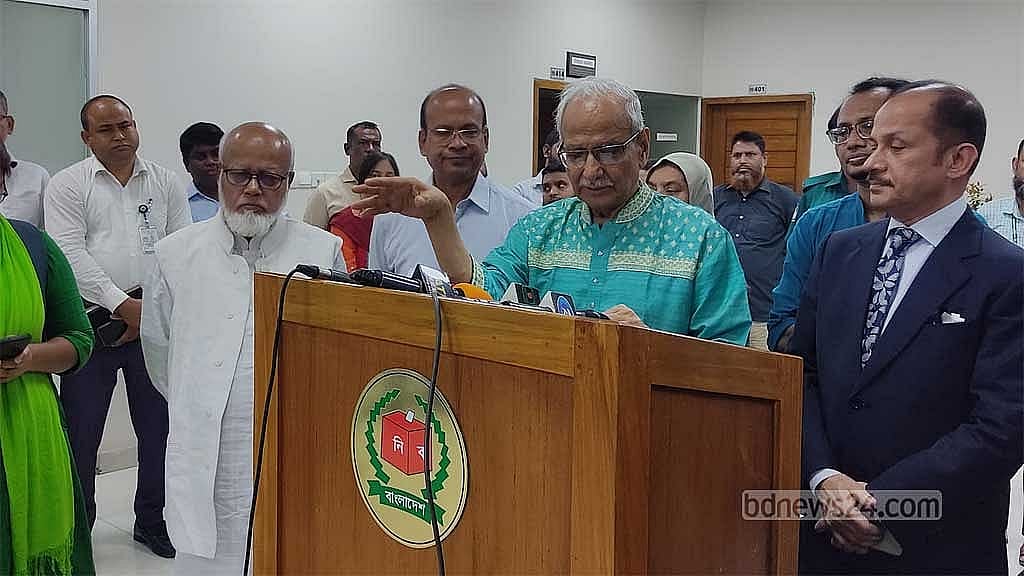
Abdul Alim, a member of the Electoral Reform Commission, said the commission has held over 50 meetings.
At least 25 meetings with stakeholders, along with divisional consultations in Chattogram, Rajshahi, Khulna, Rangpur, and Sylhet, were held.
Opinions were gathered via the website, social media, direct interactions, and mail.
In addition, a public opinion survey on electoral reform was conducted.
"After submitting the report, the government will review the matter. Our role is to make recommendations," Alim said.
According to him, the report is likely to include recommendations for clear changes in both the law and the electoral code of conduct, with a focus on stricter oversight.
It will contain at least a dozen chapters.
Alim said, “The verdicts from the court are opening up the possibility of restoring the caretaker government and referendums.
“We are also considering recommending the introduction of a proportional representation system alongside the existing electoral process.
“The idea of a bicameral parliament is also under consideration."
He clarified that there will be no recommendation for multi-day parliamentary elections.
"We have not included this in our suggestions. In the current context of the country, where would we place the ballot boxes?
“There is also an issue of trust."
The overall electoral reforms would necessitate amendments to both the Constitution and electoral laws.
Alim said, "We have spoken with them [Constitutional Reform Commission]. We had formal discussions and presented the issues regarding constitutional amendments."
“We’ve suggested removing certain clauses, such as Article 48(3) of the Constitution, which calls for consultation between the president and prime minister on the appointment of the Election Commission.”
He explained that, under the proposed reforms, the Election Commission will have full control over the electoral administration.
“This will ensure that elections are conducted on an institutional basis.”
The Electoral Reform Commission will also propose a draft law for the appointment of the chief election commissioner and other commissioners.
Alim said, “We have prepared a draft law. For example, public participation must be included in the political settlement process.
"There must be opportunities for qualified people to join the process.
“The current law lacks this, which is why we are addressing all these aspects in our draft.”
He said the commission is considering recommendations to increase the number of seats in parliament and introduce direct elections for women.
The report will also include suggestions on how and to what extent expatriate Bangladeshis' voting rights can be implemented.
In parliamentary elections, there have been instances where single candidates won uncontested in 153 constituencies.
A similar trend has been observed in many local government elections.

In one election, voter turnout reached 87 percent across 300 constituencies.
However, in three other elections (the 6th, 10th, and 12th), voter turnout ranged from 25 percent to 42 percent.
The Electoral Reform Commission aims to set a threshold for voter turnout to curb the trend of uncontested elections.
Alim said, "We are setting a specific percentage, below which we will recommend the cancellation of the election for that constituency.
However, the commission’s member did not specify the exact percentage.
"It will be something below 50 percent," he added.
Alim said even after political parties are registered, a recommendation for a review every five years will be included.
He continued, “Each party must maintain a database of their members, which should be published on their website.
“A recommendation may also be included that anyone who has not been associated with the party for three years should not be given a party nomination.”
The reform commission will recommend the rapid creation of an updated voter list and bringing the national ID service under the jurisdiction of the Election Commission.
‘IMPLEMENTATION IS CHALLENGE’
Human rights activist Khushi Kabir told bdnews24.com, “Since the interim government has no opportunity to amend the Constitution, it will leave the recommendations for the elected government.
“However, even if laws cannot be enacted, some recommendations could be implemented through executive orders.”
Her observation was that many of the political parties aligned with the current government may not accept the recommendations, as they are raising demands and questioning why certain things are not happening.
She remarked that a fair election is only possible if the Election Commission is both strong and neutral, and not influenced by the government’s “preferred” members.
“The real issue is whether the commission will be influenced by those in power. In every past election, the commission's appointments have been influenced by political power,” said Khushi.
She also reminded that elections held under the army-backed caretaker governments saw incidents of polling centres being occupied and opposing polling agents being forcibly removed.
Khushi explained that while the government itself did not orchestrate these actions, individuals with local influence wielded money and muscle power.
“The Election Commission lacked the will or strength to counter such activities, as they relied heavily on field-level election officials.”
She believes that introducing proportional representation, mandating a minimum of 33 percent female candidates from each political party, and ensuring representation from marginalised communities would significantly improve the electoral system.

"If proportional representation is implemented, the issue of fake voting will decrease. If direct voting continues, we will remain in the same situation as before.
"We are seeing the same situation now. We won't be able to voice any criticism or opposition, and if we disagree with their views, there will be fear of being silenced, with threats of expulsion.
“Without accountability, there can be no progress or true participation.”
Khushi also pointed out that, even after five months under the interim government, the situation in the country has not become "normal”.
She concluded, “Clashes are occurring; protests are ongoing in schools and colleges with different demands. The government is unable to control these; how will they manage the electoral system?"

IMPLEMENTATION DIFFICULT WITHOUT PARTY COOPERATION
Former secretary AKM Abdul Awal believes that the attitude of political parties is crucial for the successful implementation of electoral reforms.
He told bdnews24.com, "If their mindset doesn't change and they don't become more open, the implementation will be difficult.
"This government can set the framework based on the constitution, but it won't be able to carry on with the work. Without parliament, this won't be possible.
He concluded, “It is difficult to say whether the next government will implement these reforms or not."
[Writing in English by Sheikh Fariha Bristy]