Published : 11 Jul 2024, 10:10 PM
Updated : 28 Aug 2026, 01:10 AM


Police have warned demonstrators protesting against quotas in government jobs that, although they have yet to obstruct demonstrators in the first ten days of the movement, that they will take action if necessary to stop public suffering.
Law enforcers would be compelled to take ‘actions under the existing laws’ if the protestors take to the streets and create public suffering even after the top court issued a four-week ‘status quo’ order, said Dhaka Metropolitan Additional Commissioner K Mahid Uddin.
Given the decision issued by the Appellate Division of the Supreme Court, there was ‘no logic’ to continuing the movement, the additional police commissioner said at a press briefing on Thursday.
“As far as we know, they staged protests at 21 points in the city on Wednesday. We handled the matter professionally and spoke to them. But we’re bound to ensure the security and right to travel for the city residents aside from the students,” he said.
The top court issued a status quo for four weeks, upholding the 2018 circular that cancelled the quota system, Mahid Uddin said. The 2018 circular is still valid. Hence, the Dhaka Metropolitan Police believe there is no need to continue movement for the next four weeks.
“We have love and support for the students. At the same time, we must remember that we’re bound to respect the top court in the country. All of our protesters are educated. I would request they don’t stage any programme that creates public suffering.”
“Anyone creating disorder on the streets will face the law,” Mahid Uddin said in response to a question.
The top court decision favoured the students, the additional police commissioner believes.
“That’s why we find it illogical [for them] to continue the protests. We hope they’ll respect the Supreme Court and won’t stage programmes creating a public nuisance.”
In 2018, in the face of a student movement, the government issued a circular scrapping the existing quota system for direct recruitment to the posts of ninth grade (previously first class) and 10th to 13th grades (previously second class) in favour of a merit-based system. However, after hearing a petition, on Jun 5, the High Court ruled the decision to scrap the freedom fighter quota system illegal.
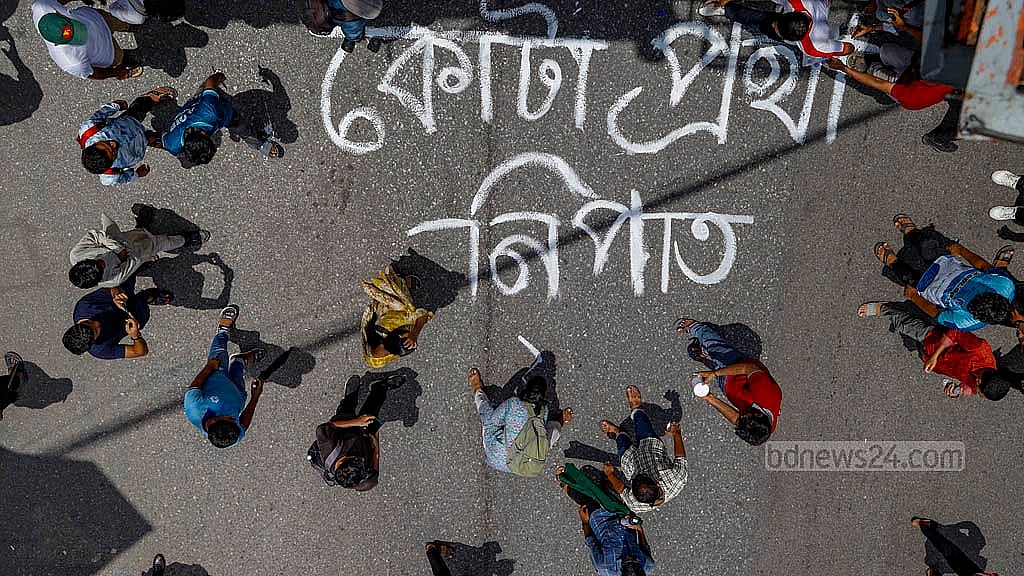
Ever since the High Court’s verdict, job seekers and students have started protesting in several parts of the country, including the capital. They staged protests through processions and human chain demonstrations in the first few days but opted for a blockade programme from the beginning of the current week. They named the programme the ‘Bangla Blockade.’
As a part of their ongoing movement, the students blocked the major intersections of Dhaka city on Jul 8 and Jul 9 to carry out the ‘Bangla Blockade’ programme, halting traffic across the city.
The protestors also formed a 65-member committee under the banner of the ‘Anti-Discrimination Student Movement’. At a press conference on Tuesday, they reduced their four-point list of demands to a single point.
This singular demand is:
“The quota system should be reformed by passing a law in parliament to abolish all kinds of unreasonable and discriminatory quotas in all grades and reduce the quota for the marginalised groups mentioned in the Constitution to the minimum level.”
By ‘minimum level’ they accepted a 5 percent quota for the disabled and people from small, marginalised, ethnic and disadvantaged groups.
The demonstrators blocked the important points of the capital on Sunday and Monday during their programme. They continued staging the same blockade on Wednesday across the country from dawn to dusk.
Although their protest movement caused severe trouble to commuters, especially those using public transports, police have not taken strong action against them. Instead of applying force to disperse the protesters, police tried to reroute the traffic.
The Appellate Division issued the status quo order on Wednesday amid the protests.
After making some observations and instructions, the top court said there could be no more talk about the quota system at this point. The Appellate Division will hear the matter again when the full decision by the High Court is published. The next hearing on the matter has been set for Aug 7.
Chief Justice Obaidul Hassan reminded the students that a court order could not be changed through movements and urged students to return to class.
In response, Asif Mahmud, one of the coordinators of the movement, said in a briefing that the students demand a commission formed by the executive division of the government to ensure a ‘logical overhaul’ of the quota system. “The students will not leave the streets until our demand is fulfilled.”
He also announced new road blockade programmes across the country for Thursday.