


Published : 24 Oct 2015, 11:02 PM
Updated : 23 Apr 2022, 01:12 PM


Tagore, who penned national anthems of both Bangladesh and India, paid a two-week visit to the then Soviet Union in late September, 1930 and wrote about the socialist regime in a book ‘Letters from Russia’.
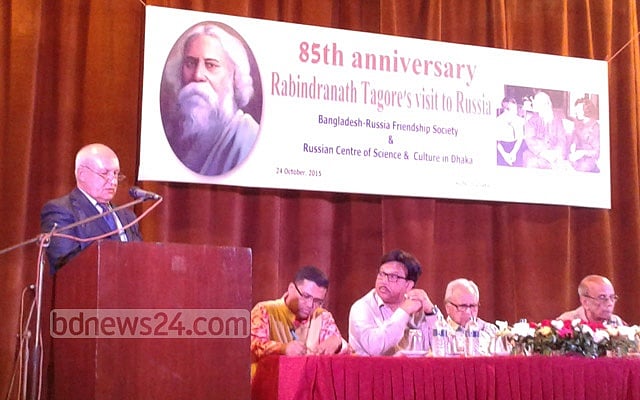
“That visit brought Bangla people to Russia and later Tagore’s ‘Letters from Russia’ took Russia to the Indian subcontinent,” Deputy Head of Mission of Russian embassy Anatoly Davydenko said on Saturday.
The Russian cultural centre along with Bangladesh-Russia Friendship Society organised a discussion in Dhaka marking the 85th anniversary of the legendary poet’s Moscow visit.
Cultural minister Asaduzzaman Noor, poet Syed Shamsul Haq, writer Hayat Mahmud and Director General of Shilpakala Academy Liaquat Ali Lucky were present, among others.
Davydenko said when Tagore visited Russia he was “much impressed” by its development efforts and by what he saw as a “real commitment to eliminate poverty and economic inequality”.
“But what impressed him most was the expansion of basic education across the Soviet Union.”
In his ‘Letters to Russia’ which was published a year after his visit, Tagore compared the acceptance of widespread illiteracy in India by British administration with Russian efforts to expand education.
Tagore also critically assessed the freedom of mind and expression under Joseph Stalin’s regime.
Davydenko said he noticed the “negative” also, but still was impressed by “the light of the mightiest sacrificial fire that has been lit in the world’s history”.
Tagore wrote: “They (Russians) were tightening their belts and striving to build a new order. But they have to do this swiftly because they have many adversaries.”
“Gurudev wrote those words as if he had foreseen the Nazi invasion on Russia in June 1941,” the deputy chief of Russian embassy said.
He said Tagore left behind “the great affection and friendship between peoples of Russia, India and Bangladesh”.
“Russian people love his poems and novels. In Moscow there is a Tagore’s statue. Tagore’s Gitanjali was translated into Russian.”
“What Tagore’s visit teaches us is that all nations should learn creativities from each other,” he said.
“When he was writing his ‘Letters from Russia’, he was constantly thinking of Indian peasants, of his Golden Bengal and its future and tried to bring Russia’s achievements to Bengal.”
Cultural Minister Noor said Tagore had visited many countries and wrote many books based on those visits but his ‘Letters from Russia’ was the most discussed as “he tried to see a new world through that visit”.












