


Published : 08 May 2020, 12:47 PM
Updated : 08 Apr 2022, 02:30 AM


Within a few years he moved from abstraction to graffiti, which fascinated de Kooning, recalled Haze, 59, who grew up in Manhattan. She told him that artists have to follow their muses in each moment.
By the early 1980s, he became part of Soul Artists, an influential New York City graffiti collective, and exhibited alongside Keith Haring and Jean-Michel Basquiat, both friends, at MoMA PS1. He showed at the Tony Shafrazi Gallery and later sent his graphic nonfigurative paintings around the world. Rejecting a life of total artist isolation, he formed a thriving design business with clients including the Beastie Boys, Public Enemy and LL Cool J. In recent years he has designed clothes and spaces for Nike and the Standard Hotel. And in 2013 he married actress Rosie Perez and led a highly collaborative and social life.
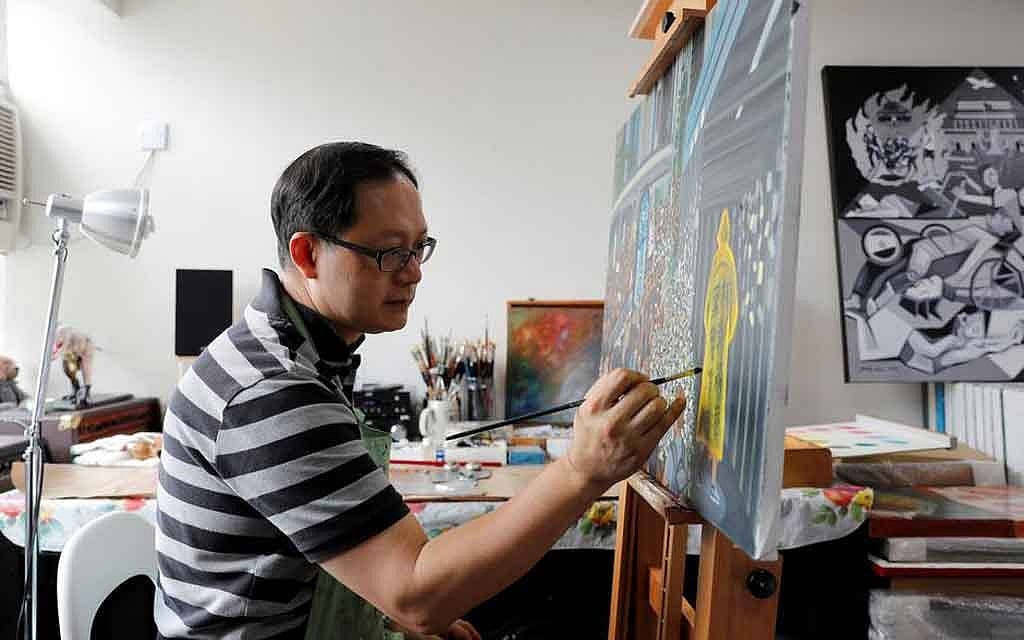
But all that changed when he started his artist’s residency at the Elaine de Kooning house in December. “I came out here with the goal of relearning how to paint,” he said from a studio with a massive window wall looking out at the barren woods in East Hampton. Dozens of his freshly painted views of the studio — in shades of gray — contrasted with de Kooning’s old colour-saturated portrait of Haze and his sister on one wall. His own earliest abstract canvases in rich hues, painted as a child under her tutelage, stood out on another.
In between was his striking new portrait of de Kooning, hair as wild as her eyes and one hand holding a cigarette.
Over the course of months, with many nights of painting through dawn, “going down a rabbit hole and ending up in such a pure state,” he said, he could feel de Kooning’s spirit — she died in 1989 — guiding him to paint people, starting with himself. “But it wasn’t until now that I felt I deserved to paint Elaine,” he said. “These last few weeks alone I really turned a corner.”
Many people have turned all kinds of corners in the weeks since quarantine began, facing isolation with nothing but their own inner creative resources to help shape their days. For many artists, writers and composers who have been awarded prestigious residencies to isolate themselves in remote places and sometimes in punishing climates, it is a coveted situation. But if, as Matisse put it, “creativity takes courage,” the extra isolation during a pandemic can start to wear away at even the most stoic artists.
“If you’re not used to it, it can be a little crippling,” said Pat Phillips, who has a painting residency at the Fine Arts Work Center in Provincetown, Massachusetts, for seven months in the offseason, when the summer resort town can feel like the end zone of a very cold and dark world. “There’s nothing else to do here but get together, so the enforced extra isolation right now is tough.”
His long days are, at least, softened by the presence of his wife, artist Coady Brown, who is also a fellow. (They’re called “bedfellows.”) But the usual community interactions and events like readings have been cancelled. Dune walks and potluck dinners made with local clams are out for now too.
“The group of residents this year was very social, but now they’re isolated,” said Richard MacMillan, the organisation’s executive director, who decided to keep things running through the quarantine months. Many residency programs have not — the Studios at MASS MoCA, the Vermont Studio Center, Ucross in Wyoming, the American Academy in Rome and Watermill Center, among others, shut down. So did Yaddo in Saratoga Springs, New York.
Meanwhile, a handful of residency programs — Djerassi in California and Bemis Center for Contemporary Arts in Nebraska among them — were able to remain open into April and even beyond with new rules to keep things safe. “The last month became extremely distracting with all the news,” said Paolo Arao, a Brooklyn artist who just returned from a three-month residency at Bemis. “But Nebraska had very few COVID cases, so it felt safer than home.”
The Elaine de Kooning House residency seems especially well designed for sheltering in place. It hosts just one artist — Haze the past few months with a single staff member on the other side of the building who left meals and fresh-baked cookies. “Eric often works through the night while I am up during the day,” Katherine McMahon, the director of programming, said in early April before the artist left to go home, “which is helpful in the age of self-quarantine to minimise interactions.”
She would wave and chat from a safe distance when Haze, often in a daze from his painting marathons, stepped outside splattered in paint for a cigarette before going back to work.
“I promised my wife I’d quit when I get home,” he said at the time. “But right now, it would be too distracting and take me out of the zone.”
On an early April Wednesday, as the pandemic was raging in New York City with reports of constant sirens, an open door to de Kooning’s former studio let in the sound of birds and tree branches creaking in the wind. Haze sat on a stool in front of a self portrait he’d only recently completed of his sultry younger self, leaning against a car, cigarette in hand just like de Kooning in the portrait on the other side of him.
Across his studio, his collection of Clorox wipes and surgical gloves (“I have boxes of them and plan to give them away to friends like bottles of wine,” he said) was dwarfed by tubes, buckets and cans of paint, rags, thinner and brushes of every size. “I brought enough supplies out here to paint through the apocalypse,” he said. To his left his large painting of de Kooning painting Kennedy, and his interpretation of the one she painted of him and his sister as children, created a hall of mirrors effect that spiralled back decades, bringing the past into the present. Nearby, a portrait of his grandfather as an immigrant boy was in progress. His time alone in residence, he said, inspired him to remember him vividly as he did all kinds of people from the past.
“Elaine has been a spiritual guiding force in these months and I’ve really fallen in love with her since I started coming out here,” he said. “Even my wife knows it.”
He said he was planning to return to Perez the following day. But a week later he was still painting through the apocalypse.
“As Elaine used to say,” he noted, “obsession is part of the process.”
c.2020 The New York Times Company












