


Published : 03 Oct 2020, 11:18 AM
Updated : 17 Oct 2022, 11:13 AM


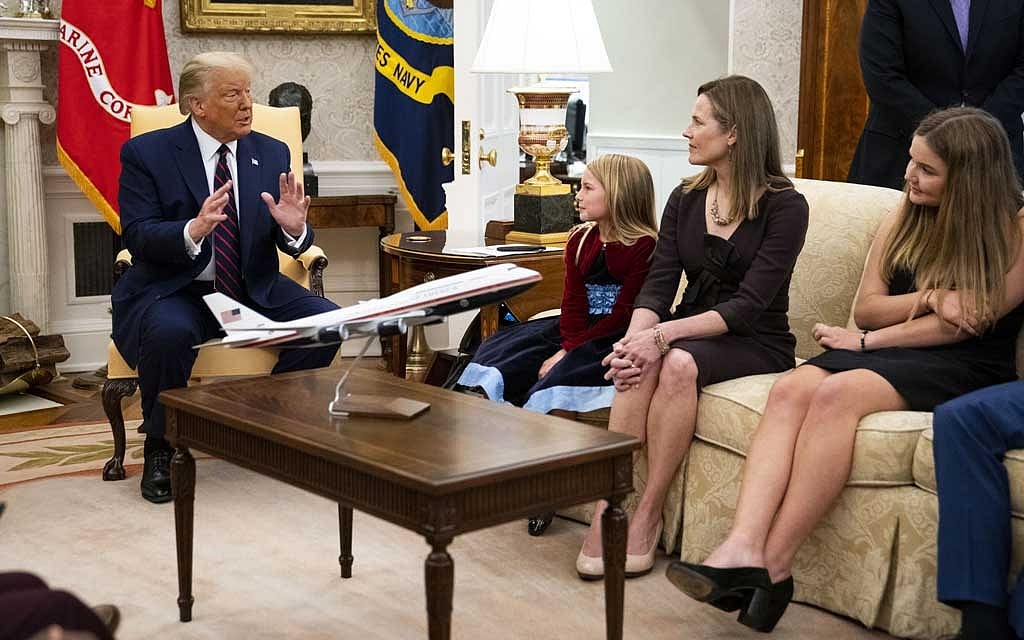
On Wednesday, Trump travelled to and from Minnesota on Air Force One along with dozens of others. On Thursday, the president appeared indoors before hundreds of supporters at a golf club in Bedminster, New Jersey.
On none of these occasions was the president wearing a mask. Often, neither were many in the room or on the airplane with him. All in all, conditions like these are a recipe for so-called superspreader events, in which a single infected person transmits the virus to dozens of others, research has shown.
“The White House has been flouting the basic rules of public health for a very long time,” said Dr Ashish Jha, dean of the School of Public Health at Brown University in Providence, Rhode Island. Regarding the president’s diagnosis that he was infected with the coronavirus, he added, “There are no surprises here.”
The problem is one scientists have been warning about for months: airborne transmission. In addition to the heavy droplets sneezed or coughed out by infected people, research has shown the coronavirus may drift in the air indoors, held aloft in tiny particles called aerosols.
Now the White House is trying to pin down exactly who had contact with Trump in recent days — and to whom these people in turn may have passed the virus. Potential contacts may number in the hundreds.
All of those people will have to be identified, tested and quarantined. “Rather than looking for a needle in a haystack, it’s like Trump is the needle, and you’re trying to find out if it touched each piece of hay,” said Angela Rasmussen, a virologist at Columbia University in New York.
Experts may never know how the president was infected or whom he may have infected. The Rev. John Jenkins, president of the University of Notre Dame, tested positive for the coronavirus after attending a White House ceremony Saturday for Barrett. So did Sen. Mike Lee, R-Utah.
The timing raises the possibility that the president could have been infected over the weekend, scientists said. Most people develop symptoms about five days after being infected with the virus, so exposure over the weekend would fit with reports that the president was showing early symptoms Wednesday and Thursday.
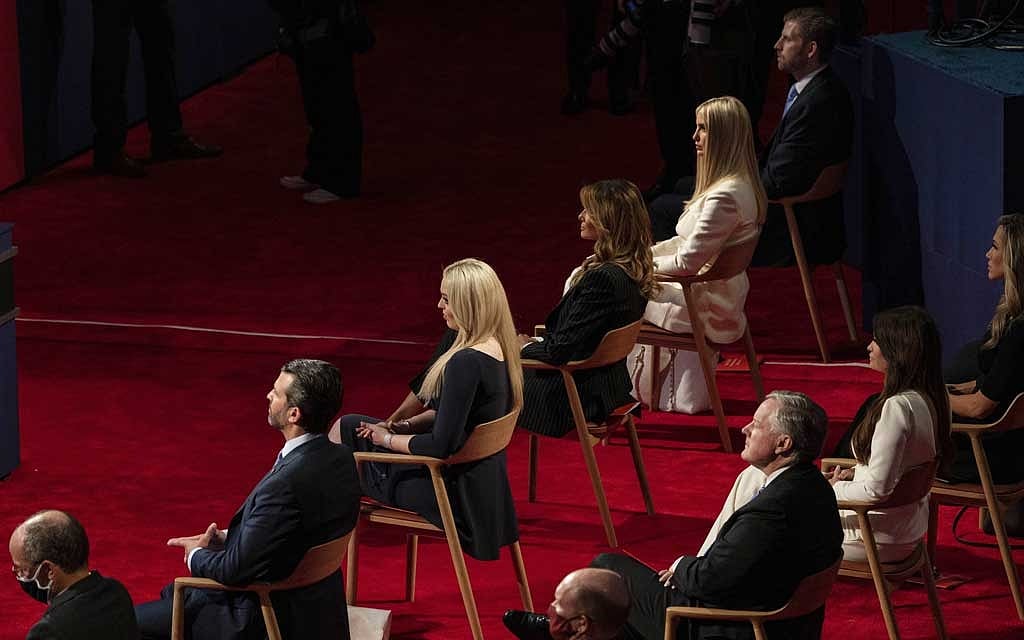
The socially distanced audience, including First Lady Melania Trump and other members of the Trump family, at the first presidential debate between President Donald Trump and Democratic challenger Joe Biden, at Case Western Reserve University in Cleveland, Sept 29, 2020. The White House is now trying to pin down exactly who had contact with President Trump in recent days, and to whom these people in turn may have passed the virus — potential contacts may number in the hundreds. (Ruth Fremson/The New York Times)
“We know that presymptomatic transmission drives a significant amount of spread of this virus,” Rasmussen said. “The bottom line is that you can be contagious before you know you’re sick.”
The presidential debate in particular resembles other indoor events at which widespread transmission has been documented — a gathering in a contained environment in which an infected person is speaking, coughing or even singing in proximity to others.
Biden tested negative for the virus Friday. Still, given that Biden was only recently exposed, “he should quarantine and get tested again,” Rasmussen said. (Biden said he would go ahead with a campaign event in Michigan planned for Friday.)
Others in the debate auditorium, too, may have been at risk.
Aerosols are expelled when people talk, shout, sing or breathe. The longer an infected person is in an indoor space, the greater the risk. Trump was in the debate hall for at least the 90-minute duration.
“He was doing a lot of talking, a lot of shouting,” said Linsey Marr, an expert in airborne transmission of diseases at Virginia Tech in Blacksburg, Virginia.
The president and Biden were at lecterns more than 6 feet apart at the debate. At that distance, Biden might have had protection from larger respiratory droplets released by the president, but not from aerosols lingering in the air.
Indoors, aerosols may travel farther than 6 feet. In August, for example, scientists reported that they had successfully isolated live virus from aerosols collected at a distance of 7 feet and 16 feet from an infected patient in a hospital.
Marr likened the aerosols released while talking or shouting to cigarette smoke. People closest to the smoker — like Biden and the moderator, Chris Wallace (who plans to take a test Monday) — would have been exposed first.
But over time, the smoke in a poorly ventilated room will drift throughout the space and reach even those much farther away.
Anyone with a face covering would be at least partly protected from the virus. But most of Trump’s family members and associates did not wear a mask during the debate, despite requests by the venue hosts, the Cleveland Clinic, to do so.
“Now the question becomes, what is the ventilation?” Marr said.
Representatives of the Cleveland Clinic did not immediately respond to requests for information about ventilation in the debate room, placement of the lecterns and other details that may bear on whether the president may have infected others.
In a prepared statement, Halle Bishop Weston, a spokesperson for the Cleveland Clinic, said Trump, Biden and people traveling with them had been tested for the virus by their campaigns and were said to be negative. Everyone gaining entry to the debate hall had tested negative for the virus, she added.
Safety measures at the debate aligned with guidelines from the Centers for Disease Control and Prevention and included “social distancing, hand sanitising, temperature checks and masking,” the statement said.
Several members of the Trump family did not wear masks during much of the debate. And experts noted that inadequate ventilation could have fostered spread of the virus.
“This is something that needs to be looked at in every indoor environment, be it schools, offices or certainly in a high-profile event like this,” said Joseph Allen, an expert on building safety at the Harvard TH Chan School of Public Health.
Ventilation becomes especially important when many people are gathered with an infected person for a long period.
“That’s exactly what we had at the debate,” Allen said. “The president was speaking often and loudly for the full hour and a half.”
© 2020 The New York Times Company







