


Published : 19 Mar 2022, 05:49 PM
Updated : 21 Oct 2022, 03:39 PM


During a nearly two-hour video call, Biden warned Xi, a close ally of Russian President Vladimir Putin's, that there would be “implications and consequences if China provides material support to Russia as it conducts brutal attacks against Ukrainian cities and civilians,” according to the White House.
But a senior administration official declined to discuss what kind of penalties the United States would impose on China if it provided Moscow with military hardware or offered it financial relief. The official also declined to say how Xi responded to Biden’s warning.
“We will continue to watch until we see what actions they take or don’t,” said Jen Psaki, White House press secretary.
As Russian forces pounded cities and towns across Ukraine, French President Emmanuel Macron and German Chancellor Olaf Scholz spoke to Putin, urging him to end the fighting.
But the calls appeared to yield few, if any, results. Speaking to Scholz, Putin complained that in intermittent talks between Russia and Ukraine, Kyiv was trying to “drag the negotiations by making a series of new, unrealistic proposals,” according to the Kremlin.
As the diplomatic efforts ground on, Russia broadened its attacks on Ukrainian targets.
A Russian missile strike about four miles from the western city of Lviv destroyed several buildings that were used to repair aircraft, shattering the relative calm in that city, a haven for civilians fleeing the heavy fighting that has engulfed the south and east and that is now gripping Kyiv and its suburbs.
The Lviv strike appeared to be an attempt to weaken the Ukrainian military’s air defences. According to a local news article in January, the plant had been the only facility in the country that repaired MiG-29 fighter jets for Ukraine’s air force.
Lviv Mayor Andriy Sadovy said that work had already stopped at the plant and that no casualties had been reported.
The Lviv strike was the latest attack on targets in western Ukraine, near the Polish border. On Sunday, a Russian airstrike hit a military base 11 miles from the border with Poland, where NATO forces are stationed on high alert.
Russia’s recent territorial gains have been mostly in the south and east, including areas around the devastated port city of Mariupol, according to Western governments and independent analysts. But Russian forces have also advanced from the southern city of Kherson, which they have captured, toward Kryvyi Rih, closer to the centre of Ukraine.
Russia’s Defence Ministry said its troops and Russia-backed separatists were “tightening the noose” around Mariupol, where residents have been preparing mass graves. The Ukrainian General Staff reported that Russians were carrying out the “total destruction of civilian infrastructure, housing and livelihoods” in the city.
In the capital, Kyiv, a large explosion from what appeared to be a cruise missile or aerial bombardment blew a crater into the courtyard of a residential building Friday, in one of the largest strikes to hit a civilian area in the city. At least one person was killed.
But some of the war’s most intensive fighting was taking place in the suburbs outside the city, particularly in Irpin, where Russian and Ukrainian armies are stuck in a savage contest at a gateway to the capital.
In the besieged city of Mariupol, officials reported that at least 130 people had been rescued from the rubble of a theatre destroyed by a missile strike Wednesday, but that hundreds — and perhaps as many 1,300 — were still missing.
The attack on the Drama Theatre has become a potent symbol of Moscow’s willingness to indiscriminately target civilians; satellite images showed that the word “children” had been written in large white letters in Russian in front of the building and behind it.
“Despite the shelling, despite all the difficulties, we will continue rescue work,” Ukrainian President Volodymyr US said in a video address Friday.
Zelensky released his speech just before Putin made his first public appearance since ordering the invasion last month, addressing tens of thousands of cheering, flag-waving Russians at Moscow’s largest stadium.
Putin, who was officially marking the eighth anniversary of Russia’s annexation of Crimea, turned the event into a theatrical display of support for the invasion of Ukraine, telling the crowd that Russians “have not had such unity for a long time.”
Luzhniki stadium was covered with posters that read “For a world without Nazism,” a reference to one of the Kremlin’s stated reasons for the invasion, to “denazify” Ukraine.
Putin’s proclamation of national unity has been undercut by the Kremlin’s increasingly fierce crackdown on dissent and the media. This month, Putin effectively criminalised public opposition and independent news reporting about the war. More than 14,900 people have been detained at anti-war rallies, according to OVD Info, a rights group that tracks arrests in Russia.
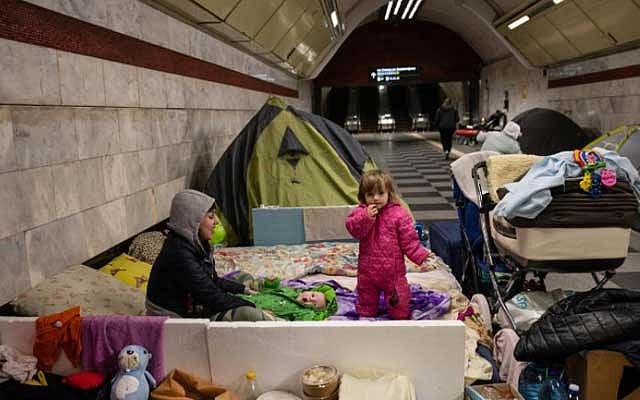
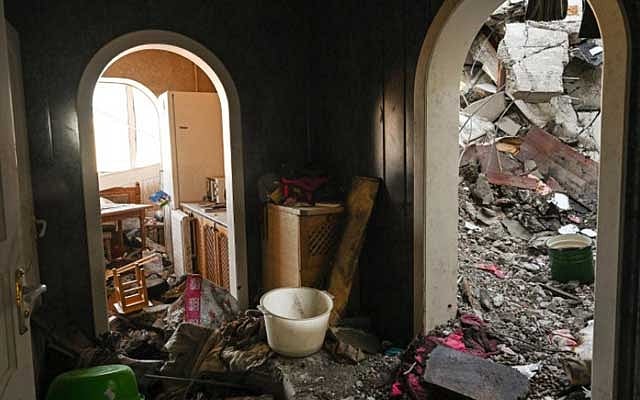
In Ukraine, the death toll and suffering from the war has been worsening as Russia, struggling to capture more territory, has stepped up its bombing of heavily populated areas, striking schools, hospitals and apartment buildings.
Hundreds of thousands of Ukrainians have lost access to food, water and heat, and at least 726 civilians, including 52 children, have been killed, according to the United Nations. More than 3.2 million people have fled the country.
Highlighting Russia’s troubles on the battlefield, the British defence intelligence service said Friday that Russian forces “made minimal progress this week,” and Ukrainian troops around Kyiv had continued to frustrate attempts to encircle the city.
As the war drags on, there is increasing concern of its impact rippling across the globe by causing a global energy crisis and hunger worldwide with the loss of Ukrainian grain exports.
Ukraine’s food supply chain is “falling apart” amid the Russian invasion, and the disruption of food supplies in the country is threatening crucial exports of grain that could undermine global food security, the United Nations said Friday.
“The consequences of this conflict in Ukraine are radiating outwards, triggering a wave of collateral hunger across the globe,” Jakob Kern, operations director of the World Food Program, told reporters. “Ukraine is a catastrophe compounding what is already a year of catastrophic hunger.”
Russia and Ukraine account for nearly 30% of the world’s wheat trade, Kern said, and the interruption of those exports is driving up prices beyond the reach of millions of poor people.
The International Energy Agency, formed in the wake of the 1973 oil crisis to ensure a stable worldwide energy market, said the repercussions of the invasion on energy supplies were likely to intensify over the next several months as the summer driving season gets underway.
Despite the shocks to the world economy, the efforts to find a negotiated solution to the conflict were still bearing little fruit. As Putin sought to rally domestic support for the invasion, Western officials said they saw little reason to hope that negotiations between Russian and Ukraine had reached a serious stage — or even confronted the most difficult issues at stake.
Zelensky has seemed in recent days to signal that his country will not join NATO, which would satisfy a key Russian demand. But Ukraine says any form of neutrality must come with security guarantees against further Russian aggression.
Moscow has also demanded that Ukraine accept the loss of Crimea, annexed by Russia in 2014, and accept that the entire regions of Donetsk and Luhansk, and not just the areas now occupied by Russian-backed separatists, become independent republics, as Putin has decreed.
© 2022 The New York Times Company













