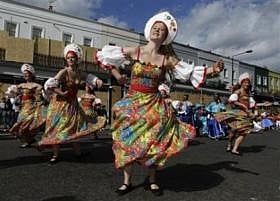
Revellers flock to heavily policed carnival
Monday's holiday in the UK was the main day of the two-day Notting Hill Carnival, an annual celebration of Caribbean culture that usually draws about one million people for a colourful procession of musicians and performers
bdnews24.com News Service
bdnews24.com
Published :
29 Aug 2011, 05:23 PM
Updated :
10 Aug 2022, 05:21 PM
London, Aug 29 (bdnews24.com/Reuters) -- Revellers flocked to west London Monday for one of Europe's biggest street parties, with record numbers of police on duty to prevent a repetition of riots that shook the capital three weeks ago.
Monday, a public holiday in England, is the main day of the two-day Notting Hill Carnival, an annual celebration of Caribbean culture that usually draws about one million people for a colourful procession of musicians and performers.
Brilliant sunshine greeted the final day of the carnival as thousands of revellers began arriving.
The streets along the procession route were lined with hundreds of food stalls flying the distinctive yellow, green and black flag of Jamaica and the black-and-red of Trinidad and Tobago.
The smell of fried fish, jerk chicken and fried plantain wafted over the route as sound systems boomed with the beats of "drum 'n' bass," hip hop, reggae and samba.
The festival carries more than usual significance this year because it is the biggest event in London since riots broke out on August 6, denting the city's reputation.
With the London Olympics less than a year away, the capital's police force needed to restore public faith in its ability to ensure security at major events.
Police said they had made 88 arrests on drugs charges, theft or other offences by late Monday morning, around the same number as last year at the same time. More than 6,500 officers are being deployed to Monday's event, nearly 1,000 more than last year.
They are using special powers that allow the police to stop and search individuals they suspect may be intent on causing trouble, and to force individuals to remove any face masks.
POLICE ON THE STREETS
Some had worried that the increased police presence would affect the mood on the streets of Notting Hill, setting for the 1999 film of the same name starring Hugh Grant and Julia Roberts.
Some businesses and homeowners boarded up their properties, reflecting nerves after the riots that amounted to Britain's worst violence in decades, but generally partygoers were positive.
"It's been a really good vibe so far. Great sound systems, floats, and the police have handled it well, they've judged it right being helpful and approachable," said Sergio Green, 47, an architect from east London attending for a second day.
"It's what Londoners needed."
Crowds lined the streets to watch a procession of trucks carrying performers with painted faces, flamboyant costumes and multi-coloured wigs, some waving flags or blowing whistles.
The police kept a relatively low profile, patrolling in pairs or on bicycles. In addition to those deployed for the event, another 4,000 police are on stand-by in case of trouble.
Riots broke out in London earlier this month after a protest over the police shooting of a suspect in Tottenham -- nine miles northeast of Notting Hill -- turned violent, later spreading to other parts of London and other English cities.
The capital's police made 2,000 arrests after the disorders, in which hooded rioters looted businesses, set buildings ablaze and fought street battles with officers.
Inspired by Trinidad's carnival, the Notting Hill event was first held in London in 1964 and has grown into one of the world's biggest, generating tens of millions of pounds for London's economy.
In its early days the carnival was marred by ethnic tension between police and youths. Riots there in 1976 inspired the Clash to write their classic protest song "White Riot."
Since then much of the area has become more affluent and home to the rich and famous, including Prime Minister David Cameron who lived here until moving into 10 Downing Street last year.
bdnews24.com/pks/2315h