


Published : 20 Nov 2012, 08:58 AM
Updated : 09 Aug 2022, 04:32 PM


US President Barak Obama on Tuesday urged Myanmar to give citizenship to hundreds of thousands of stateless Rohingyas in the west of the country where ethnic bloodshed has caused massive displacement.
After Obama's landmark visit to the reclusive South-East Asian nation, the White House in a press briefing said the Myanmar government responded positively to the issue.
Although the Royingyas in Myanmar claim themselves as aborigines, they are yet to get state recognition.
The statement came on board Air Force One, the US President's private jet, as he was going to Cambodia after the six-hour Myanmar trip.
The first serving US President to visit Myanmar, Obama gave a speech at Rangoon University where he urged Burmese people to accept Rohingyas after recent sectarian violence that killed hundreds of people and left tens of thousands homeless.
Myanmar's estimated 800,000 Rohingyas, a Muslim minority, are officially stateless, and regarded by the government of the Buddhist-majority country as illegal immigrants from Bangladesh, rather than one of its 135 official ethnic groups, as a result of which it denies them citizenship.
Bangladesh, which is hosting some 500,000 Rohingya people since 1991-92, does not recognise them either and has denied them entry after the recent spate of sectarian violence in Myanmar's Rakhaine State. The United Nations has referred to them as "virtually friendless".
Obama called for an end to communal violence between Muslims and Buddhists.
"National reconciliation will take time, but for the sake of our common humanity, and for the sake of this country's future, it is necessary to stop the incitement and to stop violence," he said.
The US President highlighted the issue in his tour at a time when the Muslim Rohingyas are being tortured anew.
Bangladesh has been urging Myanmar to take back the Rohingyas as they are considered to be an economic burden on the country. Many Rohingya refugees tried to flee to Bangladesh in July and August of this year after renewed violence.
The White House at the briefing added: "They've reiterated a commitment to pursue a ceasefire in Kachin State, which is the one remaining ethnic insurgency that they're confronting. And with regards to the Rohingya in the Rakhine State, they reiterated their commitment to not just calm the situation, but to address the underlying issues including returning displaced people to their home and addressing the issue of citizenship for the Rohingya."
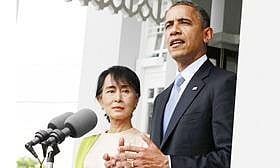
Obama also met Myanmar President Thein Sein and opposition leader Aung San Suu Kyi who heads the Rule of Law Committee responsible for reviewing the 1982 Citizenship Law that rendered the Rohingya stateless.
Bangladesh on Monday expressed surprise over Suu Kyi's comments that Rohingyas were illegal migrants from Bangladesh.
The Ministry of Foreign Affairs said the Rohingya Muslims had been living in Myanmar's western state of Rakhine for centuries and that they could not be Bangladeshis as the country was founded only in 1971.
Suu Kyi, on Nov 13, had told an Indian news channel had termed the recent violence as a "huge international tragedy", but suggested that "illegal immigration from Bangladesh" had to be stopped.
The last such major influx took place in 1991-92 when 250,877 Rohingyas took refuge in Bangladesh and out of them Myanmar took back 236,599 refugees. Later on, more Rohingyas crossed the border illegally and Bangladesh government estimates put number of undocumented Rohingyas between 400,000 and 500,000.
At the official discussions, including during the visit of Prime Minister Sheikh Hasina to Myanmar in December 2011, Burmese authorities had promised to take back these undocumented Myanmar nationals after verifying their origin.
The Nobel Prize winner Suu Kyi said: "Everyone is responsible for respecting human rights, without discriminating between majority and minority, ethnicity and religion."
The human rights champion in her defence said she had not taken sides on behalf of stateless Rohingya in order to promote reconciliation after recent bloodshed.
She has been criticised by rights groups for not speaking out on the Rohingya.







