Nepal Maoists take lead in early vote count
Nepal's Maoist former rebels took a shock early lead on Saturday in an election aimed at cementing a peace deal that ended a decade-long civil war.
bdnews24.com News Service
bdnews24.com
Published :
12 Apr 2008, 07:27 AM
Updated :
24 Apr 2022, 08:25 PM
Kathmandu, April 12 (bdnews24.com/Reuters) - Nepal's Maoist former rebels took a shock early lead on Saturday in an election aimed at cementing a peace deal that ended a decade-long civil war.
Early tallies from Thursday's elections showed the Maoists, who say they are committed to democracy but are still classified as a terrorist organisation by the United States, were leading in 61 out of 121 constituencies where counting had begun.
They had also won 11 out of the 20 constituencies where results had been declared, election officials said.
"At the rate it is going, the Maoists will be the number one party," said Kunda Dixit, editor of the weekly Nepali Times.
"Trends so far suggest that there was an overwhelming desire on the part of mostly young voters for change, peace and development," he said. "They have voted for the Maoists so that they don't go back to jungles."
Final results of the polls, Nepal's first in nine years, could take around 10 days and are almost certain to lead to a coalition government, analysts say. But Maoists were jubilant.
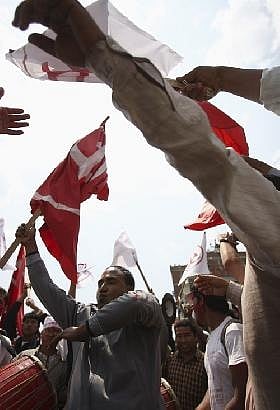
"This is the people's victory," hundreds chanted outside a counting centre in Kathmandu, many with the hammer and sickle painted on their faces or with Maoist flags wrapped around their heads. Others danced under flags in the sweltering sun.
Nepal is choosing 601-member assembly, meant to write a new constitution for the impoverished Himalayan state, formally end a 240-year-old monarchy and serve as a parliament.
There are 240 seats decided on a first-past-the-post basis, with another 335 seats decided by proportional representation and 26 to be nominated by the cabinet.
Few results are in yet from the country's southern plains, home to nearly half of the population, and Maoists are thought to be weaker there. The complex system also means the former guerrillas are very unlikely to get a majority.
"The trends don't reflect how they would do in the proportional elections," said a Western diplomat.
A Maoist victory would be hard to stomach for Nepal's conservative army, traditionally loyal to the king, as well as for the governments of the United States and India. New Delhi worries it could encourage India's own Maoist rebels.
PRAGMATISTS
But Maoist chief Prachanda, who wants to be the country's first president, insists he wants friendly relations with Washington and New Delhi.
These days his movement shies away from the language of Marx and Mao, proposing public-private partnerships but not nationalisation, advocating land reform and social justice but accepting globalisation is a fact of life.
Maoist ministers already serve in Nepal's coalition government, set up after a 2006 peace deal, and several diplomats said they had shown themselves to be pragmatists.
The election, and the abolition of the monarchy, had been the main demands of the Maoists during their long insurgency, in which more than 13,000 people died.
Running tallies showed Prachanda and other senior Maoist leaders were ahead of their rivals. Some prominent leaders from other political parties were trailing.
One diplomat said Maoists had chosen candidates intelligently from different marginalised and ethnic groups.
But it was also seen as a vote against mainstream political parties, blamed for rampant corruption and endless squabbling in the past.
During the war Maoists controlled huge swathes of the countryside, where basic services like roads, water, healthcare, education, electricity and telephones are in very short supply.
"Nepali people are looking for economic, social, cultural and political changes ... and a lasting peace," senior Maoist leader Krishna Bahadur Mahara said after being declared a winner.
"For this, they look to us as an alternative force."
bdnews24.com/amt/1711 hrs.