Musharraf steps down as army chief
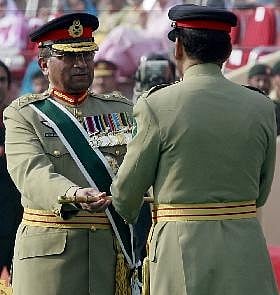
Pakistani President Pervez Musharraf stepped down as army chief on Wednesday and will be sworn in as a civilian leader for a second five-year term on Thursday. Musharraf passed the baton of command to his hand-picked successor, General Ashfaq Kayani, at a ceremony at army headquarters in Rawalpindi. >>Musharraf prepares to shed army uniform
bdnews24.com News Service
bdnews24.com
Published :
28 Nov 2007, 06:22 AM
Updated :
17 Aug 2022, 04:38 PM
Rawalpindi, Pakistan, Nov 28 (bdnews24.com/Reuters) - Pakistani President Pervez Musharraf stepped down as army chief on Wednesday and will be sworn in as a civilian leader for a second five-year term on Thursday.
Musharraf passed the baton of command to his hand-picked successor, General Ashfaq Kayani, at a ceremony at army headquarters in Rawalpindi.
In doing so he has fulfilled one of the long-held demands of his political rivals and Western allies, taking off the uniform he has referred to as his "second skin" and becoming a civilian president ahead of national elections in January.
"The system continues, people come and go, everyone has to go, every good thing comes to an end, everything is mortal," a sombre-looking Musharraf told the top brass and government leaders at the change-of-command ceremony.
For Musharraf, who seized control of Pakistan in a 1999 coup, command of the army has been his main source of power.
He now aims to become a civilian president, supported by his hand-picked successor as army commander, with a new prime minister heading the government after the Jan. 8 poll.
His power and influence are bound to be affected. The question is by how much.
"Many believe that giving away the core source of his strength, the command of a disciplined and professional army which was at his beck and call in every crisis, may prove to be an insurmountable weakness," the News newspaper said.
For the time being, Musharraf will retain powers under the emergency rule he declared on Nov. 3. He imposed the emergency in his capacity of army chief but transferred those powers to the presidency.
The United States and other Western allies, as well as the opposition, are pushing for the emergency to be lifted.
Musharraf is replaced as chief of army staff by his former intelligence chief, Kayani. He is well regarded by Western counterparts and also worked with opposition leader Benazir Bhutto after she became prime minister in the late 1980s.
"IT'S GOOD"
One of Musharraf's most pressing concerns now will be the Jan. 8 election.
Musharraf has lost much popularity since March when he tried to fire the country's independent-minded top judge, and analysts say that could hurt his ruling Pakistan Muslim League party in the election.
But Musharraf will need support in what analysts expect will be a hung parliament where he could face impeachment over his manoeuvres to secure another term in office, which opponents say violated the constitution.
If his own party fares badly, he is going to need the help of religious parties or one or other of his old rivals, Bhutto or the prime minister Musharraf ousted in 1999, Nawaz Sharif.
Sharif returned on Sunday after seven years exile. He and Bhutto have both filed election nominations but have said they might still boycott the vote.
Ordinary Pakistanis welcomed Musharraf's departure from the army.
"He has had a hold on both the army and presidency. He makes all the decisions himself. As a civilian he won't be able to," said Siddiq Akbar, a cashier at a hotel in the city of Lahore.
Amjad Butt, a stock market trader in Lahore, said Pakistan's international image would benefit.
"The emergency and martial law is not beneficial for Pakistan's standing with the international community ... The markets should benefit," Butt said.
Pakistan's main stock index, slightly higher early on Wednesday, has recovered most of the losses since Musharraf declared emergency rule. It has gained about 37 percent since the beginning of the year.
bdnews24.com/lq/1259hrs