


Published : 25 Oct 2019, 05:11 PM
Updated : 08 Apr 2022, 02:27 PM


Turkish-backed forces pushed into several villages held by the Syrian army, capturing one of them and causing an unspecified number of casualties, according to the Syrian government news agency. The Turkish-backed militias’ advance also forced the Kurdish-led militia, the Syrian Democratic Forces, to withdraw from several villages, according to the Syrian Observatory for Human Rights, a Britain-based war monitor.
Three SDF fighters were killed in the battle, the group said Thursday.
Fighting between the Kurdish-led forces and Turkey would violate the US-brokered cease-fire that President Donald Trump said this week had brought peace to the area. But fighters with the Turkish-backed militias, known as the Syrian National Army, denied attacking the villages Thursday.
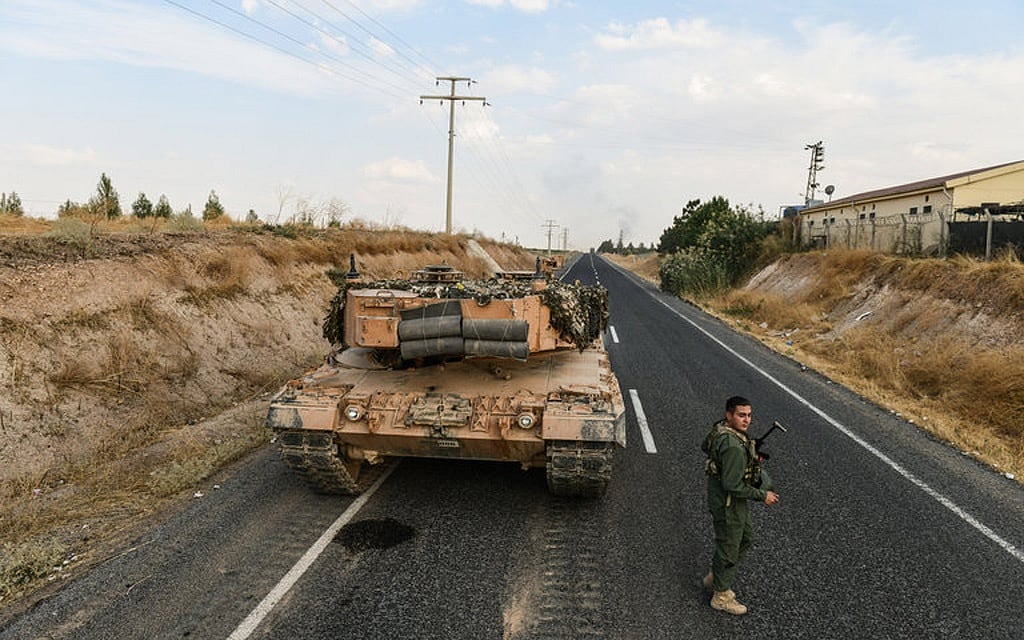
The Turkish military said five of its soldiers had been wounded Thursday in a Kurdish strike on the Syrian town of Ras al-Ayn. Turkish forces seized the town last week after the Syrian Democratic Forces, a former American ally, and US troops withdrew from it in advance of the Turkish incursion.
With US troops on the way out and their former allies falling back, the skirmishes Thursday underscored that the future of northeastern Syria was largely in the hands of Turkey, the Syrian government of Bashar Assad and Assad’s patron, Russia.
Under an agreement Tuesday between President Recep Tayyip Erdogan of Turkey and President Vladimir Putin of Russia, Turkish, Russian and Syrian government troops will now share control of the swath of Syria vacated by the Americans and Kurdish-led forces.
The power shift was evident in other ways. Erdogan demanded Thursday that the United States hand over Mazlum Kobani, the Kurdish commander whose forces helped the United States drive the Islamic State group out of Syria. Erdogan said he was “a terrorist” wanted for prosecution by Turkey.
“We have an extradition treaty with America,” Erdogan said in an interview with TRT Haber, the state news channel. “America should deliver this guy to us.”
In a letter to Erdogan two weeks ago, Trump suggested that Erdogan meet with Kobani rather than go to war. Erdogan, who reportedly threw the letter in the trash before going ahead with his military offensive, said Thursday that he was offended by Trump’s suggestion because Kobani was a wanted man.
Despite opening the door to Erdogan’s military operation, Trump administration officials have continued to criticize the move.
Defence Secretary Mark T Esper accused Turkey on Thursday of putting the United States and its allies in the Middle East and Europe in a “terrible situation” because of its agreement with Russia.
Speaking at a NATO defence ministers’ meeting in Brussels, Esper called on Ankara to start acting like an ally and not a foe of the United States and NATO. But he was besieged by questions about Trump’s sudden decision to withdraw US troops and declare victory against the Islamic State in Syria.
“Nobody has yet offered a better alternative to what the United States did,” Esper told an audience at the German Marshall Fund.
In Washington, Pentagon officials said they had prepared several options for the White House to review that would keep a small contingent of American forces in eastern Syria — perhaps a few hundred — to protect oil fields now controlled by Syrian Kurds who have been the US military’s main partner on the ground in battling Islamic State fighters in that part of the country. The troops would also continue to fight the Islamic State.
In a statement released late Thursday, the Defence Department said the United States would reinforce its presence in northeastern Syria “with additional military assets” to prevent the Islamic State from reclaiming the region’s coveted oil fields. Four Defence Department officials said that no decisions had been made on the number of troops or what type of weaponry would remain, but that at least one option included battle tanks.
The Pentagon statement did not address the possibility that Syrian government troops, allied Russian forces or Russian mercenaries could try to seize control of the oil fields in the east, as some Russians tried with disastrous results in February 2018.
Trump’s Oct 6 decision to pull out US troops effectively allowed Erdogan to send his forces into Syria and launch attacks against the Kurds.
The decision “to withdraw less than 50 soldiers from the zone of attack was made after it was made very clear to us that President Erdogan made the decision to come across the border,” Esper said.
He said that the United States could “not jeopardize the lives” of US special operations troops in Syria and that the United States could not “start a fight with a NATO ally.”
That small American force, however, had kept Turkey from invading. On Wednesday, Trump lifted the sanctions against Turkey that he had imposed after its invasion.
The NATO defence ministers’ meeting was dominated Thursday by questions about what, if anything, to do about Turkey, an alliance member that increasingly has been going its own way.
“We see them spinning closer to Russia’s orbit than in the Western orbit and I think that is unfortunate,” Esper said.
Beyond its incursion into Syria, Ankara has ignored US demands to reject delivery of Russian S-400 missile defence systems, which the Pentagon says could allow Moscow to spy on American F-35 fighter jet technology. In retaliation, the United States has begun to remove Turkey from a joint F-35 production program.
Since the beginning of his trip, Esper has been hounded by the repercussions of Trump’s Syria pullout. Esper arrived in Afghanistan on Sunday and was greeted by a tweet from his boss claiming that a cease-fire in Syria was “holding up very nicely.”
He arrived in Saudi Arabia as Russian troops were taking over military bases abandoned by US troops in Syria. And in Iraq, he was faced with Iraqi officials who loudly insisted that US troops relocating to Iraq from Syria could not stay long in the country.
Hanging over all this was the question of how to secure 2,000 Islamic State prisoners in Syria who were being held by the Kurds.
“It is extremely important to make sure that captured ISIS fighters are not set free, so those who are present on the ground have a responsibility to make sure that doesn’t happen,” NATO’s secretary-general, Jens Stoltenberg, told reporters Thursday, using an alternative name for the Islamic State.
Standing beside Esper a few hours later, he expressed concern “about jeopardizing the progress we have made in the fight against” the Islamic State.
As if to remind themselves why the alliance needed to exercise patience with Turkey, officials were passing around a 1979 brief from Margaret Thatcher, the former prime minister of Britain, in which she warned of dire consequences if NATO pushed Turkey away.
“NATO would lose control exercised by Turkey over the Bosporus and Dardanelles choke points which give the Soviet Black Sea fleet its only point of exit to the Mediterranean,” the brief said, and the United States “would be denied Turkish sites for important intelligence and air defence surveillance.”
It concluded that “the military position would be the more serious if the Soviet Union were herself able to exploit Turkish airspace or, worse, given use of Turkey’s airfields.”
The Turkish Parliament hit back Thursday at the European Parliament, rejecting its declaration that Turkey’s operation in northern Syria violated international law.
Turkey’s two ruling parties were joined by the two leading opposition parties in accusing the European Parliament of showing support for a terrorist group, the Kurdistan Workers’ Party, or PKK, instead of aligning itself with Turkey, a NATO ally, in fighting the group. The Syrian Defence Forces have ties to the PKK.
© 2019 New York Times News Service







