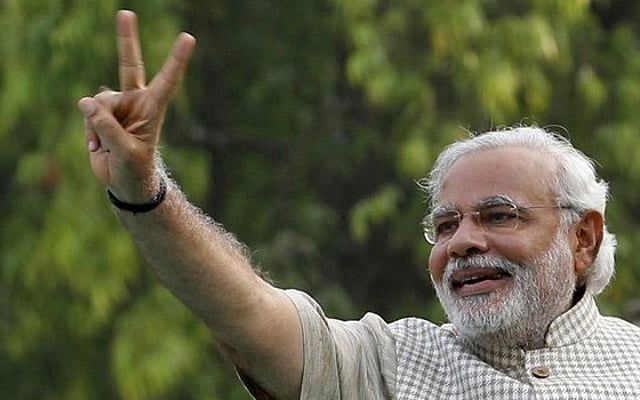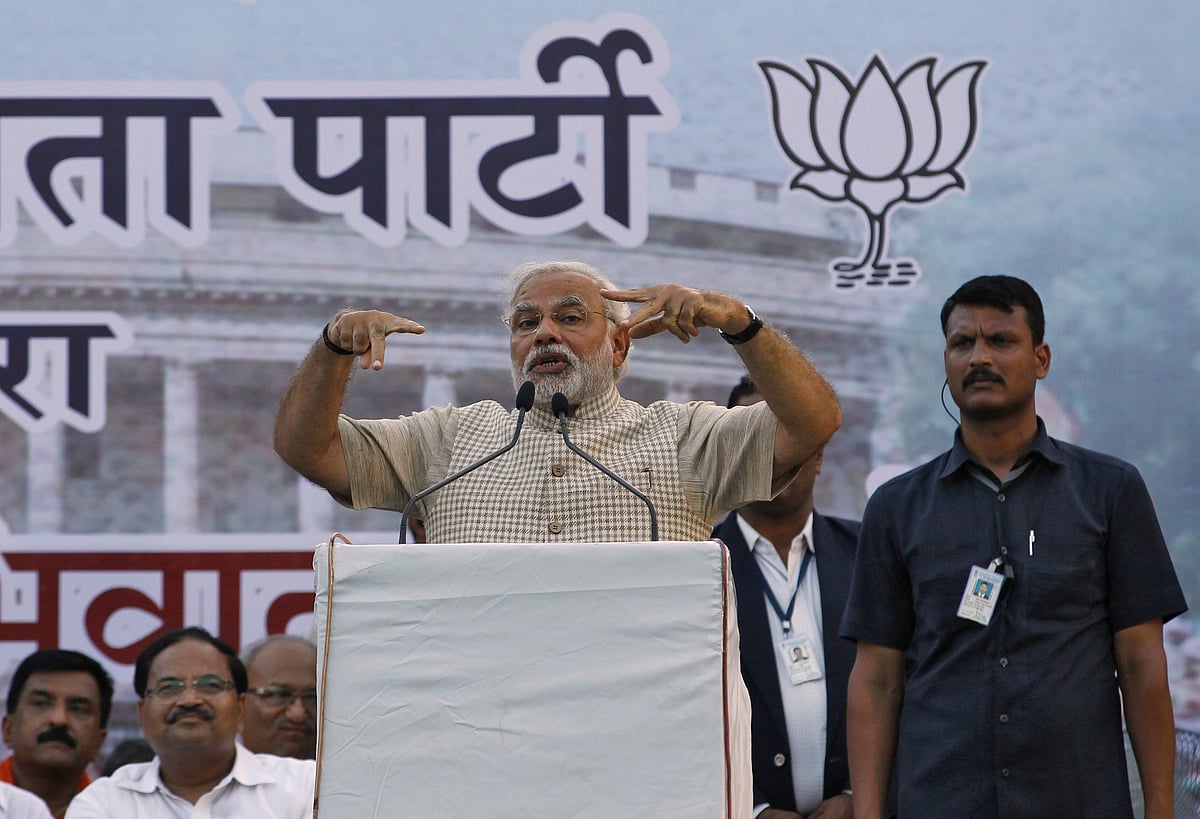
Hindu nationalist Narendra Modi gestures during a public meeting in Vadodra in Gujarat May 16, 2014. Credit: Reuters
Even political pundits gasped at the sheer scale of the Bharatiya Janata Party's sweep that election officials said was poised to give it a comfortable majority in the 545-member Lok Sabha even without the aid of its old and new allies.
"I have been elected as the prime worker of the people," said Modi, seeking to project his humility in a victory speech at Vadodara, in Gujarat, to almost rockstar-like adulation from screaming supporters, both men and women and thousands of young people.
Modi won with a parliamentary record margin of over 570,000 votes from Vadodara, one of the two constituencies from which he contested, the other being Varanasi, from where also he won.
"All the people of this country are ours. It is our responsibility to take everyone along. Our mission will be: With all, development for all," said he, seeking to allay fears among minorities about his rise.
Modi pointed out to resounding cheers from the crowd how this was the first time that a non-Congress party had got a majority on its own in a national election in India that was followed keenly around the world.
The Congress, India's oldest party which had ruled the country for a decade since 2004, faced its worst humiliation.
It had won 42 seats and was leading in two more -- its worst tally in the Lok Sabha where it had never fallen to two digits. The Congress won 206 seats in 2009.
If it gets less than ten percent of the total number of Lok Sabha seats, its president may not be recognised as the Leader of Opposition, a cabinet rank.
The Congress did not win a single seat in seven states and it was unlikely to win more than 10 seats in any state.
A chastened Congress accepted defeat. Outgoing Prime Minister Manmohan Singh congratulated Modi, who is still the Gujarat chief minister.
Congress leader Jairam Ramesh summed up the mood in the country's oldest party by saying: "Our performance is worse than the worst case scenario."
Congress president Sonia Gandhi, who won easily from Rae Bareli unlike her son Rahul Gandhi who struggled at one stage, added: "The people's verdict is against us."
Both took responsibility for the defeat, congratulated the BJP but did not name Modi.
As an army of officials continued to count the 550 million votes 1.72 million electronic voting machines polled across the country, the BJP had won 278 seats and was leading in four others until the early hours of Saturday.
The BJP is thus poised to bag a total of 282 seats in the Lok Sabha, where a party needs 272 for a simple majority.
A host of global leaders from Britain, Japan, Israel, Pakistan, Bangladesh, Sri Lanka and Australia rang up or sent congratulatory messages to Modi, who is widely expected to have a more muscular foreign policy and even changes some of India's international equations.
Modi is expected to be sworn in prime minister by President Pranab Mukherjee on May 21.
A visibly jubilant Modi promptly called on his ageing mother, the one person he respects the most, in Gandhinagar, where he has been the Chief Minister of Gujarat since 2001.
He sent a message saying "India has won" that instantly set a record as the country's most retweeted Twitter post.
"The most fundamental factor behind such a decisive mandate is the all-India anti-Congress sentiment," political commentator Dipankar Gupta told IANS.
BJP president Rajnath Singh described the party's victory as "superb" and said "a new era has begun in Indian politics."
Amit Shah, Modi's closest aide, declared that India was poised to see major changes in politics.
The BJP was poised to win all but seven seats in Uttar Pradesh which elects the maximum of 80 members to the Lok Sabha.
The BJP-led combine was also poised to bag 31 of the 40 seats in neighbouring Bihar.
Interestingly, three of the four regional parties which, too, did well in their strongholds were not allied with Modi even if their leaders have had good equations with him.
Tamil Nadu's ruling AIADMK led by Chief Minister J Jayalalithaa will be the third largest party in the Lok Sabha. It won 37 of the state's 39 seats - a showing that punctured long-time rival DMK.
In West Bengal, ruling Trinamool Congress won 34 of the 42 Lok Sabha seats in the state. The Communist Party of India-Marxist (CPi-M), the Bharatiya Janata Party and the Congress shared the remaining three seats.
It also decimated the Left.
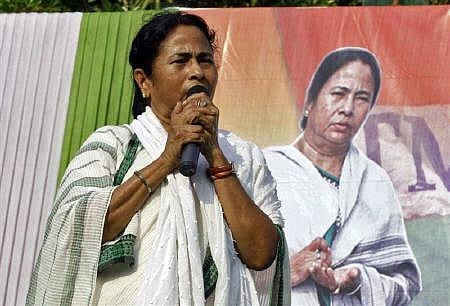
The Trinamool Congress chief, Mamata Banerjee, however, ran a vituperative campaign against Modi in West Bengal.
The ruling Biju Janata Dal (BJD) in Odisha is set to win 20 of the 21 seats.
The BJP's oldest ally, the Shiv Sena, was on the victory lap in 18 of the 48 constituencies. The Shiv Sena-BJP combine won 41 seats in the state.
Other prominent BJP victors were LK Advani (Gandhinagar), Rajnath Singh (Lucknow), Murli Manohar Joshi (Kanpur), Nitin Gadkari (Nagpur) and Sushma Swaraj (Vidisha).
The only BJP leader who lost was Arun Jaitley, leader of the party in the Rajya Sabha who was trounced by former Punjab chief minister Amarinder Singh of the Congress in Amritsar.
Tens of thousands of BJP supporters celebrated the party's victory all over the country. In New Delhi, thousands gathered at the BJP headquarters dancing, bursting firecrakcers and distributing sweets.
Many Congress veterans bit the dust. They included Home Minister Sushilkumar Shinde, Ambika Soni, Kapil Sibal, Ghulam Nabi Azad, Ajay Maken and Pawan Kumar Bansal.
The Left too suffered a major blow. AAP leader Arvind Kejriwal, who claimed he would easily defeat Modi in Varanasi, lost by more than 200,000 votes.
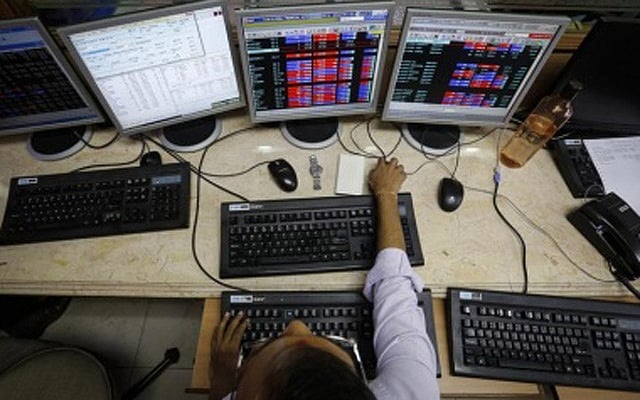
Modi's landslide was welcomed with a blistering rally on India's stock markets.
The victory gives the 63-year-old former tea-seller ample room to advance economic reforms started 23 years ago by current Prime Minister Manmohan Singh but stalled in recent years.
The desire for change has been so strong that voters put aside concerns about Modi's Hindu-centric politics.
"I'm so happy because all of India wanted a strong government," shouted software engineer Vinod Rai at the BJP's Delhi headquarters, reported Reuters.
Rai echoed the sentiments of millions of Indians who bought into Modi's promises of job creation and economic growth to satisfy a bulging youth population.
With more than six times the seats of its closest rival, Modi's is the most decisive mandate for a leader since the 1984 assassination of prime minister Indira Gandhi propelled her son to office.
Since 1989, India has been governed by coalitions.
Markets soar
Responding to the news, Indian markets got off to a roaring start, with the rupee breaking below 59 to the US dollar, an 11-month high, and the benchmark stock index jumping 6 percent to a record high before paring its gains.
Betting on a Modi win, foreign investors have poured more than $16 billion into Indian stocks and bonds in the past six months and now hold over 22 percent of Mumbai-listed equities - a stake estimated by Morgan Stanley at almost $280 billion.
Unlike his predecessors, Modi will not have to deal with unruly partners as he implements reform. That could usher in profound economic changes, and he will try to replicate his success in attracting investment and building infrastructure in Gujarat, the state he has governed for more than 12 years.
"He can afford to have a smaller but stronger cabinet, that means a far more decisive government. He has been saying less government and more governance, we are really likely to see that," said Navneet Munot, Chief Investment Officer at SBI Funds Management in Mumbai.
But with India's economy suffering its worst slowdown since the 1980s and battling high inflation, it will not be an easy task to meet the hopes of millions of Indians who have bought into the idea that Modi will quickly push their country onto the top table of global economic powers.
His party also lacks strength in the upper house of parliament, where backing is needed for legislation to pass.
"It's important to be realistic about how quickly they can instigate change. It takes time to, number one, get economic reforms through the political machinery and, number two, it also takes a while before economic reforms actually have a positive impact," said Leif Eskesen, an economist at HSBC in Singapore.
Desire for change
India's election was the world's largest ever.
Staggered over five weeks, a record of more than 500 million ballots were cast from the Himalayas in the north to the tropical south, with voters braving blistering heat for a record 66 percent turnout.
Hindu nationalist Narendra Modi gestures during a public meeting in Vadodra in Gujarat May 16, 2014. Credit: Reuters
Hindu nationalist Narendra Modi gestures during a public meeting in Vadodra in Gujarat May 16, 2014. Credit: Reuters
Since being named as his party's candidate last September, Modi has flown 300,000 km (186,000 miles) and addressed 457 rallies in a slick, presidential-style campaign that broke the mould of Indian politics.
Modi contrasted his humble roots with the cloistered life of privilege of his dynastic rivals.
He ran circles around his slow-footed opponent Rahul Gandhi, 43, from the Congress party which his family has dominated since his great-grandfather, Jawaharlal Nehru, led India to independence from Britain in 1947.
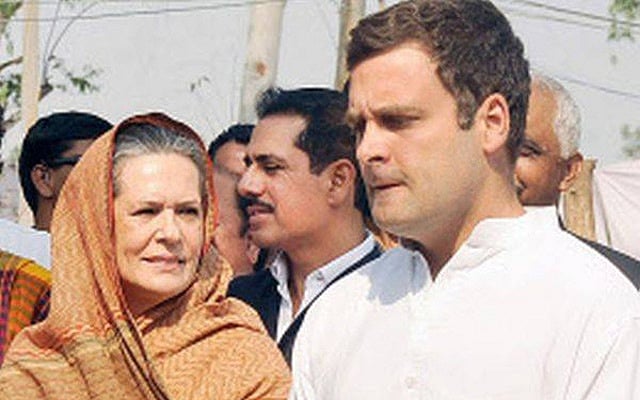
Rahul, his Italian-born mother and leader of the party, Sonia, beside him, shouldered blame for their party's rout.
Both mother and son held onto their own seats, but these were the only ones their party clinched in the crucial state of Uttar Pradesh, which sends 80 lawmakers to parliament.
Prime Minister Manmohan Singh launched reforms in 1991 as finance minister that opened India's socialist economy to global capital, but his spell in the top job ended marred by corruption and a floundering economy amid mounting policy paralysis. He has already bid farewell to his staff after ten years in office.
A dark chapter of violence against Muslims on Modi's watch in Gujarat has mattered less and less to many, including a ballooning middle class alarmed by dwindling purchasing power and job opportunities as the economy slumped to sub-five percent growth in the last two years.
Modi has promised that, if elected, he would take decisive action to unblock stalled investments in power, road and rail projects to revive economic growth.
Tax and labour market reforms, backed by a gradual opening up to foreign investment, would seek to create the 10 million jobs that Asia's third-largest economy needs every year to absorb young people entering the workforce.