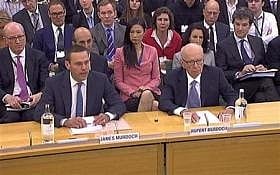
James Murdoch appears before Leveson Inquiry
James Murdoch is being quizzed about his closeness to political leaders, as the Leveson Inquiry prompted by the phone-hacking scandal at his father's newspaper empire delves into the relationship between politicians and the media.
bdnews24.com News Service
bdnews24.com
Published :
24 Apr 2012, 12:16 PM
Updated :
09 Aug 2022, 03:42 PM
LONDON, Apr 24 (bdnews24.com/Reuters) James Murdoch is being quizzed about his closeness to political leaders, as the Leveson Inquiry prompted by the phone-hacking scandal at his father's newspaper empire delves into the relationship between politicians and the media.
The ex-News International chairman said he had thought hacking a "thing in the past" when he took over his father's UK newspaper operations in 2007.
It remained his position that he did not know of the "For Neville" email until 2010, he told the inquiry.
He was also asked about meeting David Cameron during News Corp's BSkyB bid.
Earlier Mr Murdoch, who resigned from News International in February, told the inquiry into press standards it was "self-evident" the controls in place "had failed to create the sufficient transparency".
He said he had wanted a "more collaborative" management structure, when he took over in 2007.
The younger Murdoch, who stepped down this month as chairman of BSkyB, may be asked whether the family political influence his Australian-born father had built up over four decades may have contributed to a sense of invulnerability among the tabloid journalists accused of hacking voicemails to break stories.
Nine months after the Murdochs, father and son, sat together to defend their record before a parliamentary committee - an uncomfortable three hours marked by a protester hitting Rupert, now 81, with a shaving-foam "pie" - investors in News Corp will again be watching closely how they perform.
Some investors have voiced dissatisfaction with their running of the businesses and fear scandal could touch the U.S. core of the Murdochs' operations. The group has moved to defend its reputation by cooperating with British police.
NEWS OF THE WORLD
The inquiry by Brian Leveson, a senior judge, was prompted by scandal at the News of the World, a 168-year-old Sunday tabloid that was Britain's biggest selling newspaper until the Murdochs shut it down and apologized to victims of crime and celebrities whose mobile phone voicemails had been hacked by private detectives working with the paper's journalists.
Leveson and his team of legal inquisitors have already grilled hacking victims and journalists, and officers from London's Metropolitan Police, whose own passing of information to the press and failure to pursue criminal inquiries when allegations first surfaced years ago has caused public anger.
U.S.-based News Corp, owner of Fox Television and the Wall Street Journal, was thwarted in its ambition last year to buy the 61 percent of BSkyB, a major British pay-TV provider, that it did not already own. Amid the fire storm of scandal at the News of the World, it withdrew the bid.
Before that happened, however, James Murdoch met Cameron's media minister, Jeremy Hunt, early last year, at a time when the company was thrashing out concessions to British politicians who were concerned about a concentration of power across newspapers and television if the $12-billion deal went through.
The Leveson Inquiry is expected to ask about that, as well as a Christmas party James Murdoch has said he attended with the prime minister late in 2010 at the home of Rebekah Brooks, the Murdochs' star tabloid editor at the News of the World and later The Sun. She quit the company last July and has since been arrested.
James Murdoch has, since the scandal broke, stepped down from the News International subsidiary which publishes the British newspapers - including the Times and Sunday Times - and moved to New York as News Corp deputy chief operating officer.
CAMERON'S FRIENDS
Cameron, who won power two years ago, has been forced to play down his contacts with the Murdochs and with Brooks, a neighbor and frequent guest at his home in the countryside.
Many critics believe that the News of the World's ability to make and break careers, partly through information gleaned from phone-hacking, discouraged police and politicians from investigating the allegations more thoroughly years ago.
The inquiry's principal brief was to investigate press ethics but it is probing relationships between the press, police and politicians which many see as a complex web of influence.
"I'm genuinely not too sure how far Leveson can push it in terms of the relationship between media owners and politicians without its snowballing into an inquiry about politics," said Charlie Beckett, founding director of the Polis journalism and society think-tank at the London School of Economics.
"I wonder when it started whether David Cameron really thought it was going to turn into this wide-ranging inquiry about how we conduct politics. It's gone far beyond newspapers doing dodgy things."
Cameron and other top politicians are expected to be called to give evidence to the inquiry.
James Murdoch also faces questions from other quarters, including a committee of British parliamentarians about his role in covering up the scale of phone-hacking at the News of the World, whose parent company he ran in the immediate aftermath.
Although he is not accused of sanctioning the hacking itself, which took place while he was running News Corp's pay-TV businesses, he approved an unusually large payoff to one of the victims and asked few questions.
The parliamentary committee is expected to report next week on the findings of a months-long investigation.
bdnews24.com/lq/1656h.