


Published : 09 Nov 2016, 10:39 PM
Updated : 11 Apr 2022, 10:20 PM


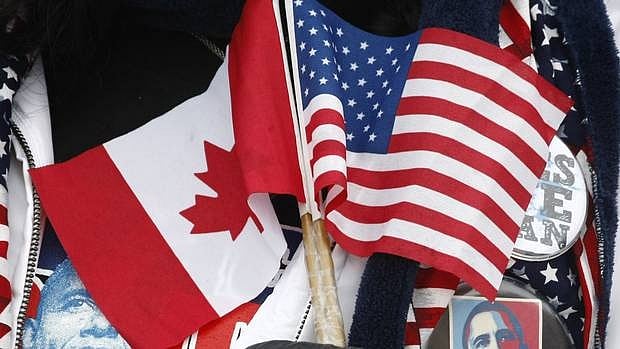
Although Prime Minister Justin Trudeau has congratulated Trump on his election and promised to work with him to bolster trade and international security, the media has summed up the victory as a ‘stunning upset’.
“Suddenly, a monkey wrench has been thrown into the works of Canada-US relations. For so long, Canadian governments worked to make sure relations would be relatively predictable. The US electorate changed that on Tuesday night,” wrote a commentator in the Globe and Mail, one of the largest-circulated dailies in Toronto.
“When a US president focuses a major part of his campaign on building up borders in every sense – on trade, immigration, security – you can bet it is a danger to the nation that depends the most on dealings across the border. That’s Canada,” the commentator said.
“Donald Trump, the surprise winner of the US presidential race, has promised to rip up many of the things Canada has tried to nail down,” he added.
“The threat of protectionist US moves that would cut off crucial trade links? Canadian leaders signed free-trade agreements to blunt that danger – but Mr. Trump pledged to tear up the North American Free Trade Agreement (NAFTA),” the commentator went on.
Canada is the biggest trade partner of the US where it exports over 75 percent of its goods and services. It also shares around 4,000 miles of territorial boundary (excluding Alaska) with America. A NAFTA break-up will change all that and put the Canadian economy in trouble.
In his campaign, everything in Trump’s rhetoric - from immigration to terrorism threats to Muslim visitors, was about bigger, thicker borders – and suggested slower passage for traffic and trade, which Canada cannot afford.
“I am going to bring our jobs back to Ohio and Pennsylvania and New York and Michigan and all of America and I am not going to let companies move to other countries, firing their employees along the way, without consequences,” Trump had said in the campaign.
He also described the North American free-trade agreement as a “disaster” and said he would renegotiate or even “break” it.
However, some economists and commentators believe that the protectionists talk in the US election is very common but when it comes to governing, the scenario could be completely different.
Not only NAFTA, Trump has questioned the value of NATO, saying he would demand that allies pay more for US protection.
Toronto’s Global News reported that Canadian officials are already bracing for a very bumpy ride as the shockwaves from stunning upset reverberates to south of the border.
Experts, according to the Global News, agree on one point: “It’s not going to be business as usual.”
It’s too early to suggest where Trump’s ‘America First’ policy would lead Canada in its relations with the neighbour. But economics and trade, environment, security and defence, and international relations may all come under further scrutiny under the new US administration.
Prime Minister Trudeau is pressing forward on a climate-change policy to reduce greenhouse-gas emissions but with Trump in power, he would find it harder to sell his own climate-change policies in Canada.
Trudeau avoided talking down Trump during the election campaign and he probably did it for Canada’s interest to build the relationship.
There are other things to build on – cross-border security arrangements and NORAD, which is the bilateral military air defence alliance, are a few to name.
But how far can Trudeau carry forward the Canadian agenda with the protectionist ‘America First’ US president? Is Trump becoming a new conundrum for Canadian PM? It will take sometime to get the answer.







