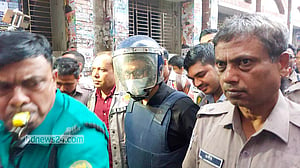
India fumes over freeing of Pakistani militant
India questioned Pakistan's will to act against "terrorist groups" on Tuesday after a Pakistani court ordered the release of a suspect in last year's Mumbai attacks.
bdnews24.com News Service
bdnews24.com
Published :
03 Jun 2009, 04:34 AM
Updated :
12 Aug 2022, 01:13 PM
LAHORE/NEW DELHI, June 3 (bdnews24.com/Reuters) - India questioned Pakistan's will to act against "terrorist groups" on Tuesday after a Pakistani court ordered the release of a suspect in last year's Mumbai attacks.
Hafiz Mohammad Saeed heads the Jamaat-ud-Dawa (JuD) charity, which the United Nations said in December was a front for the Lashkar-e-Taiba, an outlawed militant group accused of carrying out November's assault on the city.
He is one of 38 people charged by India as key planners of the attacks, in which 166 people were killed.
They led to renewed tensions between the nuclear-armed rivals as India "paused" a slow-moving peace process and demanded Islamabad "dismantle the infrastructure of terrorism".
The United States had also pressed Pakistan to take strong action against those responsible for the Mumbai attacks.
"The court has ordered that the detention of Hafiz Saeed was a violation of the constitution and the law of this country," lawyer A.K. Dogar told reporters outside the Lahore High Court.
Saeed was put under house arrest in early December after a U.N. Security Council committee added him and the Islamist charity he heads to a list of people and organisations linked to al Qaeda or the Taliban.
Saeed founded the LeT militant group in 1990, and for years it battled Indian forces in the disputed Kashmir region.
Saeed stepped down as LeT leader shortly after India accused the group of being behind an attack on its parliament in December 2001. The group was banned in Pakistan in January 2002.
Until recently, the JuD had an extensive welfare network across Pakistan, funded by donations. It played a major role in helping survivors of a 2005 earthquake in northern mountains that killed 73,000 people.
"His release raises serious doubts over Pakistan's sincerity in acting with determination against terrorist groups and individuals operating from its territory," Vishnu Prakash, India's foreign ministry spokesman, said on Tuesday.
But Pakistan rejected comments as "misplaced".
"The government of Pakistan is well aware of its obligations under national and international laws," Pakistani foreign ministry spokesman Abdul Basit said in a statement. "Polemics and unfounded insinuations cannot advance the cause of justice in civilised societies. Legal processes cannot and must not be interfered with."
"NOTHING PROVED"
India says the assault on Mumbai was carried out by Pakistan-based LeT militants who must have had backing from some official Pakistani agencies.
Pakistani investigators have acknowledged the coordinated attacks in India's financial capital were launched and partly planned from Pakistan's soil, and that the sole surviving attacker was Pakistani.
Pakistan has lodged police complaints against eight suspects, including Mohammad Ajmal Kasab, the only militant caught alive by Indian forces during the attack. Saeed was not among the eight.
A spokesman for Saeed said the court order proved the JuD charity had no link to terrorism.
"The government has been defeated. Our innocence has been proven," said JuD spokesman Yahya Mujahid.
"Ours is a relief organisation. The decision has proved that we have nothing to do with terrorism. We were on right path and it has been proved ... Nothing has been proved against us."
India gave Pakistan a dossier of information shortly after the attack and followed it up last month with what it said was more evidence that Pakistan could use to prosecute the guilty.
Indian officials say Pakistan is yet to report the progress of the investigations.
"This (Saeed's release) only shows that Pakistan's seriousness about fighting terror is still under a cloud," India's new foreign minister, Somanahalli Mallaiah Krishna, told reporters in New Delhi.
Indian experts said Saeed's release could further strain relations between the two countries.
"There seems to no match between words and action in Pakistan now," said Naresh Chandra, a former diplomat to Washington.
bdnews24.com/mhb/1044 hrs.