


Published : 09 Apr 2022, 12:46 PM
Updated : 18 Jul 2022, 02:42 PM


Thatcher was urging Bush not to let up pressure on Iraq after its invasion of Kuwait. Johnson is urging Germany not to let up pressure on Russia after its invasion of Ukraine. But Johnson was also determined to project unity, and whether he was as persuasive with Scholz in private as his hawkish predecessor was with Bush in 1990 is not yet clear.
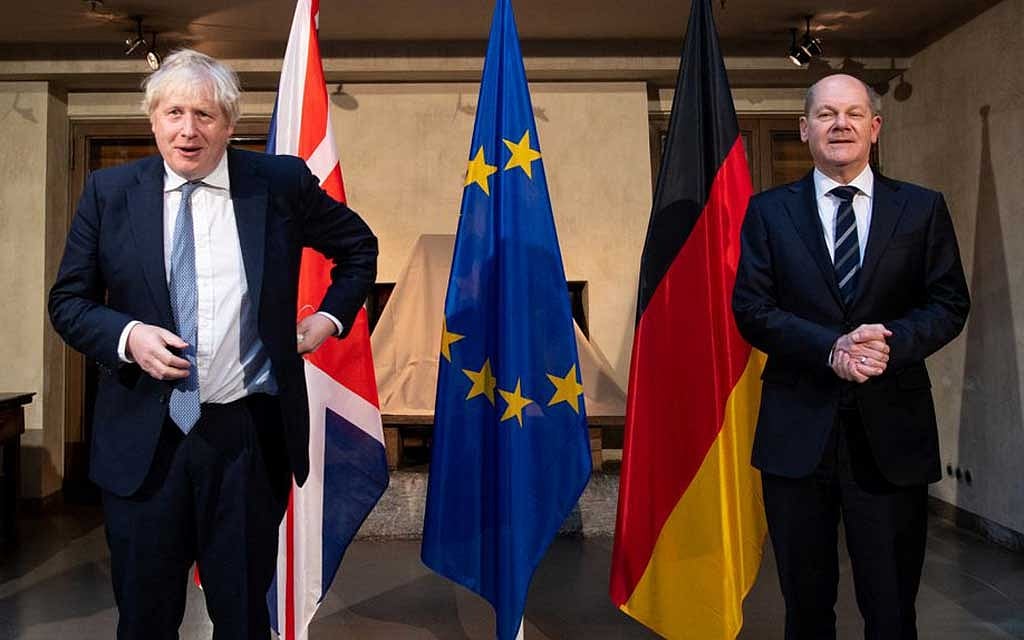
Speaking after their meeting, Johnson said Germany had committed to weaning itself off Russian energy, even if the European Union has rejected British calls for a clear timetable to eliminate imports of Russian gas. Russian President Vladimir Putin, he said, was betting that he could divide European allies on this issue, but he had failed.
“This is not easy for any of us, and I applaud the seismic decisions taken by Olaf’s government to move Germany away from Russian hydrocarbons,” Johnson said. “We cannot transform our respective energy systems overnight, but we also know that Putin’s war will not end overnight.”
Britain, under Johnson, has staked out the most aggressive role of any major European power in its support for Ukraine and its condemnation of Russia. Yet its influence on Germany and France is questionable, given that Britain, having left the EU, no longer has a seat at the table in Brussels.
“We are doing all we can, and we are doing a lot,” Scholz said of Germany’s efforts to reduce its dependence on Russia. But he warned that it would require massive investments to install the infrastructure to import gas from other countries.
For Scholz, the economic and political costs of cutting off Russian gas outweigh anything Johnson can say to him.
After making a landmark commitment to increase Germany’s military spending soon after he took office, critics say, Scholz has begun to feel the weight of his country’s geopolitical role in Europe. That has stoked concerns that he could end up enabling Putin by continuing to do business with Russia, much as critics now say his predecessor, Angela Merkel, did.
“There is vacuum of leadership in Europe, and Germany should be the country filling that vacuum,” said Norbert Röttgen, a Christian Democrat who chaired the German Parliament’s Foreign Affairs Committee until 2021. “But instead of leading, we are too slow, too late, and we are doing too little to impose maximum pressure on Russia.”
Johnson, however, steered clear of criticism on Scholz’s visit to London, his first as chancellor. To the extent he showed daylight with a European leader, it was with French President Emmanuel Macron, who has come under scrutiny for continuing to talk to Putin since the war began. Johnson has not spoken to him since before Russian troops crossed the Ukrainian border.
“Negotiating with Putin does not seem to me to be full of promise,” he said. “That is not to say that I don’t admire the efforts of those who try to find a way through, but for myself, I am very sceptical and indeed cynical.”
Johnson has made Britain an early and avid supplier of weapons to Ukraine. On Friday, he announced fresh shipments of an anti-aircraft missile system, known as Starstreak, and 800 anti-tank missiles. Defence Minister Ben Wallace said Britain would also provide Ukraine with armoured vehicles. Last week, he convened a donor conference of more than 35 countries to pledge weapons.
Before it left the EU, Britain often acted as a bridge between the United States and Europe, using its close ties with Washington to argue for American positions with France and Germany. That brought mixed results even before Brexit, and it seems even less plausible now.
“It’s very unlikely Britain could play a bridging role, because it has tried to outflank even Poland in being hard-line toward Russia,” said Jonathan Powell, who served as chief of staff to Prime Minister Tony Blair during the later Iraq war. “Boris Johnson sees himself as being the vanguard rather than a bridge.”
The risk for Britain, Powell said, is that it is viewed in other European capitals as merely a “running dog for the Americans.” That is convenient for the Biden administration, he said, because “they can always rely on him to come out and say something even more extreme than they do.”
Johnson has forged a highly visible relationship with Ukrainian President Volodymyr Zelenskyy, calling him virtually every day. On Zelenskyy’s virtual speaking tour of foreign parliaments, his first stop was Britain’s House of Commons, where he singled out Johnson to thank him for his support.
“Having someone who is out on a limb is helpful because you can use them to shame other countries,” Powell said.
For Johnson, the war in Ukraine has utterly eclipsed a skein of political scandals at home. He has certainly shown an astute capacity to seize the moment. Last week, he recorded a video for the Russian people in which he tried to separate them from Putin. “Your president stands accused of committing war crimes,” he said in passable Russian. “But I cannot believe he’s acting in your name.”
On Friday, Britain imposed sanctions on two daughters of Putin and a daughter of Russian Foreign Minister Sergey Lavrov. They were the latest in what critics say is a long-overdue effort to crack down on wealthy Russians, many of whom have poured ill-gotten gains into London real estate.
“Before the crisis, the UK position was seen as hypocritical because of the failure to tackle Russian wealth flowing into London,” said Malcolm Chalmers, deputy director general of the Royal United Services Institute, a think tank. “But now it’s done things that people have been urging them to do for years.”
Johnson has also pounded away at the need for Europe to reduce its dependence on Russian energy, a goal that is easier for Britain since it is far less reliant on it than its continental neighbours. On Wednesday, Britain announced it would stop buying Russian coal and oil by the end of 2022, and gas “as soon as possible thereafter.”
“He’s right to be a flag-bearer on the energy issue, even if it’s easier for us to do that,” said Kim Darroch, a former British ambassador to the United States. “The Europeans will say, ‘What are you doing on Londongrad?’” he said, referring to the flood of suspicious Russian money. “And the answer is: ‘Not enough yet.’”
©2022 The New York Times Company













