


Published : 05 Apr 2022, 04:12 PM
Updated : 03 Aug 2022, 11:42 AM


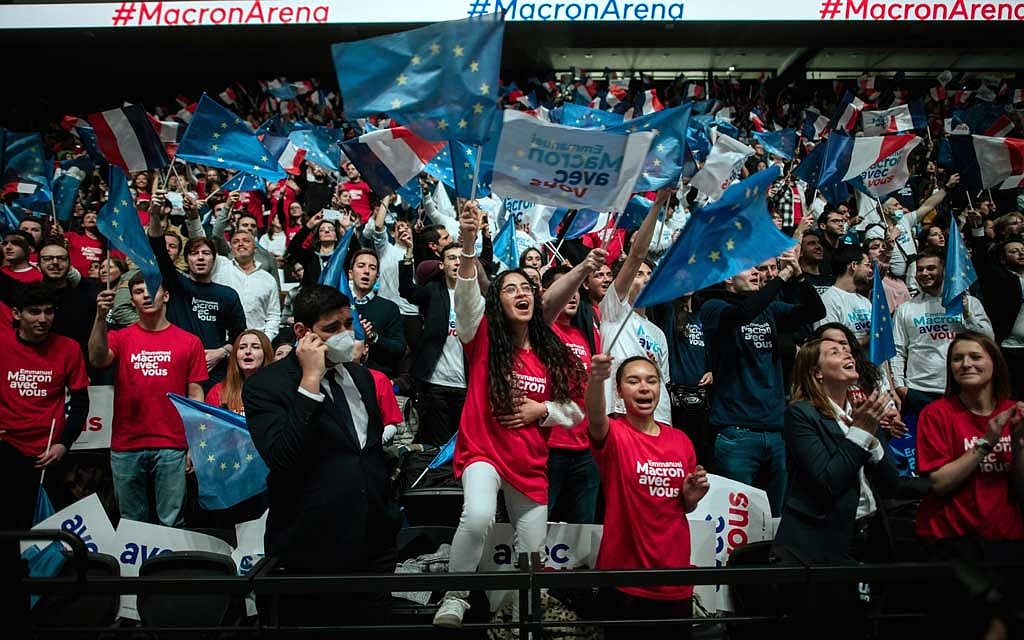
It was a highly choreographed appearance — his first campaign rally for an election now less than a week away — with something of the air of a rock concert. But Macron had come to sound an alarm.
Do not think “it’s all decided, that it’s all going to go well,” he told the crowd, a belated acknowledgment that a presidential election that had seemed almost certain to return him to power is suddenly wide open.
The diplomatic attempt to end the war in Ukraine has been time-consuming for Macron, so much so that he has had little time for the French election, only to awaken to the growing danger that France could lurch to the anti-immigrant right, with its Moscow-friendly politics and its scepticism of NATO.
Marine Le Pen, the hard-right leader making her third attempt to gain power, has surged over the past couple weeks, as her patient focus on cost-of-living issues has resonated with the millions of French people struggling to make ends meet after an increase of more than 35% in gas prices over the past year.
The most recent poll from the respected Ifop-Fiducial group showed Le Pen gaining 21.5% of the vote in the first round of voting on Sunday, almost double the vote share of the fading extreme-right upstart Éric Zemmour, with 11%, and closing the gap on Macron with 28%. The two leading candidates go through to a runoff on April 24.
More worrying for Macron, the poll suggested he would edge Le Pen by just 53.5%-46.5% in the second round. In the last presidential election, in 2017, Macron trounced Le Pen by 66.1% to 33.9% in the runoff.
“It’s an illusion that this election is won for Macron,” said Nicolas Tenzer, an author who teaches political science at Sciences Po university. “With a high abstention rate, which is possible, and the level of hatred toward the president among some people, there could be a real surprise. The idea that Le Pen wins is not impossible.”
Édouard Philippe, a former prime minister in Macron’s government, warned last week that “of course Le Pen can win.”
This notion would have seemed ridiculous a month ago. Le Pen looked like a has-been after trying and failing in 2012 and 2017. Zemmour, a glib anti-immigrant TV pundit turned politician with more than a touch of Donald Trump about him, had upstaged her on the right of the political spectrum by suggesting that Islam and France were incompatible.
Now, however, Zemmour’s campaign appears to be sinking in a welter of bombast, as Le Pen, who said last year that “Ukraine belongs to Russia’s sphere of influence,” reaps the benefits of her milquetoast makeover.
Zemmour may in the end have done Le Pen a service. By outflanking her on the right, by becoming the go-to candidate for outright xenophobia, he has helped the candidate of the National Rally (formerly the National Front) in her “banalization” quest — the attempt to gain legitimacy and look more “presidential” by becoming part of the French political mainstream.
Macron has fallen two or three percentage points in polls over the past week, increasingly criticised for his refusal to debate other candidates and his general air of having more important matters on his mind, like war and peace in Europe, than the laborious machinations of French democracy.
A recent front-page cartoon in the daily newspaper Le Monde showed Macron clutching his cellphone and turning away from the crowd at a rally. “Vladimir, I’m just finishing with this chore and I’ll call you back,” he says.
With a colourless prime minister in Jean Castex — Macron has tended to be wary of anyone who might impinge on his aura — there have been few other compelling political figures able to carry the president’s campaign in his absence. His centrist political party, La République en Marche, has gained no traction in municipal and regional politics. It is widely viewed as a mere vessel for Macron’s agenda.
His government’s wide use of consulting firms, including McKinsey & Co — involving spending of more than $1.1 billion, some of it on the best ways to confront COVID-19 — has also led to a wave of criticism of Macron in recent days. A former banker, Macron has often been attacked as “the president of the rich” in a country with deeply ambivalent feelings about wealth and capitalism.
Still, Macron has proved adept at occupying the entire central spectrum of French politics through his insistence that freeing up the economy is compatible with maintaining, and even increasing, the French state’s role in social protection. Prominent figures of the centre-left and centre-right attended his rally Saturday.
Over the course of the past five years, he has shown both faces of his politics, first simplifying the labyrinthine labour code and spurring a startup business culture, then adopting a policy of “whatever it costs” to save people’s livelihoods during the coronavirus pandemic. His handling of that crisis, after a slow start, is widely viewed as successful.
“He absolutely proved up to the task,” Tenzer said.
Still, much of the left feels betrayed by his policies, whether on the environment, the economy or the place of Islam in French society, and Macron was at pains Saturday to counter the view that his heart lies on the right. Citing investments in education, promising to raise minimum pensions and give a tax-free bonus to employees this summer, Macron proclaimed his concern for those whose salaries vanish in “gasoline, bills, rents.”
It felt like catch-up time after Macron had judged that his image as a statesman-peacemaker would be enough to ensure him a second term. Vincent Martigny, a professor of political science at the University of Nice, said of Macron that “his choice to remain head of state until the end prevented him from becoming a real candidate.”
The worrying scenario for Macron is that Zemmour’s vote would go to Le Pen in a runoff, and that she would be further bolstered by the wide section of the left that feels betrayed or just viscerally hostile toward the president, as well as by some centre-right voters for whom immigration is a core issue.
On the president’s first campaign foray into the provinces, a visit to Dijon last week where he spent time in a working-class area, accompanied by the socialist mayor, Macron offered this explanation of his sometimes seesawing policies: “When you walk you need two legs. One on the left, and one on the right. And you have to place one after the other in order to advance.”
It was the sort of clever phrase that infuriates Macron’s opponents, leaving them unsure what angle to attack him from.
Le Pen has focused relentlessly on economic issues, promising to reduce gas and electricity prices, tax the hiring of foreign employees to favour nationals, preserve the 35-hour week and maintain the retirement age at 62, whereas Macron wants to raise it to 65.
Macron has warned that the French will have to “work harder,” a phrase dear to the former centre-right President Nicolas Sarkozy, and so a means to lure Sarkozy’s faithful followers to the Macron camp.
If Le Pen has wanted to appear a softened politician, she is by no means as transformed from the anti-immigrant zealot she was as she likes to suggest. Her program includes a plan to hold a referendum that would lead to a change in the Constitution that would bar policies that lead to “the installation on national territory of a number of foreigners so large that it would change the composition and identity of the French people.”
“France, land of immigration, is finished,” she said in February. She also said the French must not allow their country to “be buried under the veil of multiculturalism.” In September 2021, she declared: “French delinquents in prison, foreigners on a plane!”
The working-class vote is essentially split between Le Pen and the hard-left candidate, Jean-Luc Mélenchon, who has also been gaining ground in recent polls as the electorate begins to focus on what vote would be most effective in propelling a candidate into the second round. But at around 15%, Mélenchon appears to be well adrift from Le Pen in the race for the runoff.
The French left has proved chronically split to the point of near political irrelevance for the first time since the Fifth Republic’s foundation in 1958. The Socialist Party, whose candidate François Hollande won the 2012 election and governed until 2017, has collapsed, with just 1.5% of the vote in the Ifop-Fiducial poll.
Although Le Pen has tried to distance herself a little from President Vladimir Putin of Russia, whom she met in Moscow in 2017, and whose policies she had backed until the war in Ukraine, she remains allergic to hard-line measures toward Russia. A victory by her would threaten European unity, alarm French allies from Washington to Warsaw, Poland, and confront the European Union with its biggest crisis since Brexit.
“Do we want to die?” she asked in a recent television debate, when asked if France should cut off oil and gas imports from Russia. “Economically, we would die!”
She added: “We have to think of our people.”
©2022 The New York Times Company













