Published :
27 Jun 2013, 03:59 AM
Updated :
09 Aug 2022, 10:51 AM
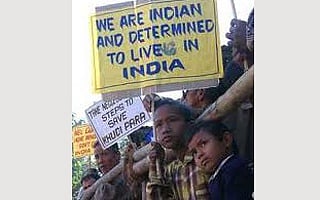
The residents took out huge rallies on Wednesday, a day they observe as Martyrs day for Kshiten Adhikari and Jiten Roy who died in police firing.
Demonstrations continued on Thursday in various enclaves.
The protests are organised by the Bharat Bangladesh Enclaves Exchange Coordination Committee.

"Our people have suffered huge deprivation since Independence. We want India to formalise the Land Boundary Agreement without any more delay," says the Committee's chief Diptiman Sengupta.
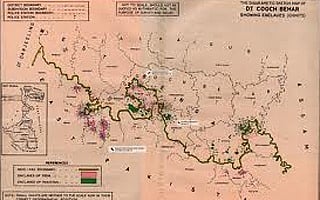
The residents of 111 Indian enclaves in Bangladesh (spread across four districts -- Kurigram,Lalmonirhat, Nilphamari and Panchagarh) have been joined by those from 55 Bangladesh enclaves inside West Bengal's Cooch Behar districts in the ongoing protests.
The Indian enclaves cover 17158 acres with a population of 200,000 and the Bangladesh enclaves are spread over 7110 acres with half that population.
Under terms of the 2011 India-Bangladesh Land Boundary Agreement, the enclaves will be exchanged and the residents can securely in their own countries.
But while Bangladesh has ratified the treaty, India is stuck with its draft in parliament as the present UPA government does not have sufficient majority to pull it off in the face of stiff resistance from the BJP and some regional parties like the Asom Gana Parishad.
The BJP, whose local unit in Cooch Behar district is not averse to the Land Boundary agreement, has strangely argued that the agreement will change India's boundaries which impacts on the 'basic structure' of the Constitution.
But analysts say that is a strange argument as that will foreclose any future agreement with any neighbour to settle a boundary dispute.
"What happens if India and China have to do a give-and-take on their disputed borders to reach a settlement at some point?" says lawyer Hafiz Choudhury. "The boundaries of a nation can always change."