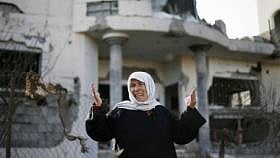
Ceasefire collapses in Gaza
Israeli ceasefire for Egyptian Prime Minister's visit to the Gaza Strip collapses after Palestinians continued cross-border rocket attacks and Israel launched air strikes. Updates
bdnews24.com News Service
bdnews24.com
Published :
16 Nov 2012, 09:42 AM
Updated :
09 Aug 2022, 04:31 PM
Gaza, Nov 16 (bdnews24.com/Reuters)—Egypt opened a tiny window to emergency peace diplomacy in Gaza on Friday, but hopes for even a brief ceasefire while its Prime Minister was inside the bombarded enclave to talk to leaders of the Islamist Hamas movement were immediately dashed.
Prime Minister Hisham Kandil arrived in the Gaza Strip on Friday officially to show solidarity with the Palestinian people after two days of relentless attacks by Israeli warplanes determined to end militant rocket fire at Israel.
Israel said it would cease fire during the visit if Hamas did too. But rockets fired from Gaza hit several sites in southern Israel and the Israeli air force responded with an attack on the house of Hamas's commander for southern Gaza, a Hamas source said.
Medics said it killed two people, one of them a child, raising the Palestinian death toll since Wednesday to 21. Three Israelis were killed by a rocket on Thursday.
However, Israel's military denied on Friday that it had carried out attacks in the Gaza Strip during a Hisham Kandil's visit to the enclave.
The Islamist Hamas group also claimed Israel launched air strikes, killing two people. The Israeli military said it had not carried out any attacks after Kandil arrived in the enclave.
An Israeli military spokeswoman said about 50 rockets were fired at Israel from Gaza while Kandil was in the Palestinian territory. Israeli broadcasts showed damage from one rocket that struck the southern city of Ashkelon.
"Hamas does not respect the Egyptian Prime Minister's visit to Gaza and violates the temporary ceasefire that Israel agreed to during the visit," Ofir Gendelman, a spokesman for Israeli Prime Minister Benjamin Netanyahu, wrote on Twitter.
Air raid sirens had wailed over Tel Aviv on Thursday sending residents rushing for shelter and two long-range rockets exploded just south of the metropolis. The location of the impacts was not disclosed.
They exploded harmlessly, police said. But they have shaken the 40 percent of Israelis who, until now, lived in safety beyond range of the southern rocket zone.
"Even Prime Minister (Benjamin) Netanyahu was rushed into a reinforced room," said Cabinet Minister Gilad Eldan.
Israel has started drafting 16,000 reserve troops, in what could be a precursor to invasion.
The 21 Palestinian dead include including eight militants and 13 civilians, among them seven children and a pregnant woman. A Hamas rocket killed three Israeli civilians a town north of Gaza, men and women in their 30s.
Their last war, a lopsided three-week long Israeli air blitz and ground invasion over the New Year period of 2008-2009, left more than 1,400 Palestinians dead, mostly civilian, and killed 13 Israelis.
The Message
"If Hamas says it understands the message and commits to a long ceasefire, via the Egyptians or anyone else, this is what we want. We want quiet in the south and a stronger deterrence," Israeli Vice Prime Minister Moshe Yaalon said.
"The Egyptians have been a pipeline for passing messages. Hamas always turns to request a ceasefire. We are in contact with the Egyptian Defence Ministry. And it could be channel in which a ceasefire is reached," he told Israeli radio.
At the same time, there were signs of possible preparations for a ground assault on Gaza. In pre-dawn strikes, warplanes bombed open land along the border zone with Israel, in what could be a softening-up stage to clear the way for tanks.
Self-propelled heavy artillery was seen near the border.
The United States has asked countries that have contact with Hamas to urge the Islamist movement to stop its recent rocket attacks from Gaza, a White House adviser said.
"We've ... urged those that have a degree of influence with Hamas, such as Turkey and Egypt and some of our European partners, to use that influence to urge Hamas to de-escalate," Ben Rhodes, Deputy National Security Adviser, said in a conference call with reporters.
US Defence Secretary Leon Panetta said in an interview with Voice of America: "I understand the reasons Israel is doing what they're doing. They've been the target of missiles coming in from Gaza ... ."
Egypt on the spot
The Gaza conflagration has stoked the flames of a Middle East ablaze with two years of Arab revolution and a civil war in Syria that threatens to inflame the whole region.
Egypt's new Islamist President, Mohamed Mursi, viewed by Hamas as a protector, led a chorus of denunciation of the Israeli strikes by allies of the Palestinians.
Mursi faces domestic pressure to act tough. But Egypt gets $1.3 billion a year in US military aid and looks to Washington for help with its ailing economy, constraining Mursi despite his need to show Egyptians that his policies differ from those of his US-backed predecessor, Hosni Mubarak.
Hamas leader Ismail Haniyeh on Thursday urged Egypt to do more to help the Palestinians.
"We call upon the brothers in Egypt to take the measures that will deter this enemy," the Hamas Prime Minister said.
The appeal poses a test of Mursi's commitment to Egypt's 1979 peace treaty with Israel, which the West views as the bedrock of Middle East peace.
The Muslim Brotherhood, which brought Mursi to power in an election after the downfall of pro-Western Hosni Mubarak, has called for a "Day of Rage" in Arab capitals on Friday. The Brotherhood is seen as the spiritual mentor of Hamas.
The Israel Defence Forces (IDF) said they had targeted over 450 "terror activity sites" in the Gaza Strip since Operation Pillar of Defence began with the assassination of Hamas' top military commander on Wednesday by an Israeli missile.
Some 150 medium range rocket launching sites and ammunition dumps were targeted overnight. "The aim of targeting these sites is to impair the rocket launching capability of terror organizations in the Gaza Strip and hamper their continuous build up," an IDF statement said.
"The sites that were targeted were positively identified by precise intelligence over the course of months," it said. "The Gaza strip has been turned into a frontal base for Iran, forcing Israeli citizens to live under unbearable circumstances."
Israeli bombing has not yet reached the saturation level seen before it last invaded Gaza in the first days of 2009, when armoured bulldozers and tanks flattened whole districts of the crowded enclave to make way for fire bases and open routes for infantry.
bdnews24.com/trb/1540h