Published : 14 Nov 2019, 12:05 AM
Updated : 08 Apr 2022, 02:29 PM


— The Basics
Who: William Taylor, the top US diplomat in Ukraine, and George Kent, a senior State Department official in charge of Ukraine policy, will appear for joint testimony.
What: The House Intelligence Committee, led by its chairman, Rep. Adam Schiff, D-Calif., will offer lawmakers from both parties a chance to question the witnesses.
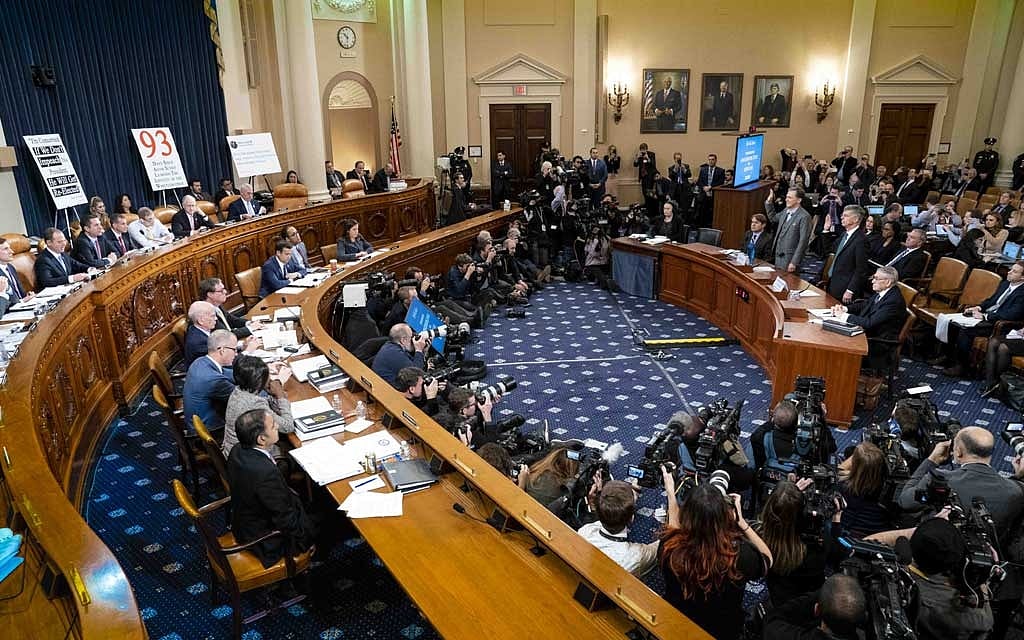
When and where: The proceedings start at 10 a.m. Eastern time in the one of the grandest hearing rooms the House has: the vaulted, columned chambers of the Ways and Means Committee. (Democrats intentionally chose the chambers as the backdrop.) We expect the hearing to go until midafternoon.
How to watch: The New York Times will stream the testimony live, and a team of reporters in Washington will provide real-time context and analysis of the events on Capitol Hill. Follow along at nytimes.com, starting a few minutes before 10 a.m.
— Four Key Issues Will Dominate the Hearings
The Democratic case against the president is built around four major issues that the president’s critics say prove that Trump abused his office:
Giuliani and a shadow diplomacy
Current and former diplomats and national security officials have described to investigators how Rudy Giuliani, the president’s personal lawyer, led a shadow foreign policy in Ukraine that circumvented career foreign service officers and established diplomatic channels in an effort to further Trump’s political agenda.
Kent told investigators that Giuliani’s influence over Trump when it came to Ukraine was “almost unmissable,” and that Giuliani led a “highly irregular” channel of policymaking on Ukraine.
The security aid
Congress approved nearly $400 million in security aid to help Ukraine counter Russian aggression. But witnesses have testified that the aid was abruptly frozen at the direction of the acting chief of staff, Mick Mulvaney, and the Office of Management and Budget. They have said they were alarmed to learn that the aid would not be restarted unless Ukraine agreed to publicly announce the investigations that Trump wanted.
In gripping closed-door testimony, Taylor recalled having seen firsthand Ukraine’s need for the security aid when he travelled to the country and witnessed its soldiers facing Russian forces across a damaged bridge. He told lawmakers that he knew at that time that “more Ukrainians would undoubtedly die without the US assistance.”
The July 25 call
At the heart of the Democratic case is the reconstructed transcript released by the White House of the July phone call between Trump and Ukraine’s president, Volodymyr Zelenskiy. In the call, Trump asked Zelenskiy, newly elected as Ukraine’s leader, to “do us a favor” and investigate the former vice president, as well as a conspiracy theory that asserts that Ukraine, not Russia, interfered in the 2016 election to help Democrats, not Trump.
Both sides have used the call to bolster their arguments. Democrats say it is direct evidence of Trump’s culpability in the pressure campaign. Republicans note that there is no direct mention during the call of the security aid and argue it falls far short of providing proof that the president was involved in abusing his office. Trump has insisted repeatedly that the call was “perfect” and exonerates him.
The ouster of Marie Yovanovitch
Among the most personal moments during Wednesday’s hearing is likely to be discussion of the ouster of Yovanovitch from her post as ambassador to Ukraine. Several witnesses have testified about a smear campaign led by Giuliani to damage Yovanovitch’s reputation and oust her.
Philip T. Reeker, the acting assistant secretary in charge of European and Eurasian Affairs, told investigators that the effort to cast Yovanovitch as a “liberal outpost” was a “fake narrative” that “really is without merit or validation.”
— Michael D. Shear
— Before then, catch up on some important background on the impeachment inquiry.
— Taylor and Kent have already appeared for closed-door depositions in the inquiry.
— Trump repeatedly pressured Zelenskiy to investigate people and issues of political concern to Trump, including former Vice President Joe Biden.
— A CIA officer who was once detailed to the White House filed a whistleblower complaint on Trump’s interactions with Zelenskiy.
— Pelosi announced in September that the House would open a formal impeachment proceeding in response to the whistleblower’s complaint.
— House committees have issued subpoenas to the White House, the Defense Department, the budget office and other agencies for documents related to the impeachment investigation.
© 2019 The New York Times Company