Published : 15 Nov 2019, 07:57 PM
Updated : 17 Oct 2022, 11:48 AM


It was grand drama and soap opera at the same time — a constitutional seminar one moment and a high school food fight the next. The president’s allies protested loudly. “You are disrupting the continuity of this meeting!” chastised the chairman trying to restore order. “We’re disrupting a railroad!” one of the president’s defenders shot back.
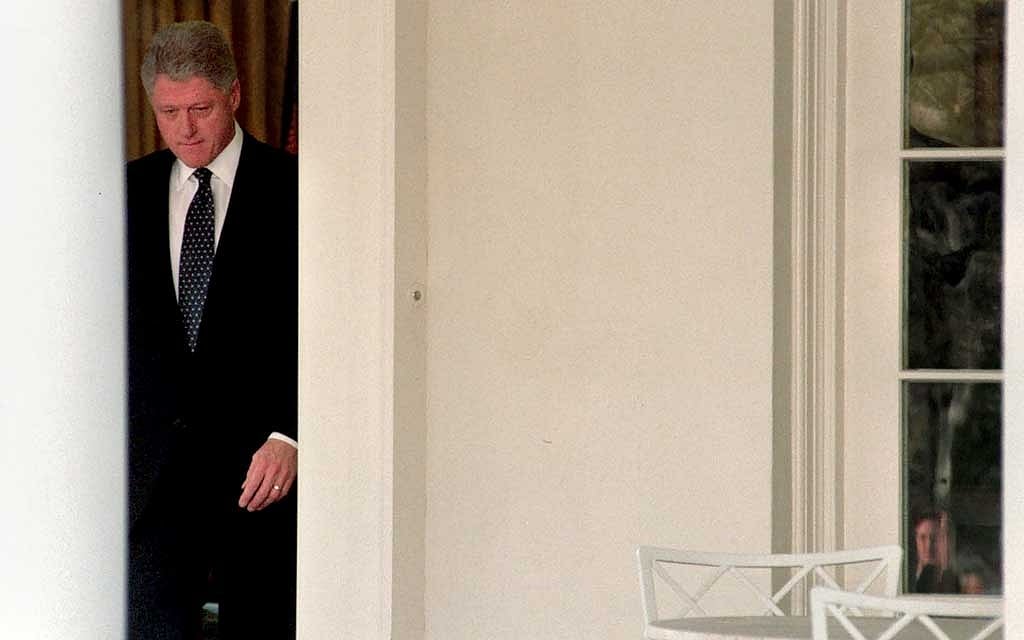
Twenty-one years later, almost to the day, another House committee has opened public hearings into whether to impeach another president, with plenty of grand drama and soap opera and food fight expected. As the first witnesses on Wednesday told their stories to a televised audience in the case against Donald John Trump, shadowing the latest constitutional showdown will be the impeachment of William Jefferson Clinton.
The scene may be similar, but the allegations are radically different — lying under oath about sexual indiscretions versus using the power of the presidency to extract foreign help against domestic rivals. The two presidents in the dock are radically different as well, both defiant, angry and aggrieved, yet one strived to hide it and be seen as above the partisan mudslinging, while the other dives headlong into the mud, energetically slinging away.
Even more transformed since the Clinton era is the Washington surround sound.
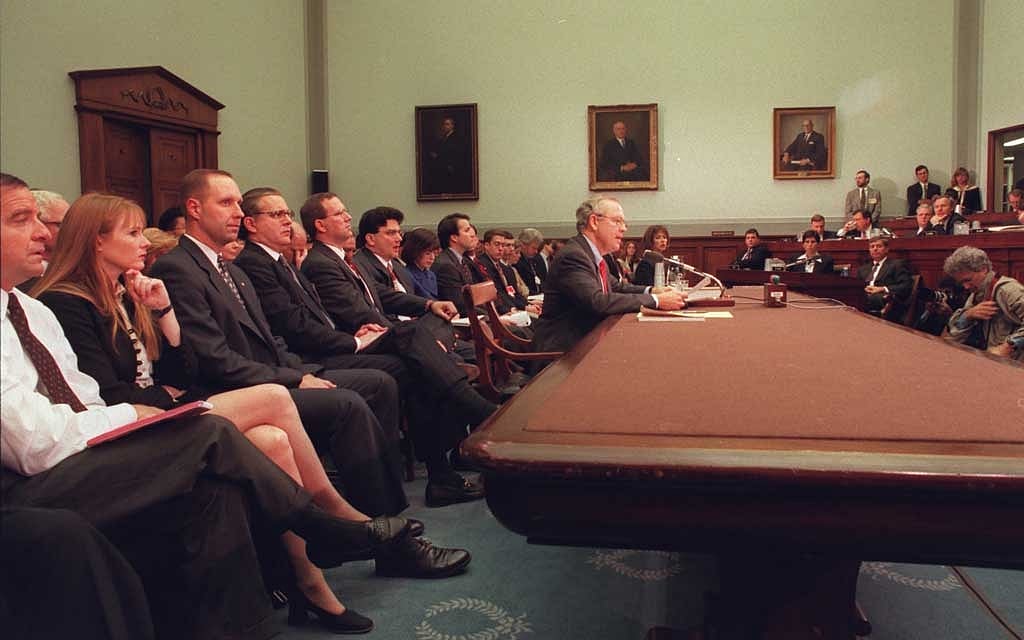
FILE -- Kenneth Starr, the independent prosecutor, testifies before the House Judiciary Committee's impeachment hearing of President Bill Clinton in Washington, Nov. 19, 1998. As the House opens public hearings into whether President Donald Trump committed high crimes and misdemeanours, the battle over Bill Clinton’s impeachment 21 years ago looms large. (Stephen Crowley/The New York Times)
“It feels like our experience 20 years ago was ‘Mayberry R.F.D.,’ and Andy Griffith was our sheriff,” said Lanny A. Breuer, who was one of the White House lawyers defending Clinton against impeachment. “As bad as we thought it was — and it was terrible, it was crazy, it was a rough and tough time — but for some reason it seems much simpler than today.”
Yet in some ways, Washington rings with the echoes of 1998, only with the partisan roles reversed.
The Republicans complain about an unfair process today, using words like “coup” and “lynching,” just like the Democrats complained about an unfair process then, using words like “coup” and “lynching.” The Democrats say they are acting on principle not partisanship today, just like the Republicans said they were acting on principle not partisanship then.
If Trump’s troubles stem from foreign affairs, Clinton’s were rooted in domestic affairs. His efforts to cover up his extramarital relationship with Monica Lewinsky, a onetime White House intern, when asked about it during a sexual harassment lawsuit led the House to impeach him for perjury and obstruction of justice. Only five Republicans and five Democrats crossed party lines on the first vote, though dozens of Republicans joined Democrats to reject two of the four proposed articles.
After a monthlong trial in the Senate in early 1999, Clinton was acquitted — less because of doubt that he did it than because of doubt that it was momentous enough to merit removal from office. Ultimately, a federal judge found Clinton in contempt of court and fined him; he acknowledged providing false testimony under oath, surrendered his law license for a time and settled the original harassment lawsuit for $850,000.
Like Trump two decades later, Clinton saw himself as the victim of enemies who were out to get him from the start, the target of what Hillary Clinton memorably termed a “vast right-wing conspiracy” pursuing one faux scandal after another until they finally found one that stuck.
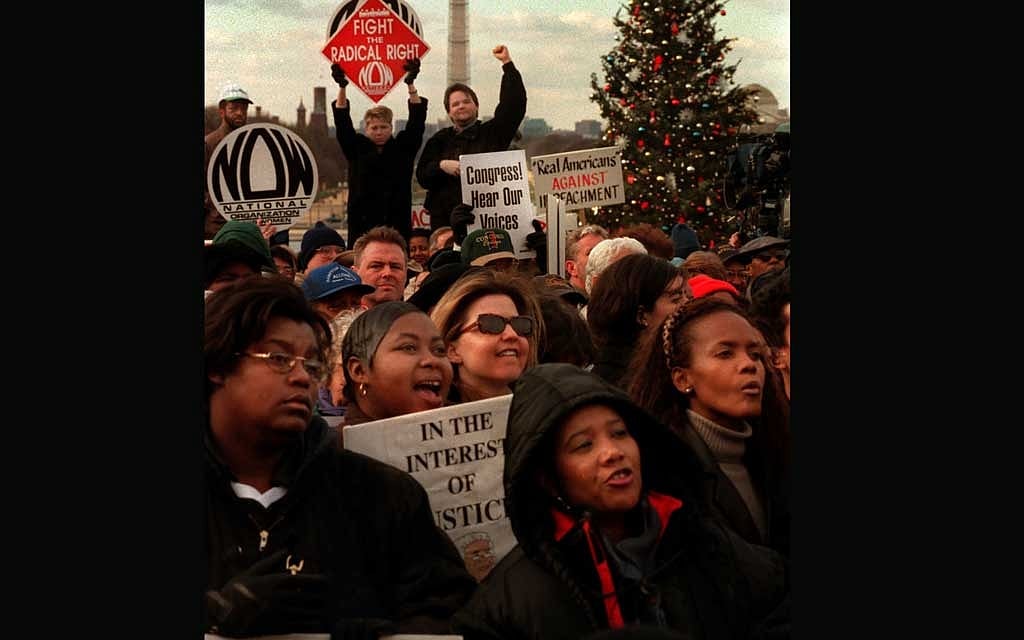
FILE -- Supporters of President Clinton take part in a rally on Capitol Hill, on Dec. 17, 1998. As the House opens public hearings into whether President Donald Trump committed high crimes and misdemeanours, the battle over Bill Clinton’s impeachment 21 years ago looms large. (Stephen Crowley/New York Times)
And there were ugly moments of collateral damage. Larry Flynt, the Hustler magazine publisher, offered a $1 million bounty for stories of adultery by members of Congress, which among other things resulted in the resignation of the next Republican speaker on the same day Clinton was impeached.
Clinton benefited throughout his battle with Congress from a strong economy, just as Trump does today. But Clinton was a significantly more popular president from the start, and most Americans opposed impeachment even though they did not like his conduct. His approval ratings were above 60% throughout the proceedings and in fact went up to 73% after the House impeachment vote.
Trump, by contrast, has never had anywhere near as much support from the public, with his latest Gallup approval rating at 41%. Judging by polls, many Americans see the allegations against Trump as far more weighty than lying under oath about sex, although they remain divided sharply along party lines in their views.
One fundamental difference is that the House in 1998 was operating on the results of an investigation conducted by Starr. In fact, the only fact witness called during the House public hearings that opened Nov. 19, 1998, was Starr himself.
“You can’t compare where we are and where we were,” said former Speaker Newt Gingrich, who led the impeachment drive in 1998 only to step down after Republicans lost midterm elections. “We had a report from Starr that used the word ‘guilty’ on 11 counts, one of which was perjury, which is a felony. After all of Mueller’s efforts, they couldn’t get him to use the word ‘guilty.’”
Indeed, House Democrats this year simply put Mueller’s report on Russia aside and instead are conducting their own investigation into Trump’s pressure on Ukraine to provide incriminating information about Democrats even as he withheld American security aid. The witnesses who will begin testifying Wednesday — William B. Taylor Jr., the top American diplomat in Ukraine, and George Kent, a deputy assistant secretary of state — were right in the middle of the events in question.
“It is extraordinary how members of Trump’s own administration have been instrumental in building the case for impeachment,” said Robert F. Bauer, the top lawyer for House and Senate Democrats during the Clinton impeachment battle who went on to become White House counsel for President Barack Obama. “And we have yet to hear from John Bolton.”
Bolton, Trump’s former national security adviser, remains perhaps the most coveted witness for Democrats because he opposed Trump’s pressure campaign on Ukraine, but he is waiting for a court to decide whether he should testify.
Julian Epstein, the counsel to House Judiciary Democrats in 1998, said there was a much stronger case for high crimes against Trump than there was against Clinton.
“What’s the same as ’98 is it’s easier to play defense than offense,” he said. “This is especially so in the age of distraction where we are addicted to social media and self-reinforcing news bubbles on our smartphone. It’s harder to get everyone into the public square and keep attention spans to hear the larger narrative. That’s the Democrats’ challenge.”
By the time Starr testified in 1998, the country knew the story pretty well, but the House Democrats this year face the task of explaining what happened through witnesses like Taylor and Kent.
Republicans are still settling on their defence. Trump says his interactions with Ukraine were “perfect.” Few Republicans go that far. Some agree that the president’s approach was inappropriate but maintain it is not worthy of impeachment. Others argue that Democrats are twisting the facts to criminalise foreign policy out of animus for Trump.
“This stuff’s all garbage,” Gingrich said. “It’s been really astonishing to me how corrupt it’s been. It’s shamelessly corrupt.”
One advantage Trump has is that he owns his party far more than Clinton ever did the Democrats. While many Republican lawmakers are not fond of Trump and would happily rid themselves of him if they could, by and large they are sticking by him in public.
Clinton and his allies were in constant fear that Democrats would turn on him and pressure him to resign the way Republicans did President Richard Nixon in 1974. Absent a drastic change in political circumstances, it is hard to imagine Republicans breaking with Trump en masse.
What is different from 1998, though, is that Clinton was in his second term and would never face voters again. Trump’s impeachment battle comes just as his reelection campaign is getting underway in earnest. If the Senate does not convict him, as expected, then the ultimate appeals court would be the electorate.
© 2019 The New York Times Company