


Published : 13 Jun 2020, 10:54 AM
Updated : 08 Apr 2022, 02:34 AM


The message has been one of solidarity with protesters in the United States — but also a call to look at racism at home.
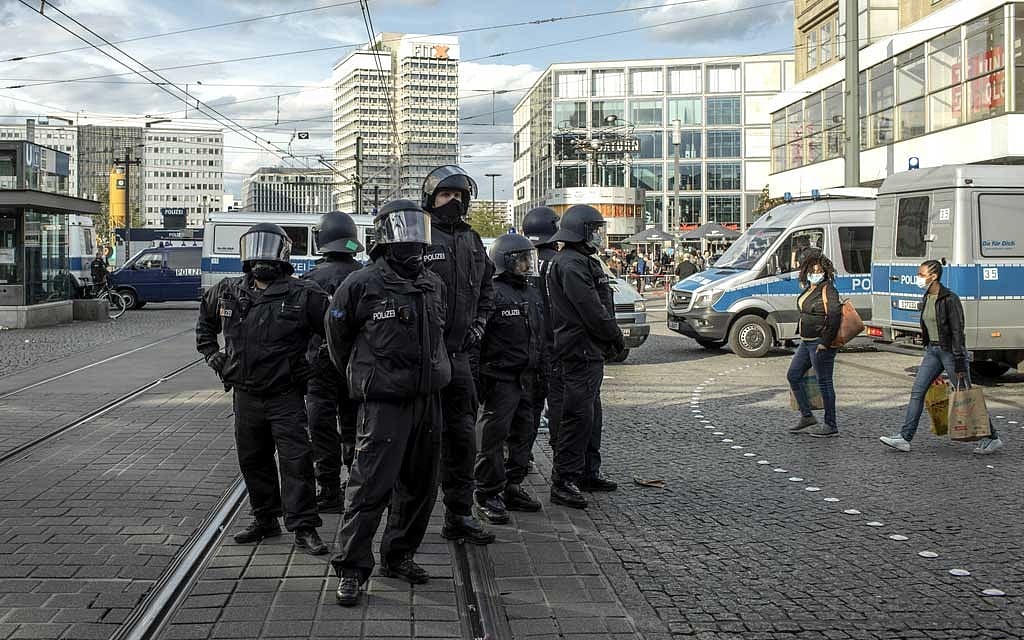
The protesters’ cries have brought to the surface a history of discrimination, especially regarding police tactics, which are now being vigorously challenged in countries like France, Germany and Britain. Demonstrators have invoked the names of past victims of police violence in their own countries, while demanding that institutional racism be redressed.
So far, no matter where charges of systemic racism have been levelled, they have been met mostly with firm official denial.
“France, the national police, the gendarmerie, they are not racist,” the French prime minister, Édouard Philippe, insisted in Parliament on Tuesday.
Yet available statistics, and the experience of Europe’s minority populations, often tell a different story, one that has proliferated with successive waves of immigration — like Britain’s Windrush Generation, which arrived from the Caribbean after World War II, or the recent influx of nearly 1 million asylum-seekers to Germany.
In France, the problems are perhaps most acute, given a long-standing failure to fully integrate Muslim and African populations from its former colonies. The French police, a largely white force, routinely target African and Arab youths for identity checks and have a long track record of abusive arrests as well as deaths of minorities in custody.
“The list is too long,” Assa Traoré told a crowd of demonstrators outside a Paris courthouse last week, reciting the names of those who died in encounters with the police.
Her brother, Adama Traoré, was one of them. He died in 2016 after being arrested by three police officers, one of whom later acknowledged that they had placed “the weight of all of our bodies” on him. No charges have been filed in his case, despite four years of investigations and duelling autopsies.
Despite its own troubles, the United States has civil rights law that can sometimes be used to prosecute abuses against members of minority groups. But in France, the authorities have long made it a practice not to keep statistics of almost any kind based on race or religion, ostensibly to forge a common national identity.
Officially, there are no minorities, only French citizens.
“Don’t forget who we are: the French people, unified” in “republican liberty and equality,” the Interior minister, Christophe Castaner, said at a news conference on Monday.
“The police, the gendarmes, they are the guardians of our republic,’’ said Castaner, often referred to in the French media as “France’s Top Cop” because he directs the national police force. He said that “there are no racist institutions; there are only republican institutions,” and that bad actors should not be allowed to “throw opprobrium on our institutions.”
Germany’s interior minister, Horst Seehofer, took a similar stance. When Saskia Esken, a leader of the Social Democrats, demanded action against “latent racism” in the country’s police departments, Seehofer rejected the notion as “completely incomprehensible.’’
The police union and some other conservative politicians also insisted that instances of racism in the ranks were isolated, though recent federal anti-discrimination legislation suggests otherwise.
“The Americans have not really solved the issue of race discrimination since the abolition of slavery,’’ said Friedrich Merz, one of three conservatives hoping to succeed Chancellor Angela Merkel next year. “In Germany, we don’t have the same problem — and there is no latent racism in the police, either.”
But Germany’s record is, in fact, blighted.
A rejected Sudanese asylum-seeker, Aamir Ageeb, died while being deported on a Lufthansa flight in 1999. Police officers had tied his arms to the armrests, bound his legs and put a motorcycle helmet on his head. When Ageeb screamed, officers pressed down on his torso and head for minutes. His autopsy revealed “death by asphyxiation due to massive exposure to violence.”
In the summer of 2018, a Syrian refugee, Amad Ahmad, was kept in a German prison even after prosecutors confirmed that he had been wrongly detained. He died in September that year after setting his own cell on fire.
In Britain, the protests have revived anger over police killings of members of minority groups, among them Mark Duggan, who was shot and killed in 2011 by an officer in north London. A jury found that Duggan was unarmed at the time, but that he had been lawfully killed. A court rejected an appeal by his mother. The police had said they believed he was planning an attack.
“Who killed Mark Duggan?” demonstrators chanted at a recent protest in London. “The police killed Mark Duggan.”
The police in England and Wales are considerably more likely to use force against black people than against those who are white or Asian — including with firearms, batons and irritant spray — and they have long subjected them to higher rates of stops and searches, according to figures from the Home Office.
Racial profiling by the police in parts of Europe has long been a common practice. For many, that has meant a daily ordeal of harassment and identity check.
“The police in France have demonstrated that they discriminate,” said Sebastian Roché, an expert on the French police at the National Center for Scientific Research, the CNRS. But the government, he said in an interview, is in a “strategy of refusing reality.”
If any more proof were needed, several harrowing videos that have emerged recently captured abusive police behaviour in the heavily immigrant Paris suburbs during the coronavirus lockdown.
“Up until the last few days, there was an incredible taboo over this, really hallucinatory,” said Bénédicte Jeannerod, director in France of Human Rights Watch.
The cases were not isolated, said Jeannerod, whose organisation is about to release a report on discriminatory behaviour in the French police. “This is about a daily, routine practice — people targeted because of their skin colour,” she said.
Last week, Castaner, the interior minister, asked the Paris prosecutor to look into French media reports of Facebook groups in which officers appear to regularly make racist remarks.
“Police checks for no reason — we’re used to it, it’s our daily routine,” said Yassin Taamourt, 30, a warehouse worker in a Paris suburb, Les Ulis.
A video circulated online graphically illustrates Taamourt’s recent run-in with the police, which left him with a black eye and a big bump on his forehead.
“As I was coming out of my building, they told me to come back inside, and they beat me up,” Taamourt said. “They smashed my head against the wall three times. And they hit me in the nose with the butt of a flash-ball gun.” He has hired a lawyer.
“In France, there is an incredible denial of the problem,” said Jeannerod of Human Rights Watch. “It’s been shifting in the last few days, but only in the last few days. We’ll just have to see if we really are in a moment of change.”
c.2020 The New York Times Company













