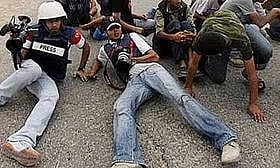
2012 deadliest year for media: UN
The United Nations terms the year 'deadliest' for media workers covering not just conflicts but also illegal activities in their own countries.
bdnews24.com News Service
bdnews24.com
Published :
23 Nov 2012, 12:33 PM
Updated :
09 Aug 2022, 04:33 PM
New York, Nov 23 (bdnews24.com) � The United Nations has described 2012 as the 'deadliest year' for media workers covering not just conflicts but also illegal activities in their own countries.
Director-General of the UN Educational, Scientific and Cultural Organisation (Unesco) Irina Bokova in her message to the 2nd UN Inter-Agency Meeting on the Safety of Journalists and the Issue of Impunity made the observation on Nov 22.
"More than 100 journalists have been killed so far this year, making 2012 the deadliest year for the media since Unesco began keeping records on the killings of journalists. And we are only in November," said Bokova.
The UN News Centre in a report said the meeting was attended by UN agencies, independent experts, governments, media houses and civil society organisations.
Of the journalists killed, 32 were killed as a result of the Syrian conflict and 18 were killed in Somalia.
"However, the overwhelming majority were not war correspondents," Bokova said, "but local reporters covering illegal activities such as drug trafficking and illegal logging."
"We must break the vicious cycle that silences journalists, deprives society of important voices and frightens other citizens, preventing them from speaking out," Bokova said in her remarks delivered by Unesco's Assistant Director-General for Communication and Information in Vienna, Janis Karklins.
Bokova reiterated Unesco's commitment to promote journalists' safety and fight against impunity globally, and called for building partnerships to raise awareness about press freedom.
The two-day meeting ended on Nov 23.
On the opening day, Under Secretary-General for Communications and Public Information Peter Launsky-Tieffenthal emphasised that attacks on media workers had far-reaching impact on society, threatening to silence all citizens.
"These attacks � not only the many murders and physical assaults, but also the countless abductions, the acts of harassment, the illegal arrests, the arbitrary detentions � have an impact that reaches well beyond the personal suffering of the person involved."
"They chill press freedom and the right of everyone to live as informed citizens in peaceful societies. They aim to silence the journalist and, by extension, all of us."
In particular, Tieffenthal pointed to the rising number of journalists targeted during conflicts as was seen most recently in the Gaza crisis.
"In the past week alone, in Gaza and southern Israel, we have seen disturbing reports indicating that journalists and their offices have been targeted during the conflict. We condemn such attacks and I urge all sides to respect the civilian status of journalists and their right to carry out their professional duties," said Tieffenthal.
He said the new UN Implementation Strategy on the Safety of Journalists and the Issue of Impunity for 2013-2014 called for taking into account the changing media environment to ensure laws protect not just journalists but also bloggers and new media reporters.
The meeting was convened by the Unesco and co-hosted by the Office of the High Commissioner for Human Rights (OHCHR), the United Nations Office on Drugs and Crime (UNODC) and the United Nations Development Programme (UNDP).
bdnews24.com/corr/eh/nir/1826h