


Published : 25 Jun 2018, 10:53 AM
Updated : 19 Oct 2022, 02:14 PM


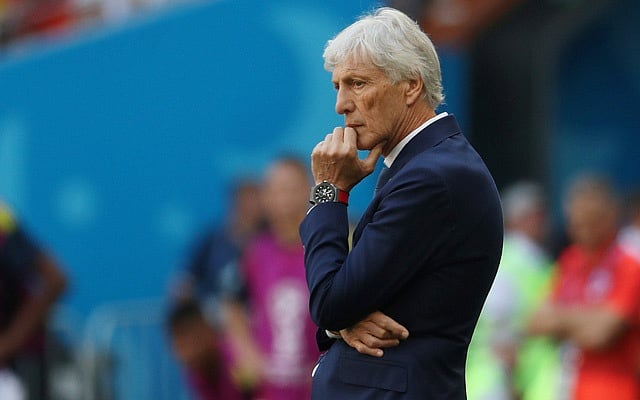
In those early days, Pékerman often arrived for training sessions in the car he had painted yellow and black himself. Coaching was his ambition, and he quickly showed he had a gift for it, but he was reluctant to part with the taxi. It was his guarantee that he could support his family, his safety net. In Argentine soccer, he knew he could never be certain when he might need it.
This has not been a vintage World Cup, so far, for anything or anyone connected to Argentina. The national team, despite the presence of Lionel Messi, has lurched from crisis to crisis. Held to a tie by Iceland, torn apart by Croatia, at risk of a humiliating group-stage exit, it is now confronting reports that its players are in a state of open rebellion against their coach, Jorge Sampaoli.
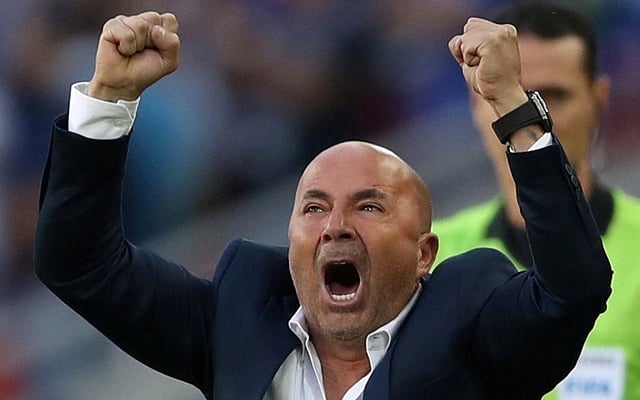
World Cup - Group D - Argentina vs Iceland - Spartak Stadium, Moscow, Russia - Jun 16, 2018 Argentina coach Jorge Sampaoli celebrates after Sergio Aguero (not pictured) scored their first goal. Reuters
None of those five, it is true, has enjoyed an especially successful World Cup. Three have seen their teams eliminated. Two of those three — Héctor Cúper’s Egypt and Juan Antonio Pizzi’s Saudi Arabia — meet Monday, fighting to avoid departing Russia without so much as a point.
Meanwhile, the third squad, Ricardo Gareca’s Peru, has won hearts here with its enthusiasm and its attacking approach — and its vast army of red-and-white clad fans — but has nevertheless lost its two games without scoring a goal. Peru waited 36 years to return to the World Cup, but its tournament lasted only eight days before its exit was confirmed.
That leaves only Sampaoli and Argentina and Pékerman’s Colombia with any hope at all of making it to the knockout round. Argentina must beat Nigeria in its final first-round game and hope Iceland does not beat Croatia; Colombia, beaten by Japan in its opening game, thrashed Poland by 3-0 on Sunday and next will face Senegal, knowing it needs to win to guarantee that it will advance to the next round.
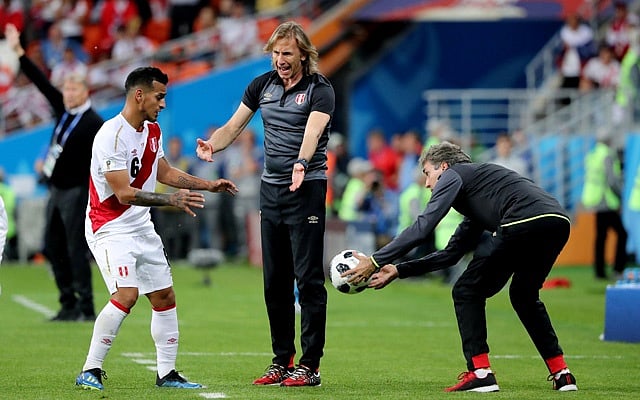
World Cup - Group C - Peru vs Denmark - Mordovia Arena, Saransk, Russia - Jun 16, 2018 Peru coach Ricardo Gareca reacts as Peru's Miguel Trauco retrieves the ball. Reuters
It is possible, however, to turn that interpretation on its head, to suggest that the number of Argentine coaches now on the sidelines in Russia should be a source of solace and of pride in Argentina — of proof that while there are concerns over player development back home, the country does know coaching.
Argentina has always produced coaches of note, of course, and it has always exported them, particularly to the rest of Latin America. Marcelo Bielsa, Claudio Borghi and Sampaoli himself all have taken charge of Chile in recent years; Pékerman is the fifth Argentine coach to preside over the Colombian national team. Even Uruguay — Argentina’s neighbor and fierce rival — has not been immune: Daniel Passarella, a World Cup-winning captain of Argentina, has coached the national team across the Río de la Plata.
In Europe, the record has been a little patchier: some of Argentina’s brightest coaching stars — Cesar Luis Menotti, Carlos Bilardo and Carlos Bianchi — found success harder to come by in the Old World than in the New, though Luis Carniglia won the European Cup while in charge of Real Madrid in the 1950s, and Helenio Herrera did the same with Internazionale a decade later.
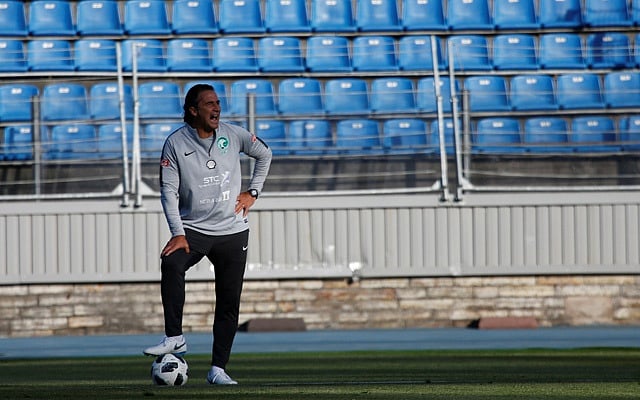
World Cup - Saudi Arabia Training - Petrovsky Stadium, Saint Petersburg, Russia - Jun 10, 2018 Coach Juan Antonio Pizzi during training. Reuters
“We try to make sure our coaches are not missing anything they will need,” Victorio Cocco, president of the Argentine Coaches’ Association, said when asked to explain the success of its alumni. Much of the focus is on technique, he said, but there are “courses in psychology, sports science, video analysis, too — we make sure they are prepared for everything they will encounter.”
Qualifying as a coach in Argentina is more arduous than in many European countries: it takes four years to be able to coach in the Primera Division, the top league. The first two, Cocco said, must be spent at the youth level, followed by two more with senior players.
“There is no fast-tracking,” he said. “Players just have to play. A coach has to know a mountain of things, from diet to how to talk to players. There are a lot of things to learn. That takes time.”
It is not just the formal education that explains it, however. It is the fact that Argentina is home to such a confluence of ideas, Cocco said, exposed to influences from “Italy, Germany, Spain, Sweden” and all points in between, that make it so easy for its coaches to move abroad. “We are happy to travel all over the world and adapt,” Cúper said.
And it is the hothouse environment of Argentine soccer, so destructive in other ways, that is especially conducive to nurturing high-calibre coaches.
Not only, as Cocco said, are there “hundreds of leagues and thousands of clubs,” giving aspiring coaches a chance to cut their teeth, but even at the youth level, the pressure is immediate, and relentless. Coaches have to learn, and learn fast, or they are fired. That was why Pékerman would not give up his taxi; that is why he is at the World Cup, in charge of Colombia.
© 2018 New York Times News Service













