


Published : 16 Jan 2015, 11:00 PM
Updated : 19 Oct 2022, 06:34 PM


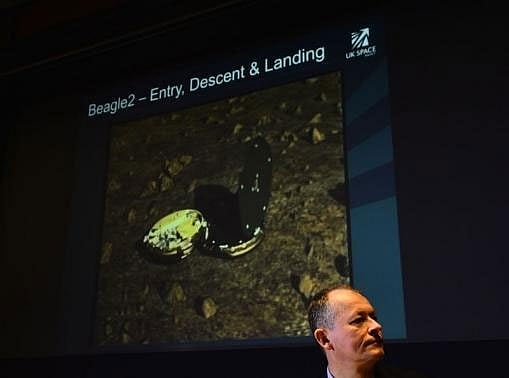




Beagle 2, part of a European Space Agency's Mars Express mission searching for extraterrestrial life, had been due to land on Mars on Christmas Day 2003, but disappeared on December 19, 2003. Until now, nothing had been heard from it.
But at a packed news conference at London's Royal Society scientific institution on Friday, space experts said the tiny Mars lander had been found on the surface of the red planet.
"Beagle 2 is no longer lost," said David Parker, chief executive of UK Space Agency.
He said recent images from the HiRISE camera on NASA’s Mars Reconnaissance Orbiter showed "good evidence" that the spacecraft landed on Mars on the date it was due -- Dec 25, 2003 -- but had only partially deployed.
"The entry, descent and landing sequence for Beagle 2 worked and the lander did successfully touch down on Mars on Christmas Day 2003," UK Space Agency said in a statement.
Beagle 2 -- measuring less than 2 meters across -- was named after the ship Charles Darwin sailed when he formulated his theory of evolution. It was built by British scientists led by Colin Pillinger for about 50 million pounds ($85 million)
The plan was for it to report back from the Mars' surface using instruments designed to help search for signs of life, but nothing was heard after it was dropped off to make its landing.
"We were left with a mystery, a mystery that has continued to this day," Parker said.
Mark Sims from Leicester University, Beagle 2’s mission manager, said that while the spacecraft had failed to communicate any data from Mars, it had succeeded in getting to its target, landing, and inspiring scientists.
"Overall, I would say Beagle 2 was a great success," he told the news conference.
Martin Rees, Britain's Astronomer Royal, last year praised Beagle 2 and its eccentric creator Pillinger, who had died at age 70, saying: "This was a failure, but a heroic failure."
Sims said the find was exciting, frustrating and "tinged with sadness" because Pillinger did not live to see it.
Asked to suggest what might have gone wrong, Sims said: "It was most probably a bad luck scenario -- a hard landing."







