Published : 20 Oct 2026, 11:22 AM
Updated : 20 Oct 2026, 11:22 AM


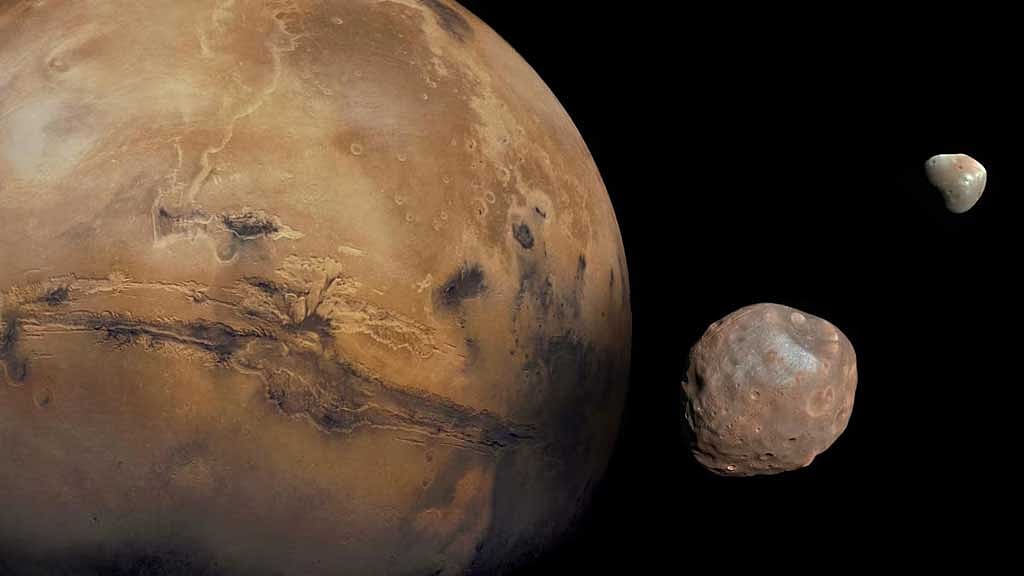
A Japanese-led spacecraft has lifted off on a pioneering mission to collect samples from the two moons of Mars, aiming to resolve one of the solar system’s enduring mysteries.
The Martian Moons eXploration, or MMX, spacecraft launched aboard an H3 rocket from the Japan Aerospace Exploration Agency’s Tanegashima Space Center in southwestern Japan on Tuesday local time, CNN reported.
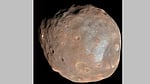
The mission -- an international collaboration involving NASA, the European Space Agency, and the space agencies of France and Germany -- will spend roughly a year travelling to Mars before spending three years orbiting Phobos, the larger of the two moons. It aims to return more than 10 grams of material from Phobos’ surface to Earth by 2031.
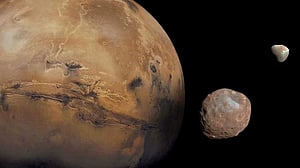
Scientists have long struggled to explain how Phobos and Deimos came to exist. Two competing hypotheses suggest either that a large object once slammed into Mars and sent debris into orbit, or that the two moons are captured asteroids pulled in by Mars’ gravity. Neither theory is fully supported by available data.
“What are these little space potatoes? We can’t explain Phobos or Deimos right now. They shouldn’t exist, but they do,” CNN quoted Daniel Glavin, a senior scientist at NASA’s Goddard Space Flight Center, as saying.
MMX will carry a small rover, named Idefix, to scout potential landing sites on Phobos before the spacecraft touches down to collect samples from two distinct regions of the moon’s surface. Instruments aboard the craft will measure terrain, minerals, chemical elements and radiation levels.
Researchers also hope the Phobos samples may contain fragments of Mars itself -- which would make MMX potentially the first mission to return Martian material to Earth, in a race with China’s planned Tianwen-3 mission, also expected back in 2031.
“If Phobos is made from bits of Mars that were thrown up,” NASA’s Jet Propulsion Laboratory research scientist Abigail Fraeman told CNN, that could offer fresh clues about the planet’s early composition and history.
Scientists say the mission could also shed light on the origins of life -- Phobos and Deimos may have once delivered water and organic material to the vicinity of Mars.
“Are we alone? Did it happen on Mars?” Glavin said. “Studying the samples from Phobos and analysing Deimos as well is part of that whole story.